
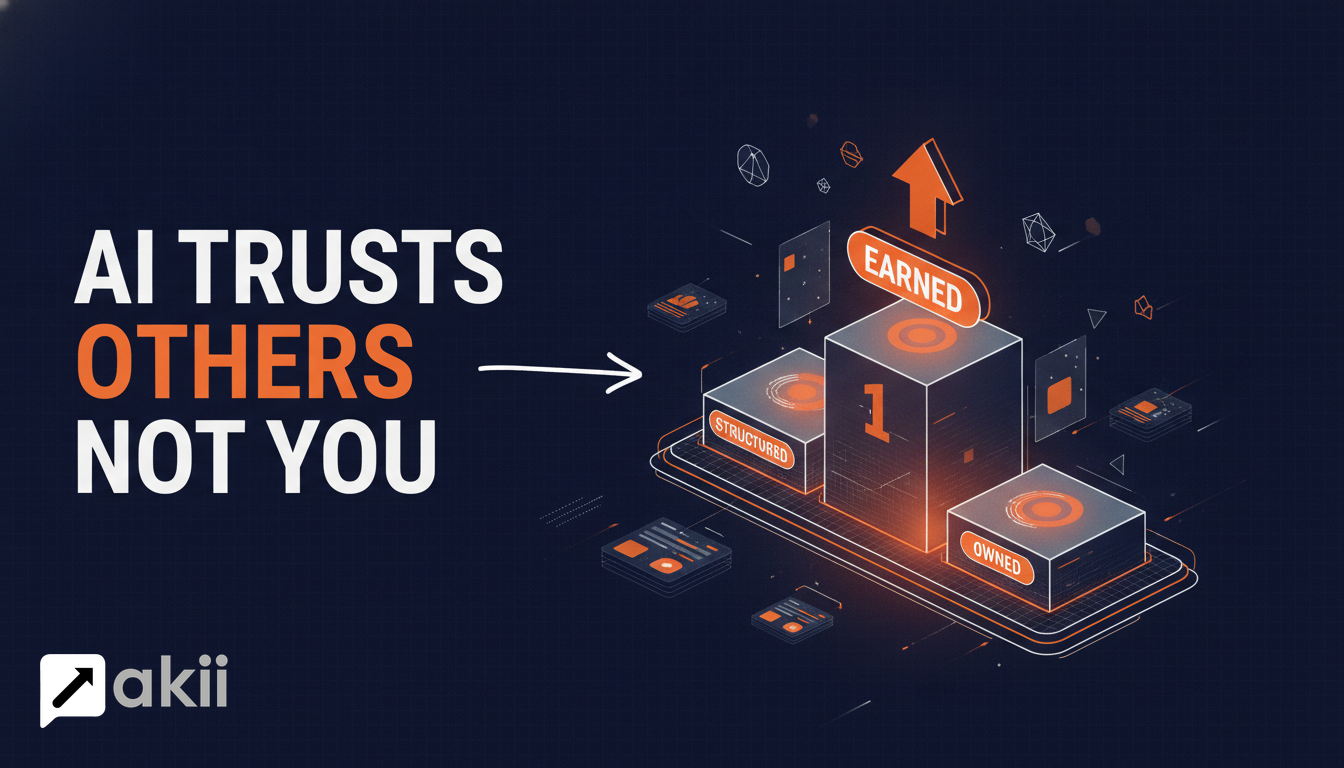
Your website can't vouch for itself. That's the core problem.
Most companies treat their own website as the center of their AI visibility strategy. They publish blog posts, refine service pages, add FAQ sections, and assume that if the content is good enough, AI engines will pick it up and recommend them.
That assumption is wrong. Or at least, it's incomplete in a way that costs you real business.
AI systems don't trust what you say about yourself nearly as much as they trust what others say about you. The shift is fundamental, and most companies haven't caught up.
Why does owned content have limited influence on AI answers?
Think about it from the AI's perspective. When ChatGPT, Gemini, or Perplexity tries to answer "Who's the best accounting firm in Dubai?" or "Which CRM should I use for a mid-size logistics company?", it's pulling from everything it can find. Your website is one source. But it's a source with an obvious bias.
Self-referential content gets discounted. Every company says they're the best. Every services page claims expertise. AI models are trained on enough of the internet to recognize promotional language, and they weight it so. Your "About Us" page saying you're industry-leading carries almost no signal compared to a third-party review site saying the same thing.
There's no external validation to anchor the claim. If the only place that says your company is great at something is your own domain, the AI has no way to confirm it. It can't cross-reference. It can't triangulate. So it either ignores you or mentions you weakly, without conviction.
This doesn't mean your website doesn't matter. It does. Your site is where you define your entity identity: who you are, what you do, where you operate. But definition is different from validation. Your site tells AI what to look for. External sources tell it whether to believe it.
85.7% of completed Akii scans scored below 40/100.
| Metric | Share of scans |
|---|---|
| Under 10 | 34% |
| 10-19 | 27.8% |
| 20-39 | 23.9% |
| 40-59 | 9% |
| 60+ | 5.3% |
Akii AI Visibility Index · 94,414 completed scans · Jun 2026
How do AI systems actually use external signals?
I've spent enough time studying how these engines surface recommendations to see patterns that keep showing up.
Cross-source consistency
When multiple independent sources say the same thing about your company, AI treats that as a stronger signal than any single source saying it loudly. If your website says you specialize in commercial real estate, and a directory listing says the same thing, and a trade publication mentioned it, and a client review confirms it, the AI has four data points that agree. That's what builds confidence in the answer.
Repeated entity confirmation
AI models build internal representations of entities: companies, people, products. Every time your company appears in a new context with consistent attributes, that representation gets stronger. The model becomes more certain about what you are, what you do, and where you fit. This is why scattered, inconsistent information across the web is so damaging. It doesn't just confuse humans. It confuses the model's entity graph.
Independent mentions
The word "independent" matters here. A mention on a site you don't control carries more weight than a mention on a site you do control. A review on Google, a listing in a curated directory, a quote in a news article, a case study on a partner's website. These are signals the AI can treat as less biased.
None of this is mysterious. It's roughly the same logic a smart buyer uses. If you're evaluating a vendor and the only positive thing you can find is what they say about themselves, you're skeptical. If several other sources confirm it independently, you trust it more. AI systems compress that same judgment into their retrieval and ranking logic.
What are the three layers of authority?
Here's a framework I find useful. Think of your company's authority in three layers, each with different weight in AI systems.
Layer 1: Owned authority
This is your website, your blog, your social profiles. You control it completely. It's where you define your entity: your name, your services, your location, your expertise. Without this layer, AI has nothing to anchor to.
But owned authority alone is a ceiling, not a ladder. It tells AI what you claim. It doesn't prove anything.
Layer 2: Earned authority
Press coverage. Client reviews. Industry mentions. Guest articles on other publications. Awards from recognized bodies. Analyst reports. Partner testimonials.
This is where trust gets built. Earned authority is harder to get and harder to fake, which is exactly why AI systems weight it more heavily. When Perplexity or Claude answers a question about your industry and cites a source that mentions you, that earned mention is doing more work than your entire blog archive.
Layer 3: Structured authority
This is the layer most companies ignore entirely. Structured authority lives in databases, knowledge graphs, directories, and schema markup that machines read directly.
Think: your company's Wikidata entry. Your Google Business Profile. Industry-specific directories with structured data. Schema markup on third-party sites that reference your entity. These aren't things humans browse. They're things AI systems query directly when building answers.
Structured authority is quiet, but it's powerful. It gives AI engines machine-readable confirmation of who you are, where you are, and what you do. Without it, you're relying on the AI to infer all of that from unstructured text, and inference is where errors creep in.
The companies that show up consistently in AI answers tend to be strong across all three layers. Most companies are strong in layer one, weak in layer two, and almost nonexistent in layer three.
Akii observations show single-digit average visibility across major AI answer surfaces.
| Metric | Average visibility |
|---|---|
| Google AI | 1.6% |
| ChatGPT | 3.4% |
| Perplexity | 3.5% |
| Copilot | 4.3% |
Akii AI Visibility Index · 1,845,596 brand-platform-day observations
Why do external signals outweigh traditional SEO signals?
If you've been doing SEO for years, this part might sting a little. But it's important.
Trust gets compressed in AI systems
Traditional search shows you ten blue links and lets you decide who to trust. AI search gives you one answer, maybe two. The engine has to make the trust decision for you. That compression means the AI needs to be more confident, not less, about which sources to rely on. And confident means externally validated.
A page that ranks #1 on Google for a keyword might still not appear in an AI answer for the same query. Why? Because the AI isn't just looking at page-level SEO signals like backlinks and keyword density. It's looking at entity-level authority: how well-confirmed is this company across the information market?
AI prefers neutral validation
Here's the pattern I keep seeing in the data. AI engines gravitate toward sources that don't have an obvious commercial motive. Review aggregators. Industry databases. News outlets. Wikipedia. Government registries.
Your company blog, no matter how well-written, has a commercial motive. The AI knows this. It doesn't ignore your blog, but it treats it as one input among many, and a biased one at that.
The Akii AI Visibility Index, built from 94,414 completed scans across 75,832 brands, shows this pattern clearly. Content coverage was the weakest measured AI-visibility dimension in our aggregate scans (Akii AI Visibility Index, 2026). Companies are investing in owned content but underinvesting in the external signals that actually move the needle.
And the stakes are real. 51% of B2B software buyers now start research with an AI chatbot more often than Google (G2, 2026). In the UAE specifically, 80% of surveyed consumers use AI to shop, with 41% using it for product research (Visa, 2025). When an AI summary appears, click-through to traditional results drops from 15% to 8%, and about 26% of sessions end with no click at all (Pew Research Center, 2025).
Your buyers are getting answers before they ever see your website. The question is whether external sources are confirming your authority in those answers.
How do you actually build external authority for AI systems?
This is where it gets practical. Two areas to start, two more to build toward.
Entity presence expansion
Get your company's entity represented accurately across every surface AI systems are likely to query. That means:
- Directories that matter for your industry. Not spam directories. Real ones. If you're in UAE professional services, that's DMCC, DIFC, Dubai Chamber listings, industry-specific directories, and regional business databases.
- Knowledge graph entries. Wikidata, Google Knowledge Panel, Crunchbase if you're in tech. These are machine-readable sources that AI engines pull from directly.
- Consistent NAP and entity attributes. Your company name, address, phone, and core service descriptions need to match across every listing. Inconsistency creates entity confusion, and confused entities don't get recommended.
I wrote more about the entity layer in our guide to entity SEO for AI. It's the technical foundation for everything else.
Citation ecosystems
This is about creating a web of references that AI can follow. Not link building in the old SEO sense. Citation building in the AI sense.
- Earn mentions in publications your industry reads. Trade press, regional business media, partner case studies. The mention doesn't need to be a feature story. Even a passing reference in a relevant article creates a citation node.
- Contribute expertise to other platforms. Guest posts, podcast appearances, conference talks that get written up. Each one creates an independent mention that confirms your entity and expertise.
- Client reviews on platforms AI reads. Google reviews, G2, Trustpilot, Clutch, industry-specific review sites. These are high-trust sources for AI because they aggregate independent opinions.
The goal isn't volume for volume's sake. It's creating enough independent confirmations that when an AI engine asks "Is this company credible for this topic in this market?", the answer comes back strong.
Structured third-party references
This is the technical layer most companies skip.
- Schema markup on partner and client sites. If a partner mentions you on their website, ask them to include Organization schema that references your entity. This creates a machine-readable confirmation that the AI can parse directly.
- Structured data in directories. Make sure your directory listings use structured data formats. Many directories do this automatically, but verify it.
- Industry databases with structured entity data. Some industries have databases that AI engines query directly. Financial services has Bloomberg and Refinitiv. Tech has Crunchbase and G2. Find the structured databases for your industry and make sure you're in them with accurate data.
This is where Generative Engine Optimization differs most from traditional SEO. It's not about ranking pages. It's about building a distributed, machine-readable proof layer that AI engines can verify independently.
The weakest Akii-scored dimensions point to content coverage and reputation clarity.
| Metric | Average score |
|---|---|
| Content coverage | 22.8 |
| Brand sentiment | 23.5 |
| Brand recognition | 30.3 |
| Brand understanding | 35.2 |
Akii AI Visibility Index · 406,829 scored scans
What does this look like in practice?
Let me give you a simple test. Ask ChatGPT or Perplexity: "What companies in [your city] are known for [your core service]?"
If you don't appear, or you appear with vague or inaccurate descriptions, your external authority layer is thin. The AI doesn't have enough independent confirmation to recommend you confidently.
Now ask the same question about your strongest competitor. If they appear and you don't, the gap isn't about who has a better website. It's about who has more external validation.
In the Akii AI Visibility Index, 85.7% of scanned businesses scored under 40 out of 100 (Akii AI Visibility Index, 2026). Only 5.3% scored 60 or higher. The gap between visible and invisible in AI search is enormous, and it maps almost directly to external authority.
The AI visibility flywheel explains how this compounds over time. Companies that build external authority get cited more, which builds more authority, which gets them cited more. Companies that don't build it fall further behind each quarter.
Where should you start?
If I had to prioritize for a company starting from scratch on external authority, here's the sequence I'd follow.
First: Audit your entity consistency. Is your company described the same way across every platform where you appear? Fix the inconsistencies before you do anything else.
Second: Identify the four or five external sources that matter most for your industry and market. Get listed, get reviewed, get mentioned. Quality over quantity.
Third: Build structured references. Schema on partner sites, structured directory listings, knowledge graph entries. This is the layer that compounds fastest because machines read it directly.
Fourth: Create a steady rhythm of earned mentions. One quality mention per month in a relevant publication does more than fifty blog posts on your own site.
The companies winning in AI search aren't the ones with the most content. They're the ones with the most external confirmation. That's the shift, and it's not going back.
If you want to see where your company stands, book an AI Search Audit or reach out through our contact form. We'll show you exactly where external authority gaps are costing you visibility in AI answers.