
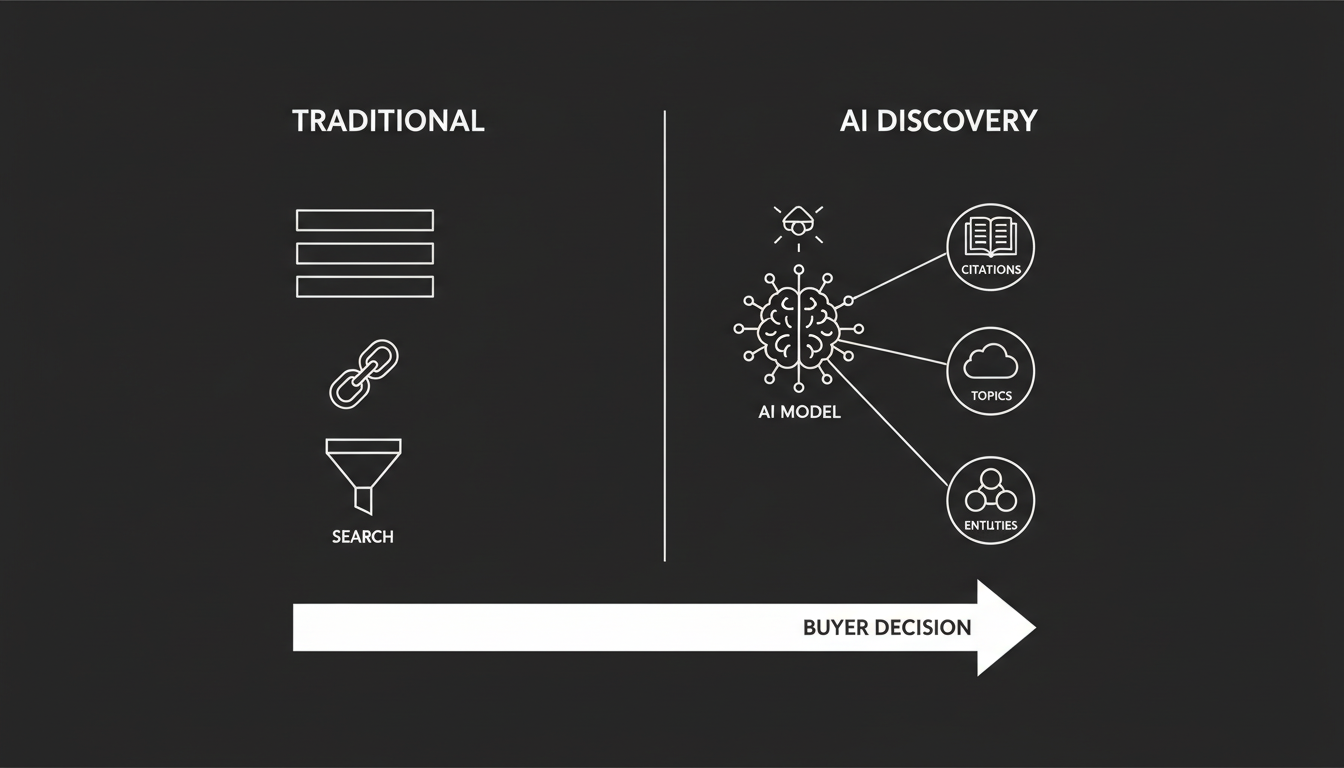
Your Competitors Are Already Showing Up in AI Answers. Are You?
Here's what I keep running into with marketing leaders and founders: they're still measuring competitive positioning through traditional search rankings. Page one of Google. Backlink profiles. Domain authority scores.
Meanwhile, the actual discovery layer has shifted underneath them.
When a buyer asks ChatGPT "what's the best tool for X," the AI doesn't pull up ten blue links. It gives an answer. If your competitor is in that answer and you're not, you've already lost the deal before you knew it existed.
This isn't a future problem. It's happening right now.
Why Traditional Competitive Analysis Misses the Point
Most competitive intelligence still works the old way. You look at what keywords competitors rank for, study their content calendar, maybe run some backlink analysis.
That's fine for traditional search. AI systems don't work like search engines.
AI models build internal representations of brands based on training data, citations, topical associations, and the structured information they can find. They don't match keywords. They form something closer to an opinion about which brands are authoritative on which topics.
So the question isn't just "who ranks for this keyword?" When an AI model gets asked about your category, does it even know you exist? And if it does, what does it think you're good at?
That's a fundamentally different competitive problem. It requires a fundamentally different kind of intelligence.
What Does AI Competitor Intelligence Actually Look Like?
Most people's mental model breaks down here. They hear "competitor intelligence for AI search" and assume it's traditional SEO with a new label slapped on it.
It's not.
Who are you actually competing against?
In traditional markets, your competitors are obvious. The companies selling similar products at similar price points to similar buyers.
In AI outputs, the competitive set is wider and stranger.
You're competing against direct competitors, sure. But you're also competing against adjacent players expanding into your space and media properties that AI models treat as trusted information sources. Take a movie ticketing company. Your direct competitors might be Fandango or Atom Tickets. But in AI answers about movies, you're also competing with IMDb, Rotten Tomatoes, and Ticketmaster, not because they sell tickets the same way you do, but because AI models associate them with the topics your buyers are asking about.
This competitive overlap is common in AI search. Models prioritize topical authority over traditional industry boundaries. If you don't map the full picture, you're improving against the wrong rivals.
Where are your competitors being cited, and where aren't you?
In AI-driven discovery, citations are credibility. Full stop.
When Reuters, Bloomberg, or a respected industry journal mentions your competitor, that signal feeds into the trust models AI systems rely on. The practical question is: which sources are citing your competitors but not you?
That's not a vanity metric. That's your PR target list. Instead of spraying press releases everywhere and hoping something sticks, you know exactly which outlets matter for AI visibility and where your competitors have a citation advantage you need to close.
I've seen teams cut their PR effort in half while doubling their impact just by getting specific about which sources actually move the needle in AI outputs.
What Content Gaps Are Your Competitors Leaving Open?
Here's what most people miss about competitive content analysis: the gaps matter more than the strengths.
If your competitor covers a topic well and AI models already associate them with it, that's a hard hill to climb. But if there are topics in your category that nobody covers well, those are open doors.
What topics do competitors own that you don't?
This is the defensive question. If competitors have deep content on topics that directly affect AI visibility in your space and you have nothing, that's a gap you need to close. Not because of SEO. Because AI models have no evidence to associate you with those topics.
What topics does nobody own yet?
This is the offensive question, and it's usually more valuable.
Emerging trends, new use cases, shifting buyer concerns. These are topics where no competitor has established authority yet. Get there first with substantive, well-structured content and you can own the AI association before anyone else shows up.
The difference between content strategy for traditional search and content strategy for AI visibility comes down to this: traditional search rewards volume and optimization. AI visibility rewards being the most useful, structured, and authoritative source on a specific topic.
What content formats actually get picked up by AI models?
Not all content is equal in AI discovery. Models tend to prefer content they can easily extract, summarize, and present as a direct answer. Think structured comparisons, fact-based resources, and well-organized analysis. These formats consistently appear in AI-generated answers because they're easy for models to work with.
If your competitors are publishing in these formats and you're not, that's a structural disadvantage no amount of keyword optimization will fix.
This is exactly why we built the Competitor Intelligence capabilities in Akii. Not to give you another dashboard of metrics, but to show you exactly which content formats and topics are driving AI visibility for your competitors, and where the openings are.
How Do AI Models Actually "Understand" Your Brand?
This is the part that trips up even sophisticated marketers.
AI models don't just index your website. They build an internal representation of your brand based on everything they've been trained on and everything they can access. That representation includes what topics you're associated with, how authoritative you're perceived to be, and what your relationship is to other entities in your space.
If a model associates your competitor with "authoritative cinema reviews" but doesn't link you with any particular expertise, that's not a content problem. That's a knowledge representation problem.
Fixing it usually involves a few things:
Structured data and entity signals. Make it easy for AI systems to understand what your brand is, what it does, and what topics it's authoritative on. Schema markup, knowledge graph presence, and consistent entity information across the web all matter here.
Fact-based resources. AI models weight factual, verifiable content more heavily than opinion or marketing copy. Publishing original research, data-driven analysis, and well-sourced guides builds the kind of authority AI systems recognize.
High-authority partnerships. Being cited by or associated with trusted sources in your category signals to AI models that you belong in the conversation. This is where strategic PR pays off in ways traditional metrics won't capture.
The goal isn't to game AI systems. It's to make sure they represent your brand accurately. If the real-world truth is that you're a strong player in your category but AI models don't reflect that, the problem is a gap between reality and representation. That's fixable.
So You Have the Intelligence. Now What?
This is where I get impatient with most competitive intelligence tools. They give you data and leave you to figure out what to do with it.
Data without prioritization is just noise.
What matters is turning insights into a sequenced plan with clear priorities.
What moves the needle fastest?
Not everything has equal impact. Securing citations from a specific industry journal that AI models heavily weight can shift your visibility in weeks. Building a complete content library on a new topic takes months. You need to know which is which, and sequence them based on impact and effort, not gut feel.
What resources does each action actually require?
"Create better content" is not a plan. A real action plan specifies whether you need your content team, PR outreach, or technical implementation. It estimates timelines. It defines what success looks like.
For example:
- Develop in-depth analysis content in your category. This differentiates you from competitors who rely on shallow coverage. Timeline: 3 to 6 months. Resources: content team plus subject matter experts.
- Secure citations from specific industry journals. This builds credibility in the citation system AI models trust. Timeline: ongoing. Resources: PR outreach.
- Fix structured data and entity signals. Often the fastest win because it helps AI models correctly understand what you already are. Timeline: weeks. Resources: technical team.
These aren't abstract tips. They're strategic moves with measurable outcomes.
How do you measure progress?
Traditional competitive metrics won't tell you if you're winning in AI discovery. You need to track how AI models represent your brand over time, whether you're appearing in AI-generated answers, and how your citation profile is changing relative to competitors.
This is exactly what Akii is built to track. Not vanity metrics. The actual signals that determine whether AI systems recommend you or your competitor.
From Intelligence to Content: Closing the Execution Gap
I've learned across 25 years of building products that the gap between insight and execution is where most strategies die.
You can have perfect competitive intelligence. You can know exactly which topics to cover, which formats to use, and which sources to target. But if the execution bottleneck is "now someone has to actually create all this content," most teams stall.
Good competitive intelligence should come with execution scaffolding. Not just "here's what to write about" but structured outlines that specify the angle, the unique value proposition, the format, and the approximate depth.
If your analysis shows that in-depth movie analysis is a gap your competitor isn't filling well, you shouldn't get a note that says "write movie analysis." You should get an outline that specifies the educational angle, the comparison structure, the suggested depth, and what makes this piece different from what already exists.
That turns a strategic insight into something you can hand to a writer and actually ship.
The Shift Most Teams Haven't Made Yet
I'll be direct about what I think is happening across most marketing organizations right now.
Teams are still allocating 90% of their competitive intelligence effort toward traditional search and 10% or less toward AI discovery. But buyer discovery behavior is shifting fast. When someone asks an AI assistant for a recommendation, they're often further along in their decision process than someone typing a keyword into Google.
That means the AI answer isn't just one touchpoint among many. It's often the deciding one.
If your competitive strategy doesn't account for how AI models see your brand relative to your competitors, you're refining for a game that's becoming less important while ignoring the one that's becoming more important.
Traditional search still matters. But the marginal return on AI visibility intelligence is much higher right now for most brands, precisely because so few competitors are paying attention to it.
That's the window. And windows close.
Where to Start
If you're reading this and thinking "we haven't done any of this," don't panic. Most companies haven't. That's the opportunity.
Here's what I'd do first:
Map your real competitive set for AI discovery. It's probably different from your traditional competitive set. Include content platforms and media properties, not just direct competitors.
Audit your citation profile. Where are you cited? Where are your competitors cited that you're not? That gap is your immediate action list.
Check your AI knowledge representation. Ask ChatGPT, Gemini, and Claude about your category. See who they mention. See what they say about you. If the answer surprises you, that's the problem you need to fix first.
Build a content plan based on gaps, not volume. Don't just create more content. Create the specific content that fills the gaps AI models need to associate you with the right topics.
You can do this manually, or you can use a tool built specifically for it. We built Akii's Competitor Intelligence because I got tired of watching smart teams fly blind in a discovery layer that's already reshaping how buyers find and choose products.
The companies that figure this out in the next 12 months will have a structural advantage that's very hard to reverse. The ones that wait will spend years trying to catch up.
I've seen this pattern play out across every major technology shift I've lived through. The early movers don't win because they're smarter. They win because they started.