
What's Actually Changed About Being Found Online
For 25 years, I've watched how discovery works online. Directories first. Then keywords. Then links. Now something structurally different.
AI models don't find you the way search engines did. They don't crawl a ranked list of results. They reason about entities, looking for structured facts, clear relationships, and consistent signals across multiple knowledge bases before deciding whether to mention you at all.
That's a different game. Most brands aren't playing it yet.
The shift from SEO to what people are calling Answer Engine Optimization (AEO) isn't just a vocabulary change. It's structural. What determines whether ChatGPT, Gemini, or Claude mentions your brand isn't keyword density. It's whether you exist as a clearly defined entity in the knowledge systems these models rely on.
That's where knowledge graphs come in. Not as a buzzword. As the actual technical infrastructure that makes your brand legible to AI.
What Is a Knowledge Graph, Really?
Strip away the jargon and a knowledge graph is simple. It's a structured map of facts about real things and how they relate to each other.
Think of it this way:
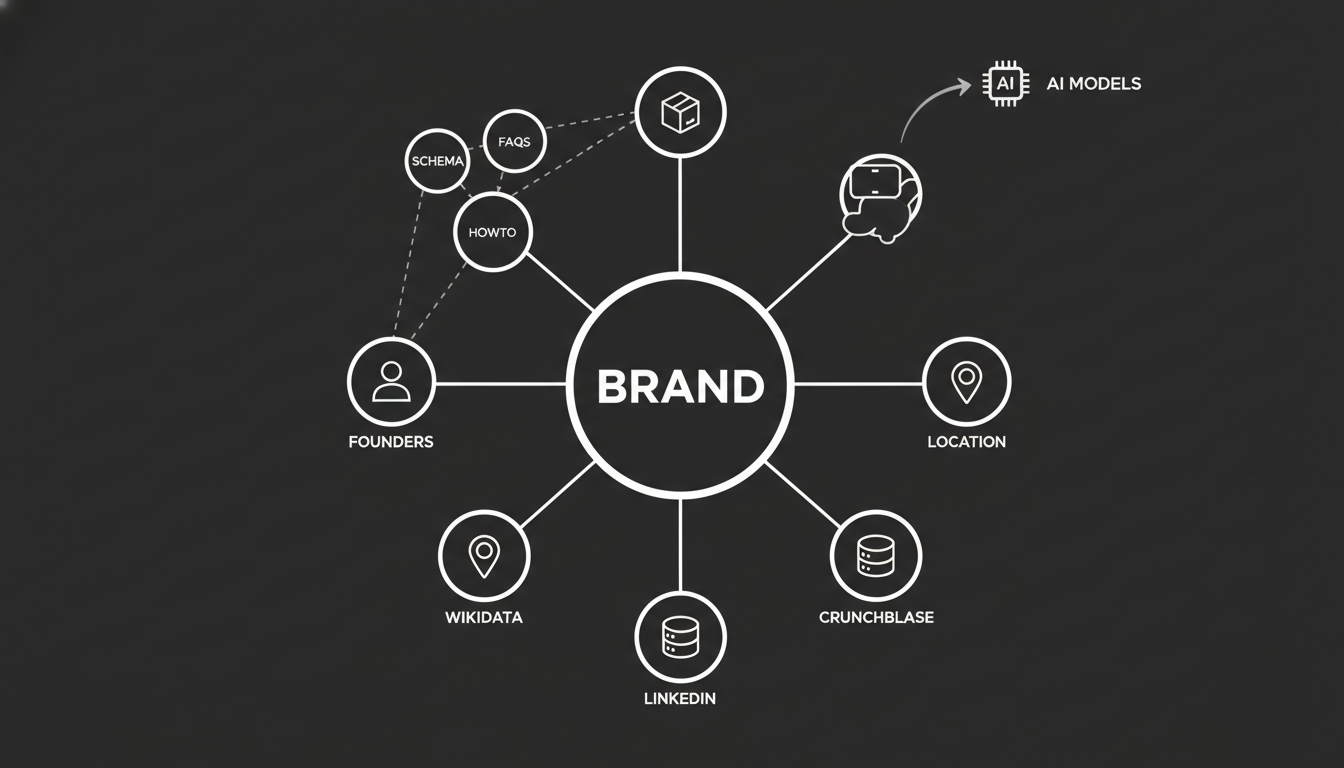
- Entities are the nodes. Your company. Your products. Your founders. Your locations.
- Attributes describe those entities. "FreshBrew Coffee is a specialty coffee shop."
- Relationships connect them. "FreshBrew Coffee sells Ethiopian Roast." "FreshBrew Coffee was founded by Maria Lopez."
Nodes, attributes, connections. That's the whole structure.
What makes this matter now is that LLMs like Gemini, ChatGPT, and Claude don't just read text. They rely on structured, factual representations to reason about brands. When a user asks "What's a good specialty coffee shop in Los Angeles?", the model isn't scanning web pages the way Google circa 2015 did. It's checking whether an entity called "FreshBrew Coffee" has consistent attributes and verified relationships that make it a credible answer.
Here's what most people miss: AI engines prioritize verified nodes in their knowledge graphs over traditional keyword-optimized pages. Gemini inclusion, for example, skews heavily toward brands with strong Knowledge Graph entries and proper schema markup. If your entity profile is inconsistent or weak, models will hesitate to include you.
They won't tell you they're hesitating. You just won't show up.
Why Does This Matter More Than Traditional SEO Now?
Think about what traditional SEO optimized for. Keywords on a page. Backlinks pointing to that page. Meta tags. Title structure. All of it was designed to help a search engine index and rank a document.
AI models don't rank documents. They construct answers. And to construct an answer that mentions your brand, they need to be confident about what your brand actually is.
That confidence comes from entity clarity. Not keyword volume.
I've seen this pattern before across different technology cycles. The companies that win aren't the ones that react fastest to new tactics. They're the ones that build the right foundation before the tactics even matter. Right now, that foundation is a clean, consistent knowledge graph.
How does this connect to being cited by AI?
AI models penalize inconsistency. If your brand name is slightly different on Crunchbase than on Wikidata, if your product descriptions contradict each other across directories, if your founder's bio says one thing on LinkedIn and another on your website, models notice. They don't flag it. They just skip you.
A well-built knowledge graph gives AI models a single source of truth about your brand. That directly translates to what we at Akii call Brand Understanding, one of the four critical dimensions of the AI Visibility Score.
Entity consistency is a prerequisite for being cited confidently. You're making your brand quotable and machine-readable. Without that, you're invisible to the systems increasingly deciding what gets recommended.
What about authority and trust?
The principles of E-E-A-T (Experience, Expertise, Authoritativeness, Trustworthiness) still apply. They just express differently in an AI context.
Entity clarity reinforces authority. The major SaaS brands that dominate AI visibility don't do it through blog volume or backlink campaigns alone. They do it through entity saturation across knowledge bases. They're everywhere AI models look when checking authority signals.
If you're only improving your website, you're tuning one node. The brands winning this game have dozens of consistent, interlinked nodes across the web.
What Are the Core Components of a Strong Knowledge Graph?
Building a knowledge graph isn't mysterious. It requires defining the core subjects, linking them clearly, and translating those links into a language AI models understand.
Your primary entity
This is your master entity. Your company. It needs one unified description, one taxonomy, one boilerplate. Not three slightly different versions spread across your site, your Crunchbase profile, and your Google Business listing.
One version. Replicated everywhere.
I've audited brands where the company description on their About page doesn't match their schema markup, which doesn't match their Wikidata entry. Each version is close. But "close" isn't good enough for a model checking consistency across sources. The penalty for that inconsistency is quiet. You just stop appearing.
Supporting sub-entities
These are the entities that orbit your primary one. Products. Services. Key people. Locations. Each one should be clearly linked back to the primary entity.
"Ethiopian Roast is a Product of the Organization FreshBrew Coffee." That's a relationship. Simple. And it's exactly the kind of structured fact that makes AI models confident enough to include you in an answer.
Schema types and properties
Schema.org markup is the technical mechanism you use to communicate entity relationships to AI crawlers. Think of it as the translation layer between your knowledge graph and the machines reading it.
The schema types that matter most for AI visibility:
- Organization for your primary entity and its defining attributes
- Product for your services or tools, linked back to the Organization
- FAQ for concise, extractable answers to common questions
- HowTo for instructional content structured for easy extraction
These aren't optional decorations. They're how you make your knowledge graph readable by the systems that decide whether to mention you.
Relationship clarity
Relationships define how entities connect. "FreshBrew Coffee's owner is Maria Lopez." "FreshBrew Coffee's location is Los Angeles." Clean schema with sameAs links between your official profiles strengthens these connections.
Without clear relationships, you have a collection of disconnected facts. With them, you have a graph. That's the difference between being findable and being invisible.
How Do You Actually Build One? Step by Step.
This is where most guides get vague. I want to be specific. Building a knowledge graph for AI visibility requires both technical optimization (AEO) and external authority building (GEO, or Generative Engine Optimization). Here's how to approach it.
Step 1: Identify your core entities
Start with a master entity profile. One description. One taxonomy. One boilerplate. Write it once, get it right, and replicate it across your site, your schema, your directories, and every knowledge base you can control.
This sounds tedious. It is. But if you skip it, you're building on sand. Models penalize inconsistency, and the penalty is silence.
Ask yourself: if someone pulled your brand description from five different sources right now, would they get the same answer five times? If not, that's your first problem to fix.
Step 2: Map your relationships
Before you touch any code, map the relationships between your entities on paper or in a simple diagram.
"Product X is sold by Organization Y." "Organization Y was founded by Person Z." "Product X is reviewed on Platform W."
AI models need a structured understanding of these relationships. If you can't articulate them clearly yourself, a machine certainly can't infer them.
Step 3: Add structured data
This is the technical AEO step. You're making your content machine-readable and extractable.
Organization schema: Roll out it with sameAs links pointing to your official profiles on Wikidata, Crunchbase, LinkedIn, and anywhere else your entity exists.
Product schema: Especially important for SaaS and e-commerce brands. Link every product back to the parent organization.
FAQ and HowTo schema: Add these to your evergreen content. Write concise, declarative statements that AI engines can extract directly. This is one of the most effective ways to show up in surfaces like Google AI Overviews.
Akii's Website Optimizer is built to analyze up to 50 pages and generate the Schema.org markup package for every page analyzed. If you're doing this manually across a large site, that's where the time savings become real.
Step 4: Build external entity corroboration
Here's where most technical guides stop. Technical optimization alone isn't enough. For generative models to choose to cite you, they need external corroboration of your entity's authority. This is the GEO side of the equation.
Wiki Maintaining an up-to-date, consistent entry here is not optional. It's one of the primary knowledge bases that AI models reference.
Crunchbase: A strong presence here reinforces your organizational authority, especially for B2B and SaaS brands.
LinkedIn: Consistent profiles for your organization and key people strengthen entity signals.
Review platforms: Trustpilot, G2, Capterra. These aren't just for social proof anymore. They're nodes in your knowledge graph that AI models check.
The pattern is the same across all of these: consistency. Every external profile should echo the same core facts as your primary entity definition. Same name. Same description. Same relationships.
What Tools Actually Help With This?
I'll be direct about what's useful and what's noise.
Google Knowledge Graph API lets you check whether Google recognizes your entity and what attributes it associates with you. Good diagnostic starting point.
Neo4j is a graph database platform. If you're building a complex knowledge graph with many entities and relationships, it's a serious tool. It's also serious overhead for most small and mid-size businesses.
Schema App helps with schema markup generation and management. Useful if you're handling schema at scale.
Akii's entity mapping tools are what we built specifically for this problem:
- The Website Optimizer generates a deployment-ready Schema.org markup package.
- Competitor Intelligence includes AI Knowledge Mapping as a key step in its 7-step analysis workflow, so you can see how your entity graph compares to competitors.
- The AI Brand Audit tracks entity-related dimensions like Brand Understanding and Technical Infrastructure to make sure your foundational elements are performing.
Pick the tools that match where you are right now. Then actually use them.
How Do You Know If Your Knowledge Graph Is Working?
This is the question that separates strategy from activity. You can build the most thorough knowledge graph in the world, but if AI models still aren't mentioning you, something's off.
The honest answer is that measurement in this space is still maturing. But there are concrete signals you can track.
Are AI models mentioning your brand by name when users ask relevant questions? Are they getting the facts right when they do? Are they associating you with the right products, categories, and attributes?
Those are the questions that matter. They're exactly what the AI Visibility Score is designed to answer. It measures how models like Gemini, ChatGPT, and Claude actually perceive your brand's entity profile right now.
Not how you think they perceive it. How they actually do.
What Most People Get Wrong About This
People treat knowledge graph work as a one-time project. Build the schema, update Wikidata, move on. That's not how this works.
AI models are constantly re-evaluating entity signals. Your competitors are improving their entity profiles. New knowledge bases emerge. Existing ones update their schemas. The models themselves change how they weight different signals.
This is ongoing infrastructure work, not a campaign. The brands that will consistently show up in AI answers over the next few years are the ones that treat their knowledge graph the way they used to treat their website: as a living asset that needs regular attention and improvement.
The good news is that the work compounds. Every consistent signal you add strengthens every other signal. Every clean relationship makes the next one more credible. Over time, you build an entity profile that AI models trust enough to cite with confidence.
Visibility in the AI era isn't luck. It's engineered. And the engineering starts with your knowledge graph.
If you want to see where you stand right now, get your free AI Visibility Score. It takes minutes, and it shows you exactly how AI models perceive your brand's entity profile today. Akii offers 100 free AI credits to start your optimization from there.