
Why the Old SEO Playbook Doesn't Work on AI
I've watched three major shifts in how people find things online. Directories first. Then search engines and keywords. Now a third shift is underway, and most brands are still running the second playbook.
Here's what changed: AI models don't rank links. They construct answers. The raw material they use isn't your keyword density or your backlink profile. It's whether they can identify your brand as a verified, well-defined thing in their internal map of the world.
That "thing" is called an entity. Entity SEO is the practice of making your brand so clear, so consistent, and so well-corroborated that AI models can confidently include you in their answers.
This isn't a tweak to your existing strategy. It's a different game with different rules.
What Does "Entity-First" Even Mean?
Think about how you'd explain your company to a very literal, very smart person who has zero tolerance for ambiguity. That's roughly how an LLM processes your brand.
Traditional SEO trained us to think in strings of text. Target "best project management software," rank a page for that phrase. The AI equivalent isn't a phrase. It's a node in a knowledge graph, a structured representation of who you are, what you do, what you sell, and how those things connect to each other.
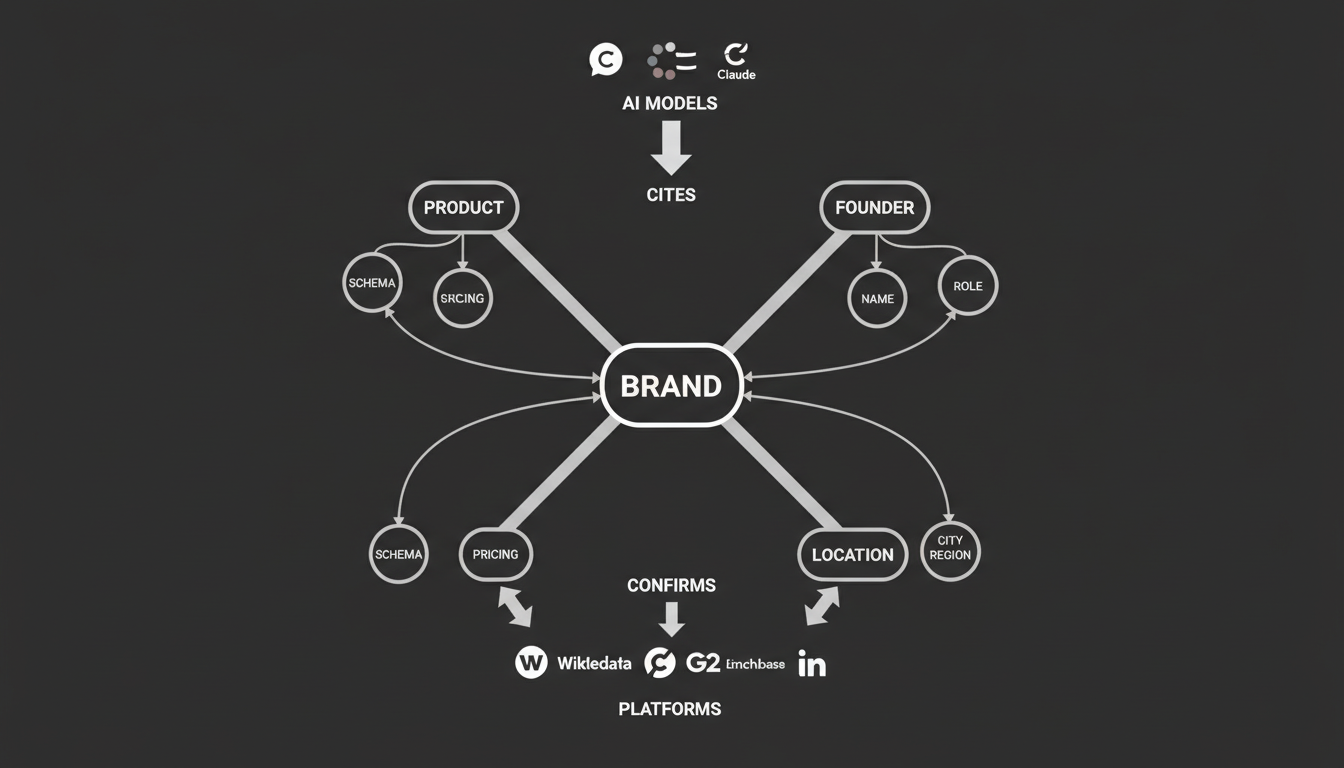
Google Gemini, ChatGPT, Claude: they all build internal knowledge graphs. These graphs have three components.
Entities are the nodes. Your brand, your products, your founders, your locations. Each one is a distinct thing the model can reference.
Attributes are the facts attached to each node. "Akii is an AI visibility platform." That's an attribute.
Relationships are the connections between nodes. "Akii offers an AI Brand Audit." That's a relationship linking the organization entity to a product entity.
When these components are clear and consistent across multiple sources, the model treats your brand as reliable. When they're messy, contradictory, or incomplete, the model either skips you or gets you wrong.
So the real question isn't "are we ranking for the right keywords?" It's: does the AI actually understand what we are?
Why Does Consistency Matter So Much to AI Models?
Here's what most people miss about how LLMs decide what to include in an answer.
These models aren't just reading your website. They're cross-referencing what your site says against what Wikidata says, what Crunchbase says, what G2 says, what your LinkedIn profile says. Consistent story across those sources? The model gains confidence. Conflicting signals? It hedges or drops you entirely.
I call this the corroboration threshold. Being technically correct on your own site isn't enough. You need external sources confirming the same facts in the same way.
This is where a lot of brands unknowingly hurt themselves. Marketing teams update the website copy but forget the Crunchbase profile. Someone rewrites the boilerplate for a press release and introduces slightly different positioning. The LinkedIn company page says one thing, the G2 listing says another.
To a human reader, these variations are trivial. To an LLM building a knowledge graph, they're signal degradation. The model can't tell which version is authoritative, so it treats none of them as authoritative.
Consistency isn't a nice-to-have. It's the prerequisite for being cited.
What's the Difference Between AEO and GEO?
You'll hear two terms in this space. They describe two sides of the same problem.
Answer Engine Optimization (AEO) is the technical side. Schema markup, structured data, FAQ formats, clear entity definitions on your own properties. This is what helps AI crawlers parse your site and extract facts cleanly.
Generative Engine Optimization (GEO) is the authority side. Third-party reviews, directory listings, authoritative mentions, consistent profiles across platforms the models treat as ground truth. This is what builds external corroboration so AI models trust what they've extracted.
You need both. AEO without GEO means you're perfectly structured but unverified. GEO without AEO means you have authority signals the model can't parse. Neither works alone.
At Akii, we track both dimensions because we've seen brands nail the technical markup and still get ignored. The missing piece is almost always external corroboration. Or the reverse: strong brand reputation but a website that's opaque to AI crawlers.
How Do You Actually Build an Entity Profile?
Here are the steps that matter, in order.
Start with a Master Entity Definition
Before you touch any markup or any external profile, write down exactly what your brand is. One description. One taxonomy. One boilerplate.
Sounds simple. It's not. Most companies have four or five slightly different descriptions floating around, each written by a different person at a different time for a different audience. That fragmentation is the root cause of most entity problems.
Your master entity definition should answer:
- What is this organization?
- What category does it belong to?
- What are its primary products or services?
- Who leads it?
- Where is it based?
Write it once. Make it precise. Replicate it everywhere. This single source of truth is what helps models resolve ambiguity when they encounter your brand across different sources.
Audit Your Current Entity Footprint
Once you have your master definition, go check reality. Is your brand description identical across your website, your schema markup, your Crunchbase entry, your LinkedIn page, your G2 profile?
Almost no one's is when they first look. I'd bet yours isn't either.
The Akii AI Brand Audit can help here. It tracks dimensions like Brand Understanding to show you exactly how AI models currently perceive your brand, where the gaps are, and where inconsistencies are costing you visibility. Even without a tool, you can do a manual audit. Pull up every major profile and compare them side by side.
What you're looking for: any variation in how your brand is described, categorized, or positioned. Every variation is a potential point of confusion for the model.
Disambiguate Aggressively
Ambiguity is the enemy. If an AI model can't determine whether your product serves enterprise customers or small businesses, it won't recommend you for either.
This matters especially for brands that operate across multiple segments or have products with overlapping names. Your schema and your content need to explicitly tag what each product does, who it's for, and how it differs from adjacent offerings.
Without disambiguation, you risk something worse than invisibility: hallucination. The model might confidently recommend your product for a use case it doesn't actually serve. That's a brand problem, not just a search problem.
Build the Technical Markup
This is the AEO layer. You need Schema.org markup that communicates your entity relationships to AI crawlers.
The essentials:
- Organization schema to define your primary entity. Name, description, category, founding date, location.
- sameAs links that point to your official profiles on Wikidata, LinkedIn, Crunchbase, and anywhere else you maintain a presence. These links tell the crawler that all those profiles represent the exact same entity.
- Product and Offer schema to define individual products with their own attributes, pricing tiers, and relationships to the parent organization.
Think of it as building a machine-readable map. The clearer the map, the easier it is for the model to find you and place you correctly.
Build External Corroboration
This is the GEO layer, and it's where most brands underinvest.
The platforms that matter most are the ones LLMs treat as ground truth. Right now, that means:
Wikidata and Crunchbase. These are foundational knowledge sources for most models. Outdated, incomplete, or inconsistent entries here leave real authority on the table.
G2 and Trustpilot. Review platforms reinforce authority, particularly for SaaS and service brands. A strong, consistent presence signals to the model that real users validate your entity's claims.
Industry directories and authoritative publications. Any trusted source that confirms your entity attributes adds weight to your profile.
The goal isn't to be everywhere. It's to be consistent everywhere you are.
What Does a Good Entity Map Look Like?
Let me make this concrete.
Say you're FreshBrew Coffee. Your entity map should look something like this:
Primary Node: FreshBrew Coffee (Organization)
- Attribute: Specialty Coffee Shop
- Relationship (Sells): Ethiopian Roast (Product Node)
- Relationship (Managed By): Maria Lopez (Person Node)
- Relationship (Located In): Los Angeles (Place Node)
Each of those sub-entities, the product, the person, the location, is its own node with its own attributes. Each relationship is explicitly defined through schema markup.
When the model encounters "Where can I get specialty Ethiopian coffee in Los Angeles?", it doesn't need to guess. It follows the graph: FreshBrew Coffee sells Ethiopian Roast, located in Los Angeles, specialty coffee shop. Clean path. Confident answer.
Now imagine that same brand with inconsistent data. The website says "artisan coffee roaster." Crunchbase says "coffee retailer." The Google Business Profile says "cafe." The model sees three different categories and can't resolve which is accurate. So it picks a competitor with a cleaner signal.
That's the cost of ambiguity.
Where Do Most Brands Go Wrong?
I've seen the same mistakes over and over. Not complicated, but persistent.
Varying the Boilerplate to Sound Fresh
Marketing teams love variety. They'll write five different versions of the company description because repeating the same one feels stale. For human readers, that instinct makes sense. For AI models, it's poison.
Every variation dilutes your entity signal. Stick to the master profile. Boring consistency beats creative fragmentation every time.
Forgetting sameAs Links
Surprisingly common, even among brands that otherwise have solid schema implementation. Without sameAs links, the crawler has no explicit signal that your website, your LinkedIn page, and your Crunchbase entry are the same entity. You're forcing the model to infer the connection instead of stating it directly.
Don't make the model guess. Tell it.
Writing Content That's Hard for AI to Parse
Long, unstructured pages with no clear factual statements force the model to extract meaning from context. Sometimes it gets it right. Often it doesn't.
The fix is to structure your content for fact extraction. Use FAQ schema. Use HowTo schema. Write concise, declarative statements that fit cleanly into the model's reasoning window. Think of each key fact as a standalone unit that should make sense even if pulled out of the surrounding text.
Your content doesn't have to be dry. The important facts just need to be findable without reading three paragraphs of setup first.
Is This Really That Different From Traditional SEO?
Yes. More fundamentally different than most people realize.
Traditional SEO was about competing for attention on a results page. You optimized for clicks. The user still had to visit your site, read your content, and make their own judgment.
Entity SEO is about competing for inclusion in an answer. The user might never visit your site. They get your brand name, your product recommendation, your expertise cited directly in the AI's response. The decision happens before the click.
That changes what winning looks like. It's not about traffic volume. It's about whether the AI considers you a reliable enough entity to mention by name.
Here's the part worth paying attention to: once a model has a strong, clean entity profile for your brand, that signal compounds. Every new corroborating source reinforces the existing graph. Every consistent mention increases confidence. Brands that build this foundation early will have a structural advantage that's genuinely hard to overcome later.
The ones that wait will be trying to catch up against competitors already deeply embedded in the model's understanding of their category.
Where Do You Start?
If you haven't thought about entity SEO before, the path forward is straightforward.
Write your master entity definition first. Get internal alignment on exactly how your brand should be described.
Then audit your existing footprint. Check every major platform and profile for consistency.
After that, set up the technical markup: Organization schema, sameAs links, Product schema.
Build external corroboration on the platforms that matter.
Then measure. You can get a free AI Visibility Score from Akii and see exactly how models like Gemini, ChatGPT, and Claude currently perceive your brand. That baseline tells you where to focus.
Visibility in the AI era isn't accidental. It's built through clarity, consistency, and corroboration. Brands that treat their entity profile as infrastructure, not an afterthought, are the ones AI models will confidently cite and recommend.
The window to build that foundation is right now. Not because the sky is falling. Because the compounding advantage of moving early on structural shifts like this is real and measurable. I've watched enough technology cycles to know: the brands that move first rarely regret it.