
The Real Battleground Shifted While Most Brands Were Still Tweaking Meta Tags
I've watched three major platform shifts in 25 years. Each one followed the same pattern: incumbents kept improving for the old game while a smaller group of faster movers quietly built positions in the new one.
This is one of those moments.
For two decades, brands poured resources into Google rankings. Keywords, backlinks, domain authority, page speed. The playbook was clear, the tools were mature, and the competition was well understood.
Then something fundamental changed. AI search engines don't rank pages. They decide who gets mentioned, cited, and recommended in a direct answer. ChatGPT, Gemini, Perplexity are not search engines in the traditional sense. They're answer engines. And the way they choose which brands to reference has almost nothing to do with your SEO checklist.
Most brands haven't caught up yet. That gap is where the opportunity lives.
Today, we're introducing AI Engage, the most large capability in Akii's visibility platform. It's the piece that moves your brand from being technically ready for AI search to actively shaping how AI models talk about you.
Here's why that matters, and how the full system works.
Why Does Traditional SEO Fall Short in AI Search?
The core problem is simple. Traditional SEO was built for a world where search engines returned a list of links and users clicked through. Your job was to be the best link on that list.
AI search skips the list entirely. When someone asks ChatGPT "What's the best project management tool for remote teams?" the AI doesn't show ten blue links. It gives one answer. Maybe two. It cites a few sources, summarizes, recommends.
If your brand isn't in that answer, you don't exist in that interaction. There's no page two. No "next result." You're either in the response or you're not.
That's a fundamentally different competitive dynamic. The signals AI models use to decide who gets mentioned are different from traditional ranking factors. They care about how well they understand your brand, how consistently your information appears across sources, and how much structured authority they can attribute to you.
Most of the SEO industry is still refining for a game that's being replaced. Not overnight. But steadily, and faster than most people expect.
What Does It Actually Take to Win in AI Search?
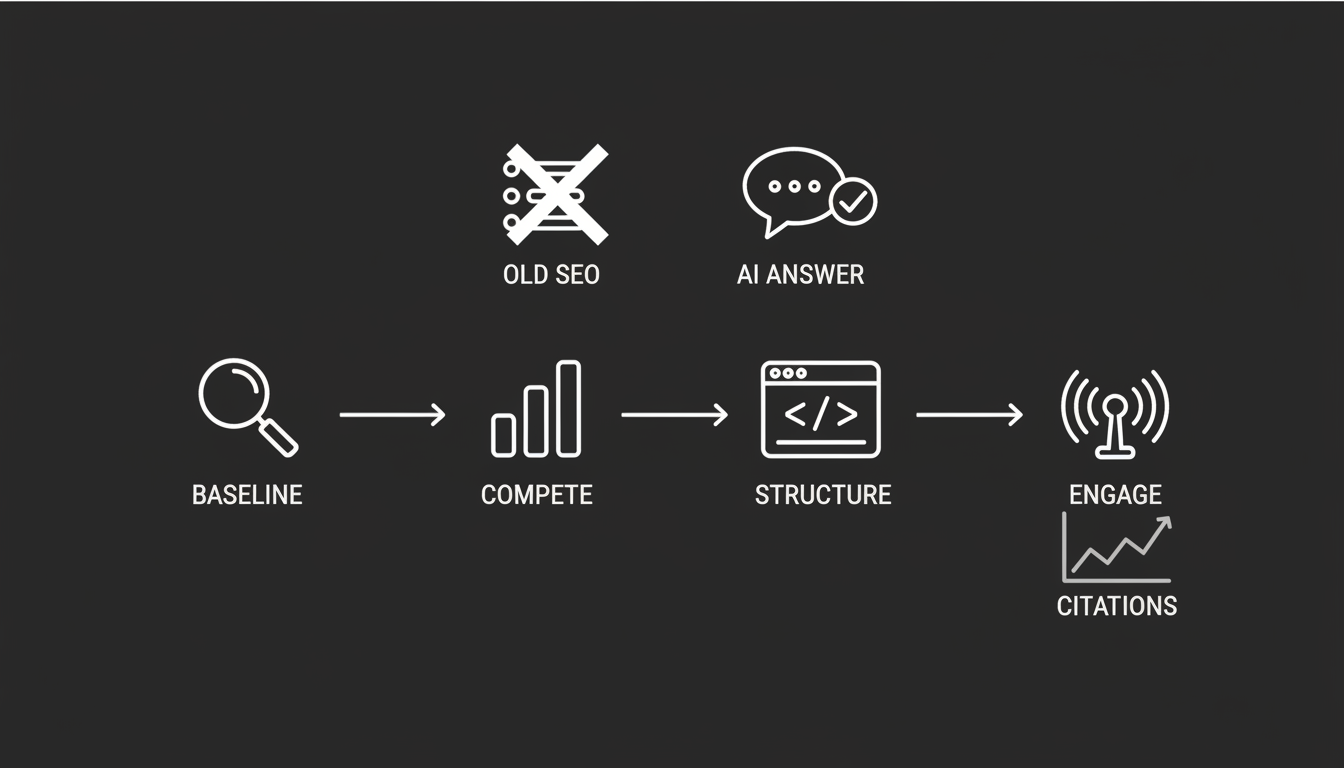
We built a 4-step framework at Akii because winning in AI search isn't a single tactic. It's a sequence. Each step builds on the one before it, and skipping steps means you're building on a weak foundation.
The logic matters here, so let me walk through each one.
Step 1: Know How AI Already Sees You
Before you change anything, you need a baseline. How do ChatGPT, Claude, Gemini, and other models currently interpret your brand?
This isn't a vanity exercise. Akii analyzes your brand across seven core visibility dimensions: discoverability, content quality, reputation, authority, and more. The output is an AI perception snapshot that tells you exactly where you stand and what to fix first.
If you don't know how AI models currently understand your brand, every optimization you make is a guess. Guessing is expensive when the stakes are this high.
Most brands I talk to are surprised by what they find. They assume their strong Google presence translates to strong AI visibility. It usually doesn't.
Step 2: Understand Who AI Already Favors
This is the competitive intelligence layer. Which competitors are already showing up in AI-generated answers? What are they doing that you're not? Where are the gaps you can break through?
Akii identifies the brands dominating AI-generated responses in your space and maps the specific visibility gaps where you can move in. It's a competitor benchmark paired with an opportunity map.
I've seen this step change strategies overnight. When a brand realizes that a competitor they've been outranking on Google for years is consistently cited by ChatGPT while they're invisible, the urgency becomes real fast.
Step 3: Make Your Website AI-Readable
Here's where the technical work happens. AI crawlers need to understand your site differently than Google's traditional crawler does. Akii generates ready-to-use robots.txt configurations, sitemap.xml files, llms.txt files, and schema.org markup designed specifically for AI comprehension.
This is the structural foundation. Without it, AI models struggle to parse your content accurately. With it, you become significantly easier for these models to understand, categorize, and reference.
Most websites are built for human visitors and Google's crawler. Very few are built for the AI crawlers that power ChatGPT Search, Gemini, and Perplexity. That's a fixable problem. Fixing it is step three.
So What Makes AI Engage Different From Everything Else?
Steps one through three get your brand ready. They're necessary. But they're not sufficient.
Here's what most people miss. Being technically prepared for AI search is like having a perfectly formatted resume. It helps, but it doesn't guarantee you get the job. Someone still has to notice you, understand your value, and decide to recommend you.
AI Engage is step four. It's where you move from passive readiness to active influence.
AI Engage is the first system designed to programmatically shape how AI models talk about your brand. It uses ethical, human-patterned engagement to reinforce your brand's authority within AI platforms like Google AI Search, ChatGPT Search, and Perplexity.
Let me be specific about what that means.
How Does It Work in Practice?
AI Engage runs targeted engagement campaigns across three major AI engines: Google AI Search, ChatGPT Search, and Perplexity. These campaigns use over 150 million residential proxy IPs to generate real, geo-targeted, human-like interactions that teach AI models your brand's relevance.
The campaigns are flexible. Depending on your plan, you can run from 150 to 5,000 targeted engagements per 30-day period. Each engagement is tracked through live analytics so you can see exactly what's happening: how many engagements ran, what AI answers looked like, and whether your brand was cited.
This isn't black-hat manipulation. It's systematic brand education at scale. You're giving AI models the consistent, structured signals they need to understand that your brand is relevant, authoritative, and worth citing.
Why Call It an Unfair Advantage?
I don't use that phrase lightly. But I think it's accurate, and here's why.
Right now, almost nobody is doing this. The vast majority of brands are still focused on traditional SEO, maybe experimenting with some AI-specific content work. Very few are actively engaging AI search engines to shape how those models understand and reference their brand.
That means the brands starting now are building a position that compounds over time. AI models learn. They build associations. The earlier you establish your brand's authority in these systems, the harder it becomes for competitors to displace you later.
I've seen this pattern before. In the early days of Google SEO, the brands that moved first built advantages that lasted years. The same dynamic is playing out now with AI search, but the window is smaller because the technology moves faster.
Is This Just Another Hype Cycle?
Fair question. I've been through enough technology cycles to know that not every new thing lives up to its billing.
But this one is different in a specific, measurable way. AI search usage is growing rapidly, and the behavior pattern is clear: people are increasingly asking AI for recommendations instead of searching Google. When that happens, the brand cited in the AI's answer wins the interaction completely. There's no partial credit.
The shift from "search and browse" to "ask and receive" is structural. It changes the economics of visibility. And it's already happening at scale.
I'm not saying Google is dead. What I'm saying is that a growing percentage of high-intent queries are being answered by AI models, and that percentage is increasing every month. If your brand isn't visible in those answers, you're losing ground you may not even know about.
What Are Early Adopters Actually Seeing?
The results from brands using the full Akii system, including AI Engage, have been striking.
One CEO reported a 94% citation rate within 90 days of deploying AI Engage. Their brand was being cited in AI-generated answers 94% of the time for their target queries. That's not incremental improvement. That's a category shift.
Marketing leaders have reported outranking competitors in AI search results within weeks, competitors that had been ahead of them in traditional search for years. The playing field really does reset when the platform changes.
These aren't hypothetical projections. They're measured outcomes from brands that moved early.
What Does This Mean for Your Strategy Right Now?
If you're a marketing leader or a founder, here's how I'd think about this.
First, get your baseline. You can't make good decisions about AI visibility without knowing where you currently stand. Akii offers 100 free AI credits to run your initial visibility analysis. No credit card required. Start there.
Second, understand that this is a sequence, not a single tactic. The brands getting the best results are working through all four steps: visibility monitoring, competitive intelligence, technical optimization, and active AI engagement. Jumping to step four without the foundation underneath it is like running ads to a broken website.
Third, recognize the timing advantage. The brands building AI visibility now are establishing positions that will be very difficult to challenge later. AI models develop associations over time. Early authority compounds.
Stop treating AI search as a future problem. It's a current one. Every day your brand is invisible in AI-generated answers is a day your competitors might be building the associations that keep you out permanently.
Where Does This Go From Here?
We're in the first inning of a fundamental shift in how people find and choose brands. The move from link-based search to answer-based search changes everything about visibility strategy.
Akii was built for this moment. Not because we predicted it perfectly, but because we've been watching the signals and building tools that match how AI search actually works. The 4-step framework isn't theoretical. It's running right now for brands that decided to move early.
AI Engage is the piece that turns preparation into influence. It's the difference between being ready for AI search and actually winning in it.
The brands that figure this out in the next 12 months will have an advantage that lasts much longer than that. The ones that wait will spend years trying to catch up.
I've seen that movie before. The ending is always the same.
If you want to see where your brand stands right now, start with a free AI visibility baseline. It takes minutes, costs nothing, and the data alone will change how you think about your visibility strategy.