
Most Brands Have No Idea How AI Sees Them. Here's How to Fix That.
I keep running into the same situation when I talk to founders and marketing leads. They've spent years building their brand's presence in traditional search. SEO, content, backlinks, all of it. And it's worked.
But when someone asks ChatGPT or Gemini for a recommendation in their category, their brand doesn't come up. A competitor does. Or the AI just describes a generic solution and moves on.
This isn't theoretical. It's happening right now, across every industry. Most companies don't even know it's happening because they have zero visibility into how AI models actually perceive their brand.
That's the gap I built the AI Brand Audit to close.
Why Does This Matter Right Now?
A growing share of product discovery is moving through AI interfaces. Not search engines with ten blue links. Conversational AI that gives one answer, maybe two. If you're not in that answer, you don't exist in that moment.
The old model: rank on page one, get clicks, earn consideration. The new model: get cited in the AI's response, or get skipped entirely.
Here's what most people miss. The factors that make AI models trust and cite your brand are related to traditional SEO, but they're not the same thing. You can have a technically clean website, strong domain authority, and solid content, and still be invisible to AI systems. Because AI models weigh things differently. They care about factual consistency, structured data, sentiment signals, topical depth, and whether your brand shows up in the kinds of sources they're trained on.
You can't fix what you can't see. That's where the audit comes in.
What Does the AI Brand Audit Actually Tell You?
The value isn't in running a scan. It's in what you do with the results. Let me walk through how this works in practice.
Setting Your Baseline
You start by adding your brand in the Manage Brands section inside Akii. Then you select which AI model you want to evaluate against and run the scan. Takes a couple of minutes.
Think of this as a health check. Before you start making changes, you need to know where you actually stand, not where you think you stand, according to the AI models your customers are using right now.
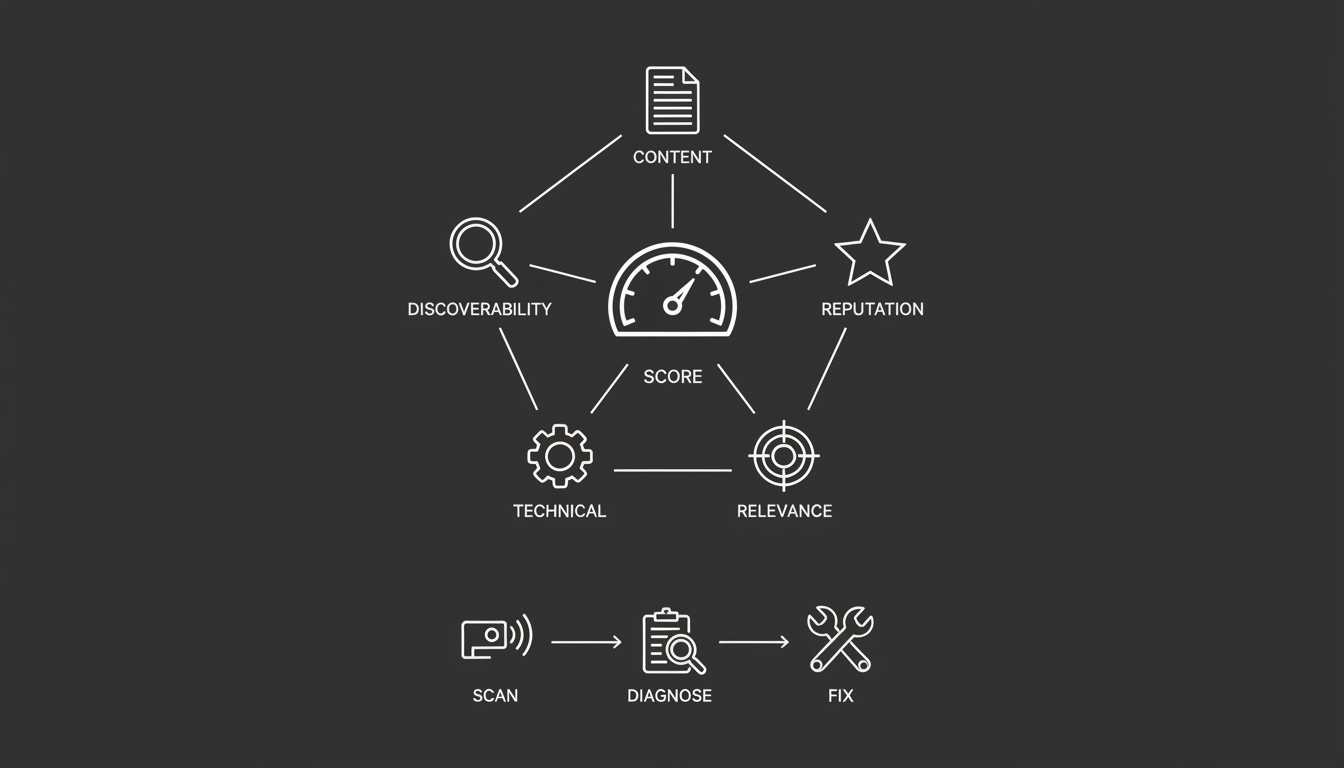
The scan gives you an AI Visibility Score out of 100. That number is a useful benchmark. The real insight, though, is in the breakdown underneath it.
The Five Dimensions That Determine Your AI Visibility
Your score breaks down into five areas. Each one tells you something specific about why AI models are or aren't citing your brand.
AI Discoverability. Are AI models surfacing your brand when people ask questions in your category? Or are they recommending competitors instead? This is the most direct measure of whether you're part of the AI conversation at all.
Content Quality. Do AI systems see your content as credible, current, and evidence-based? Thin content, outdated pages, and lack of depth all hurt here. AI models are looking for substance, not word count.
Reputation and Authority. This is about external signals: reviews, sentiment, thought leadership, third-party mentions. Your product could be excellent, but if the signal environment around your brand is weak or negative, AI models notice.
Topic and Market Relevance. Are you showing up for the high-value queries that matter in your industry? You might appear in one category but be completely absent from another that's more important to your business. This dimension catches that.
Technical Infrastructure. Is your site structured so AI systems can easily crawl, interpret, and trust it? Schema markup, internal linking, site navigation. The plumbing that makes everything else work.
Here's where it gets interesting. You might score well in Technical Infrastructure but poorly in Discoverability. That tells you your site is ready from a technical standpoint, but you're not yet part of the AI conversation. Those are two very different problems with two very different fixes.
What Do the Detailed Reports Actually Reveal?
Each dimension comes with its own analysis showing strengths and weaknesses. This is where the audit stops being a scorecard and starts being a diagnostic tool.
In Discoverability, you might find that your brand is misrecognized or completely absent from AI-generated recommendation lists. That's a signal you need stronger brand signals and better factual feeds into the sources AI models draw from.
In Content Quality, the audit often uncovers shallow coverage, outdated pages, or a lack of educational depth. I've seen brands with hundreds of blog posts score poorly here because most of those posts were written for keyword density, not genuine topical authority. AI models can tell the difference.
In Reputation and Authority, negative UX reviews or a lack of visible thought leadership can drag your score down even if your product is solid. This one surprises people. They assume product quality speaks for itself. It doesn't, at least not to an AI model evaluating external signals.
In Technical Infrastructure, the report examines schema markup, internal linking, and navigation structure. A technically sound site makes it dramatically easier for AI systems to index and cite you. This is often the easiest dimension to fix and the one most commonly neglected.
In Topic and Market Relevance, you might discover you're showing up for "cinema deals" but completely missing from "cinema technology innovations." That kind of misalignment means you're visible in the wrong conversations and invisible in the right ones.
This breakdown is where insight turns into action. Instead of wondering why your brand isn't getting cited, you see exactly what's holding it back.
How Do You Turn Findings Into Actual Improvements?
Diagnostics without a clear path forward are just expensive anxiety. This is the part I care about most.
The Action Plan translates every finding into a prioritized to-do list. Each recommendation includes a clear description of the issue, who should own it, a confidence level, and expected impact with a realistic timeline.
Some examples of what this looks like in practice:
"Fix structured data inconsistencies." Owned by your technical team. High confidence. Expected impact in about 7 days.
"Create evidence-based articles on core topics." Owned by your content team. Builds topical relevance. Impact in about 10 days.
"Feed authoritative facts to LLMs through PR and third-party sources." Owned by your PR team. Improves brand recognition in AI responses. Impact in about 14 days.
These aren't abstract suggestions. They're assignable, trackable tasks. You hand them to the right person and measure whether they moved the needle.
In my experience, the gap between knowing what's wrong and doing something about it is where most strategies die. The action plan is designed to close that gap.
Is This a One-Time Thing or an Ongoing Process?
It's ongoing. That's not a sales pitch. It's the reality of how AI systems work.
AI models update constantly. Your competitors are adapting too. A score that looks good today can slip in a month if you're not paying attention.
The audit lets you compare your current score to past scans. You can track each dimension separately over time, so you can see whether your content improvements, technical fixes, or PR efforts are actually translating into better visibility.
Over time, this builds into a historical record of your brand's AI search presence. It becomes proof that your strategy is working and a guide for where to focus next.
I think of it like financial reporting. You wouldn't check your revenue once and assume it stays the same. AI visibility works the same way. It's a moving target, and you need a system for tracking it.
What's the Practical Starting Point?
If you've read this far, here's what I'd suggest.
Run your first scan. Don't overthink it. You're not committing to anything. You're finding out where you stand.
Look at the dimension breakdown, not just the overall score. The score tells you how visible you are. The dimensions tell you why.
Pick the two or four action items with the highest confidence and shortest time to impact. Execute those first. Then rescan and see what changed.
That's it. No massive strategy overhaul required. Just a clear baseline, a focused set of fixes, and a way to measure progress.
The brands that will win in AI-driven discovery aren't necessarily the biggest or the best-funded. They're the ones that understand how AI models make decisions and adapt so. The AI Brand Audit gives you that understanding.
Run a free AI Visibility Score and see where your brand actually stands.