


The Internet Isn't Changing. It Already Changed.
Most brands are still building for a world that's fading. They're chasing rankings, tweaking title tags, writing blog posts aimed at humans who type queries into Google.
The actual decision layer has already shifted underneath them.
In 2026, the question isn't whether your brand shows up on page one. It's whether an AI agent knows you exist when it's assembling a shortlist on behalf of your customer. That's a fundamentally different problem. And the old playbook doesn't solve it.
What's an AI Agent, and Why Should You Care?
The terminology is a mess right now, so let me be precise.
An LLM (like GPT-5 or Gemini) is a reasoning engine. It synthesizes data and predicts text based on training.
A chatbot (like ChatGPT's interface) lets a human talk to that reasoning engine. You ask, it answers.
An AI agent is something else entirely. It's an autonomous system that uses an LLM to reason, plan, and execute tasks using tools. Agents don't just answer questions. They act.
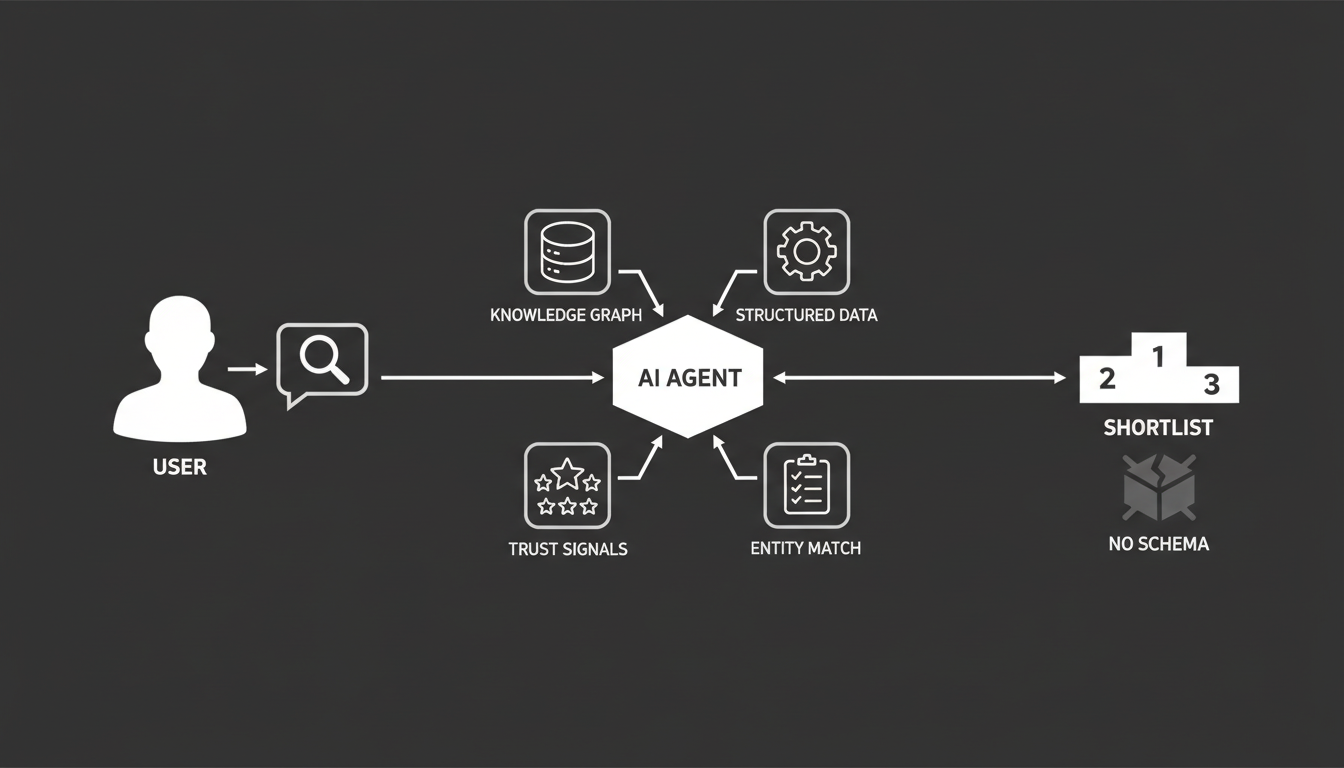
Why does that distinction matter for your brand? When someone asks an agent to "find the best CRM for a small business," that agent doesn't visit ten websites. It retrieves, synthesizes, and builds a shortlist instantly, pulling from knowledge graphs, reviews, structured data, and comparison signals. No browsing. No clicking.
If your brand isn't part of that initial synthesis, you're filtered out before a human sees anything. That's not a ranking problem. That's an existence problem.
How Do AI Agents Actually Make Decisions?
Most people assume agents work like search crawlers. They don't.
Agents rely on knowledge graphs, not keyword indices. Here's how the logic actually runs:
Retrieval. Agents scan for verified entities in their knowledge graph. They prioritize brands with clear, consistent data across trusted sources like Wikidata and Crunchbase. Keyword-stuffed pages don't help here. Clean, structured identity does.
Tool use. Agents call APIs and structured feeds to check real-time pricing, availability, feature specs. If your content isn't extractable by these tools, it doesn't exist to the agent.
Memory. This one surprises people. Agents depend on entity consistency. If your brand description says one thing on your website, something slightly different on G2, and something else on Crunchbase, the agent loses confidence. That inconsistency can produce hallucinations or get you excluded entirely.
Reasoning. LLMs analyze product specs and reviews to infer whether your product solves a specific user problem. They're working from the relationships defined in your entity graph, not from how clever your copy is.
I've watched this same pattern play out across every technology cycle in my 25 years in this industry. The companies that win aren't the ones with the best marketing. They're the ones that make it easiest for the new distribution layer to understand them. Right now, that layer is AI agents.
What Signals Do Agents Actually Look For?
Want to be chosen by an agent? You need to broadcast specific, machine-readable signals that confirm relevance and reliability. Not vague brand awareness. Specific ones.
Does the Agent Understand What You Do?
I'd call this functional clarity, and it's the most underrated factor in AI visibility.
Can an AI model accurately describe what your company does? Not approximately. Not with hallucinated details. Accurately.
If your product entity is unclear, or if your description varies across the web, the agent can't map your solution to the user's intent. You need a single, unified taxonomy for your core entities. One description. One set of categories. Replicated everywhere.
Is your description consistent across every platform where you appear? Most brands, if they're honest, would say no.
Does the Agent Trust You?
Agents are built to minimize risk. They look for external corroboration before recommending anyone.
That means sentiment signals from reviews, citations in authoritative media like Gartner or TechCrunch, and entity saturation across knowledge bases. High-trust institutions get privileged treatment in these systems. If you're in healthcare, think Mayo Clinic. If you're in SaaS, think about how well-represented you are across review platforms and analyst reports.
Trust isn't a feeling for an agent. It's a data pattern.
Can the Agent Match You to a Specific Problem?
Agents match specific problems to specific solutions. Your content must clearly map your product to the high-intent queries and use cases it actually solves.
If an agent can't determine whether your software handles enterprise-grade security, it won't recommend you for an enterprise task. It doesn't guess. It moves on.
Most brands are terrible at this because they've spent years writing content for humans who browse, not agents that retrieve.
Can the Agent Actually Read Your Data?
Machine readability is non-negotiable. Agents rely on Schema.org markup to parse details like price, availability, and ratings. E-commerce brands need SKU-level clarity using Product and Offer schema. SaaS brands need feature-level structured data.
If your data isn't structured for extraction, you're invisible to the tools agents use to make decisions. Full stop.
How Do You Actually Build for This?
Most advice floating around about "AI optimization" is either too vague to act on or too hyped to trust. So let me be direct about what the work actually looks like.
The shift is real, but it's not mysterious. It's a move from SEO toward what's being called AEO (Answer Engine Optimization) and GEO (Generative Engine Optimization). Different acronyms, same core idea: make your brand machine-readable and entity-clear.
Step 1: Build Machine-Readable Brand Documentation
Start with what I'd call a Master Entity Profile. This is the single source of truth for your brand.
Define one description, one taxonomy, one boilerplate. Then replicate it across your website, your schema markup, and every third-party directory where you appear. Generate an AI-friendly robots.txt and an /llms/ directory to guide agents to your most critical data. Think of it as a front door built specifically for machines.
This isn't glamorous work. It's foundational work. Most companies skip it because it feels like plumbing rather than strategy. That's exactly why it's an advantage for the ones who do it.
Step 2: Provide Clear Value Mappings
Your schema needs to explicitly tag your value propositions. Not imply them. Tag them.
Here's a real example. An e-bike brand called AeroCycle discovered that AI systems were describing it as a standard bicycle. The fix was simple: they updated their Product schema to explicitly tag attributes like "electric" and "lightweight." That correction directly improved how accurately AI systems described the brand.
Small structural fix. Meaningful visibility impact.
Step 3: Create Agent-Friendly Content
Agents prefer what I'd call quotable canonicals. Concise, declarative statements that can be extracted and cited cleanly.
In practice, that means structuring content with FAQ and HowTo schema, using question-based headings, and putting TL;DR summaries at the top of long-form pieces. Convert buying guides into structured comparison tables that agents can parse without effort.
Here's the practical reality: if an agent can't pull a clean, accurate sentence from your content to answer a user's question, it will pull that sentence from someone else's content instead.
Step 4: Test Your Brand Across Multiple Agent Systems
Most companies have a blind spot here. They might check how they appear in ChatGPT and stop there. But visibility varies wildly across different reasoning engines.
You need to test how your brand is perceived across ChatGPT, Gemini, Claude, Perplexity, Llama, and DeepSeek. Each system has different training data, different retrieval methods, and different reasoning patterns. You might be positioned as a category leader in one system and completely absent from another.
Akii tracks exactly this. We built our platform to monitor how AI engines mention and position brands in real answers, across multiple systems, because legacy reporting tools were built for a search world that's disappearing. You can run a free AI agent readiness baseline to see where you actually stand.
Visibility in the agent economy is volatile. What's true today can shift next month as models update. Continuous monitoring isn't optional if you want to know whether your work is actually landing.
What Does This Look Like by Industry?
The principles are consistent. The execution differs.
SaaS
SaaS brands currently lead in AI visibility, with roughly 48% inclusion rates, largely because they tend to excel at entity saturation and third-party validation through review platforms. The priority here is ensuring feature sets are clearly defined in schema so you win comparison queries. When an agent is asked "what's the best project management tool for remote teams," it's pulling from structured feature data, not your homepage hero copy.
E-Commerce
Agents tend to prioritize large platforms like Amazon, but individual brands can break through. SKU-level clarity and strong review velocity using AggregateRating schema are what matter. Clean product data plus strong review signals gives agents what they need to recommend you directly.
Local Services
For local queries, the trust signals that matter most are review velocity and consistent NAP (Name, Address, Phone) data across directories. When someone asks an agent for "the best dentist near me," it's pulling from structured local data, not your website's About page.
Why Most Brands Are Behind on This
I've been through enough technology cycles to recognize the pattern. There's always a gap between when a shift becomes real and when most companies start responding to it.
Right now, most brands are still operating as if traditional search is the primary discovery channel. It still matters. But the agent layer is growing fast, and the brands that build for it now will have a structural advantage that's genuinely hard to close later.
The work isn't complicated. It's disciplined. Clean entity data, consistent descriptions, structured schema, regular testing across multiple AI systems.
The companies that treat this as a real operational priority, not a side project handed off to the SEO team, are the ones that will show up when agents are making decisions on behalf of their customers.
Where to Start
Don't try to do everything at once. Start with the foundation.
- Audit your entity consistency across every platform where your brand appears.
- Build your Master Entity Profile with one canonical description.
- Build structured schema for your core products and services.
- Test your visibility across at least six major AI systems.
- Set up continuous monitoring so you catch shifts before they cost you.
If you want to see where your brand stands right now, Akii's AI Brand Audit gives you a baseline across all the major reasoning engines. It's the fastest way to find out if you're being recommended, misrepresented, or ignored entirely.
The agent economy isn't coming. It's here. The only question is whether your brand is readable to it.