


Digital Discovery Has Changed Again
The way people find information shifts every decade or so. Each time it does, the businesses that notice early build an advantage. The ones that don't spend years catching up.
Search engines came first. You built a site, optimized for keywords, competed for page one. The rules were clear. The feedback loop was measurable. If you ranked, you existed.
Then social media changed the game. Discovery became less about intent and more about attention. Algorithms decided what showed up in your feed. Brands had to earn engagement, not just clicks. The signal moved from "who ranks" to "who resonates."
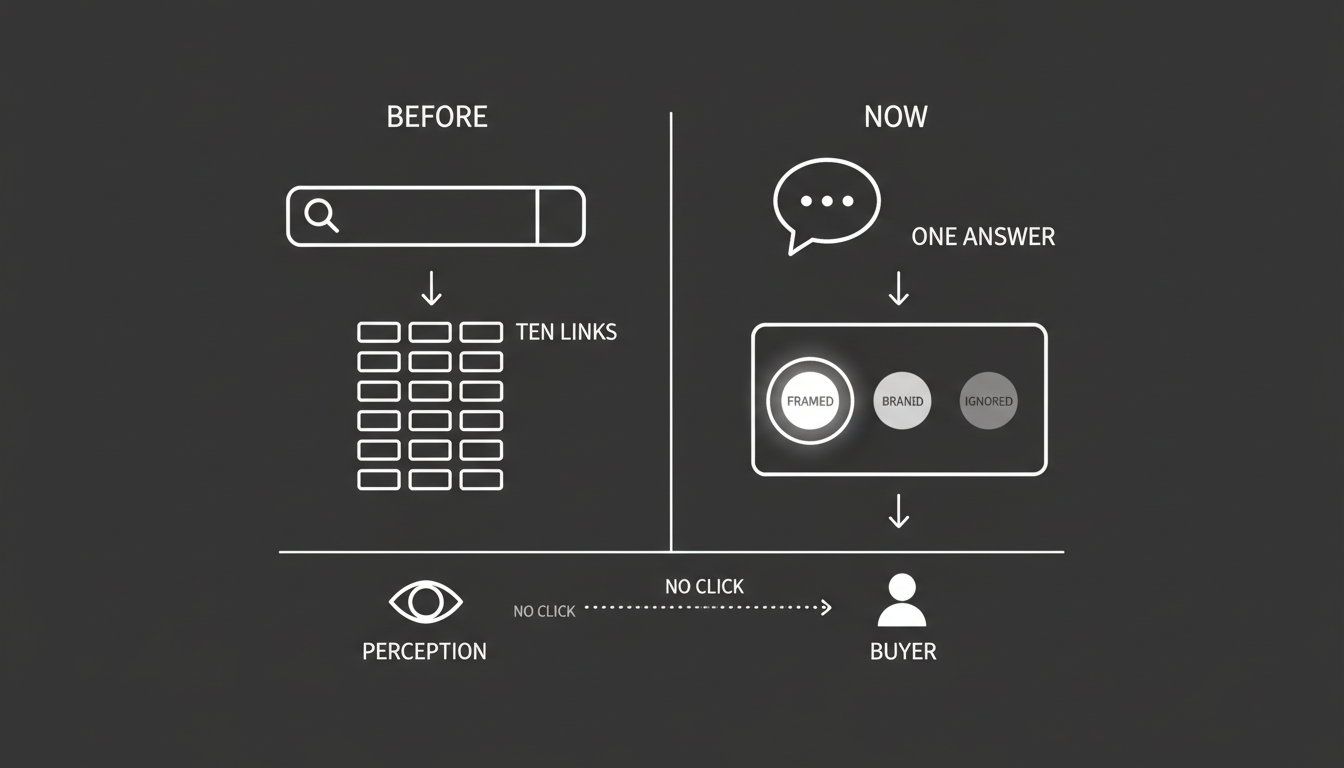
Now we're in the middle of the next one. AI assistants are becoming the primary layer between people and information. ChatGPT, Perplexity, Gemini, Copilot. Millions of people ask these tools questions every day. The answers they get don't come with ten blue links. They come as single, synthesized responses.
Here's what most people miss about this shift: it's not just a new channel. It's a different kind of information architecture. One where the AI decides what to include, what to leave out, and how to frame it. That's a fundamentally different dynamic than anything we've dealt with before.
Search engines pointed people toward sources. Social platforms amplified voices. AI assistants replace the need to visit sources at all. They just answer.
If your brand isn't part of that answer, you're not in the conversation. And if you are part of the answer but framed poorly, that might be worse than not showing up at all.
The Rise of AI-Mediated Perception
Think about how most people interact with AI tools right now. They ask a question. They get a response. They move on.
They don't check the sources. They don't cross-reference. They treat the AI's answer the way they used to treat the first Google result, except now there's only one result.
That answer is synthesized from training data, retrieval sources, and whatever ranking logic the model uses internally. It's not a list of options. It's a position. A framing. A narrative.
When someone asks "What's the best CRM for small teams?" or "Which analytics platform is most reliable?", the AI doesn't say "here are some links to explore." It says "X is widely regarded as..." or "Many users prefer Y because..."
That's not search. That's recommendation. And it carries the weight of perceived authority.
I've watched this pattern play out across multiple technology cycles. The medium that controls the framing controls the perception. It happened with print, with broadcast, with search. And it's happening now with AI.
The difference this time is speed and scale. These models serve millions of answers a day. Each one shapes how someone thinks about a product, a brand, a category. Most companies have zero visibility into what's being said about them in those answers.
What does your brand sound like when an AI describes it? Do you even know?
Why Traffic Is No Longer the First Signal
For twenty years, marketing teams have been trained to measure success by traffic. Clicks, visits, sessions, pageviews. The assumption was simple: if people are coming to your site, your marketing is working.
That assumption is breaking down.
When an AI assistant answers a question directly, the user often doesn't click through to anything. They got what they needed. The interaction is complete. Your brand may have been mentioned, recommended, or dismissed, and you'd never see it in your analytics.
This is influence before the click. It's the moment where perception is formed, preference is shaped, and decisions start to take root. And it happens entirely outside your owned channels.
I think this is the single biggest blind spot in marketing right now. Teams are still improving for traffic while the real action is happening upstream, in the AI's answer layer.
Consider the buying journey. Someone asks an AI tool to compare options in your category. The AI names three competitors and leaves you out. Or it mentions you but frames you as "good for beginners" when you're actually built for enterprise. That framing sticks. It becomes the starting point for how that person thinks about you.
By the time they visit your website, if they visit at all, the perception is already set.
Traffic metrics can't capture this. Click-through rates can't capture this. Traditional SEO dashboards can't capture this. The signal has moved to a place most marketing teams aren't watching.
That's why I wrote about why AI visibility is not a dashboard problem. The tools we've relied on for measurement were built for a different information architecture. They measure what happens after someone arrives. They don't measure what happens before someone decides whether to arrive at all.
The New Marketing Imperative
So what does this mean in practice?
Marketing teams need to add a new discipline: monitoring and managing how AI systems perceive and present their brand. This isn't about gaming an algorithm. It's about understanding a new layer of influence and being intentional about it.
Two things matter here.
First, monitor AI perception. You need to know what AI engines say about you when someone asks a relevant question. Not once. Continuously. These models update. Their answers change. The way they frame your brand today might be different next month, and you need ongoing visibility into that.
This is different from brand monitoring on social media or tracking press mentions. AI answers are synthesized. They blend multiple signals into a single narrative. Understanding that narrative requires a different kind of intelligence.
We built Akii's AI visibility metrics framework around this exact need, because the existing measurement approaches weren't designed for synthesized AI outputs. They were designed for links, rankings, and mentions. That's not enough anymore.
Second, manage narrative signals. Once you understand how AI systems perceive your brand, you can start influencing the inputs that shape those perceptions. Your content strategy, your public positioning, how you're referenced across the web, the structured data you make available.
This isn't about stuffing keywords into blog posts. It's about ensuring that the signals AI models consume accurately represent who you are, what you do, and why it matters.
That's a strategic shift, not a tactical one. It changes how you think about content, PR, partnerships, and product positioning. Because all of those things feed into the information layer that AI models draw from when they construct answers.
Is your marketing team thinking about this yet? Most aren't. And that gap is where competitive advantage lives right now.
The Infrastructure Marketing Teams Will Need
Here's where it gets practical.
You can't manage what you can't see. Right now, most organizations have no systematic way to track how AI engines represent them. What's needed is continuous intelligence for AI perception. Not a one-time audit. Not a quarterly report. A system that tracks how AI models answer questions relevant to your brand, your category, and your competitors, on an ongoing basis.
This is the infrastructure layer for the next era of marketing. It needs to do a few things well.
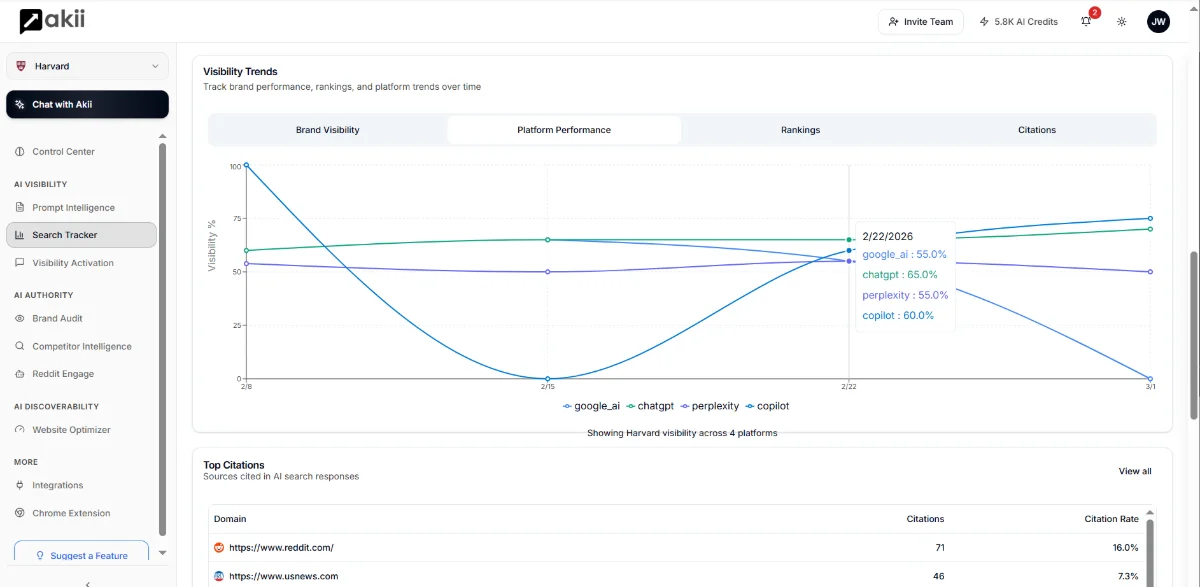
Track AI answers over time. Models change. Answers shift. You need a longitudinal view, not a snapshot. What an AI says about you this week might be different from what it said last month. Understanding the trajectory matters as much as understanding the current state.
Compare across AI engines. ChatGPT, Gemini, Perplexity, Copilot don't all say the same thing. Each model has different training data, different retrieval methods, and different biases. Your brand might be well-represented in one and invisible in another. You need visibility across all of them.
Surface competitive framing. It's not just about whether you're mentioned. It's about how you're positioned relative to competitors. Are you the default recommendation or the afterthought? That relative positioning is where perception is won or lost.
Connect to action. Intelligence without action is just trivia. The system needs to help teams understand what to do: what content to build, what signals to strengthen, what narratives to correct.
At Akii, this is the problem we're focused on. We track how AI engines mention and frame brands in real answers, across models, over time. You can see what we're building at akii.com/features. It's designed for the reality that AI-mediated perception is now a primary marketing surface.
I wrote more about where this is headed in the future of AI brand intelligence. The short version: the companies that build this muscle early will have a structural advantage. The ones that wait will spend years trying to correct perceptions that formed while they weren't paying attention.
I've been through enough technology transitions to know how this plays out.
First, a small number of people notice the shift. Then early adopters start building for it. Then there's a tipping point where everyone scrambles to catch up. By that point, the early movers have already established their position.
We're in the early stages right now. Most marketing teams are still focused on search rankings and social engagement. Those things still matter. But they're no longer the whole picture.
The brands that win the next five years will understand one thing clearly: perception is increasingly formed in AI-generated answers. Not on your website. Not in your ads. Not in your social posts. In the AI layer.
That doesn't mean traditional marketing goes away. It means it's no longer sufficient on its own. You need a new layer of awareness and a new set of tools to go with it.
The question isn't whether AI will shape market perception. It already does. The question is whether you'll have visibility into it or be flying blind.
I'd rather know what's being said about my company in the answers millions of people are reading every day. And I'd rather have the ability to do something about it.
That's not a future problem. It's a today problem. The teams that treat it that way will be the ones setting the narrative instead of reacting to it.