
The Market Is Confused, and That's Costing You
Here's what I keep running into. A marketing team tells me they're doing AI SEO. I ask what that means. They pull up a content writing tool that generates blog posts faster.
That's not AI visibility. That's word processing with a language model attached.
"AI SEO" has become so overloaded in 2025 that the label is nearly useless. It covers everything from headline generators to full brand monitoring across AI answer engines. Because the label is identical, teams assume the capability is identical.
It isn't. Not even close.
The gap between tools that use AI to help you write content and tools that measure whether AI models actually recommend your brand is enormous. Publishing a great article is one thing. Actually showing up when a buyer asks ChatGPT "what's the best solution for X?" is a completely different problem.
If your team can't explain that difference, keep reading.
Why Does This Distinction Matter Right Now?
For years, SEO meant one thing: rank higher in a list of blue links. The first wave of AI tools automated that process. Write faster. Find keywords quicker. Publish more.
That was a reasonable bet when Google's link index was the primary way people found products and services. But the ground has shifted.
People now ask AI assistants for recommendations directly. ChatGPT, Gemini, Perplexity, Claude. These aren't search engines in the traditional sense, and they don't return a ranked list of pages. They return synthesized answers, recommend specific brands, compare products, and make judgment calls.
A tool that helps you write a blog post cannot tell you whether an AI model is recommending your brand or steering buyers toward your competitor. Those are two completely different problems requiring two completely different instruments.
If your entire stack is built around content creation, you're solving a 2015 problem with 2025 technology. Your customers have already moved on.
What Do AI SEO Tools Actually Do?
Let's be precise about what most people mean when they say "AI SEO tool."
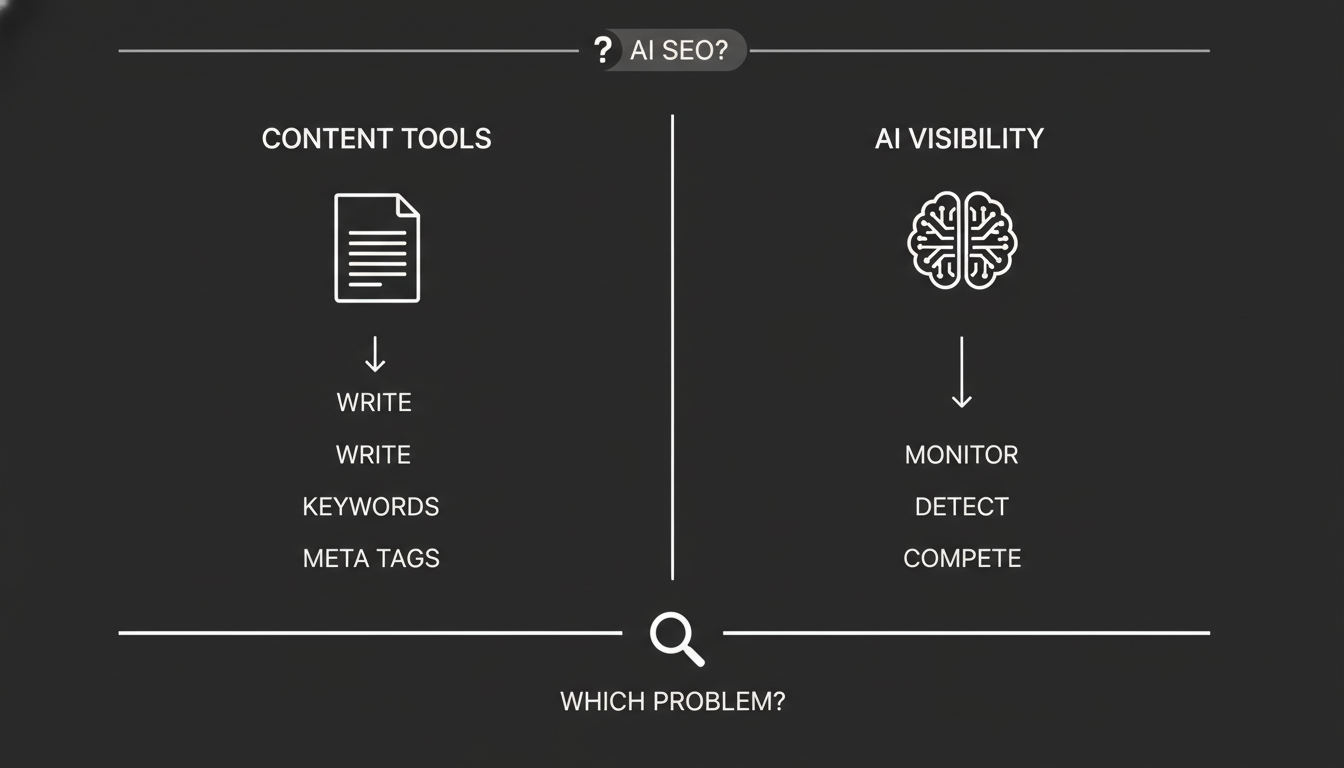
They're talking about content creation and on-page optimization assistants. These tools use large language models to speed up the traditional content production workflow.
Content generation. They draft blog posts, social captions, landing page copy. The value proposition is speed. What took a writer four hours now takes 30 minutes.
Prompt optimization. Some tools help you structure inputs to get better creative output from models like GPT-4. Think of it as template engineering for content teams.
On-page analysis. They check keyword density, readability scores, meta tag structure. The goal is helping individual pages rank better in Google and Bing.
These are creation tools. They help you build assets designed to rank in a traditional keyword index, and for that purpose, they work fine.
But here's the question nobody asks: what happens after you publish?
Where Do Content Tools Go Blind?
This is where most teams have a dangerous gap in their understanding.
A content writing tool, no matter how sophisticated, is completely blind to what happens inside AI models. It can help you create content. What it cannot do is tell you how that content is being interpreted, cited, or ignored by the AI systems your buyers are actually using.
No monitoring. A content tool can't tell you how often ChatGPT mentions your brand when someone asks about your category. It doesn't track inclusion rates across different models or give you any visibility into whether you're being recommended, ignored, or actively dismissed.
No competitive context. These tools can analyze keyword difficulty on Google. They can't tell you that Gemini recommends your competitor as the "best solution" while framing your brand as a "risky alternative." That's a completely different data layer they don't touch.
No model-level diagnostics. They can't detect if an AI model is hallucinating your pricing, inventing features you don't offer, or telling potential customers your company shut down two years ago. These things happen more often than you'd expect.
Think about what that means practically. You might have perfect on-page SEO. Your content might be well-written, well-structured, technically sound. But if an AI model believes your business closed in 2023 because of bad training data, you lose the customer before they ever reach your website.
You can't fix a problem you can't see.
What Are AI Visibility Tools Built to Do?
AI visibility tools solve a fundamentally different problem. They're not for writing content. They're for measuring and influencing your presence inside the AI models themselves.
This is the shift from Search Engine Optimization to what some people call Answer Engine Optimization. I don't love the acronym, but the concept is right. The question isn't "where do I rank on a page?" It's "am I part of the answer?"
Here's what that looks like in practice.
Measurement. Tools like Akii quantify your inclusion rate, which is the percentage of times an AI model cites your brand in response to high-intent queries in your category. This is a number most marketing teams have never seen. It's also arguably the most important metric they're missing.
Risk detection. These tools identify hallucinations where models provide incorrect facts about your product. Wrong pricing. Invented features. Outdated information presented as current. Once you see the problem, you can address it through schema markup and entity work.
Competitive intelligence. Why does an AI model cite your competitor and not you? AI visibility tools reverse-engineer the answer. Maybe it's specific schema types, maybe it's authority sources the model trusts, maybe it's structured data your competitor has that you don't. Without this intelligence, you're guessing.
Long-term monitoring. AI model outputs are volatile. You can be in the recommended shortlist on Monday and gone by Thursday. Visibility tools track these shifts across environments like Perplexity, Google AI Overviews, and direct model queries, then alert you when something changes so you can respond.
These are intelligence tools. They don't help you create content. They help you understand and influence how AI agents perceive your brand.
How Do You Know Which One You Need?
This isn't an either/or question for most teams. But the answer depends on what you're actually trying to accomplish.
If you're a content creator and your primary KPI is publishing volume and organic traffic from traditional Google links, a content generation tool is sufficient for that specific job. You need help writing and improving for keywords. These tools serve that need well.
Don't confuse that with AI visibility, though. You're solving a production problem, not a perception problem.
If you're a brand leader or CMO, the question is different. You need to know how your brand is perceived across the AI systems your buyers are using. Are you being recommended? Are you being compared favorably? Are you losing share in the zero-click era where buyers never visit your website because the AI already told them what to buy?
A content tool can't answer any of those questions. You need AI visibility intelligence.
If you run an agency, you probably need both. Content tools to deliver client work efficiently. AI visibility tools to offer services that actually differentiate you. An "AI Brand Audit" is a fundamentally different offering than another blog post package, and it's much harder to commoditize when every agency on earth now has access to the same content generation models.
If you're a SaaS or eCommerce founder, this isn't optional. You can't afford to be invisible to the AI systems that are increasingly making or influencing purchasing decisions. Your product specs, pricing, and positioning need to be machine-readable and accurately represented by the models your buyers trust. If a potential customer asks ChatGPT about your category and you're not in the answer, that's revenue you'll never see and never know you lost.
What Does This Look Like Side by Side?
Sometimes the clearest way to see the difference is through specific tasks.
Use a content tool when you need to:
- Write a blog post faster
- Find keywords for Google Search
- Improve meta tags and readability
Use an AI visibility tool when you need to:
- Check if ChatGPT recommends your brand
- Find competitors that AI models favor over you
- Fix hallucinations about your pricing or features
- Track brand sentiment inside AI responses
- Deploy schema that AI agents can actually read
Notice the pattern. Content tools help you produce. Visibility tools help you understand what's happening in places you can't directly see.
Why Is the Market So Confused About This?
I've watched technology markets go through this exact phase multiple times over 25 years. A new category emerges. The existing players relabel their products to capture the new demand. Buyers get confused because everything sounds the same.
That's exactly what's happening with "AI SEO" right now.
Legacy SEO platforms added AI content generation features and started calling themselves AI SEO tools. Technically accurate. Deeply misleading. They're using AI to do the same thing they've always done: help you rank in traditional search. They haven't built the infrastructure to monitor what's happening inside AI models because that's a completely different technical problem, and it requires starting from scratch.
The result is a market where the label tells you almost nothing about the capability. You have to look past the marketing and ask a simple question: does this tool tell me what AI models are saying about my brand?
If the answer is no, it's a content tool. Call it what it is.
What Happens If You Only Invest in Content Tools?
I want to be direct about the risk here because most teams are underestimating it.
If your entire AI strategy is "use AI to write more content," you're building on an assumption that traditional search will remain the primary way buyers find and evaluate solutions. That assumption is weakening every quarter.
When a buyer asks Perplexity "what's the best project management tool for remote teams" and gets a direct answer with two or three recommendations, your beautifully optimized blog post ranking fourth on Google doesn't matter. The buyer already has their answer. They never scrolled. They never clicked.
You can have the best content strategy in your industry and still be invisible in the channel that's growing fastest. That's the uncomfortable reality.
Good content is one of the signals AI models use to form their understanding of your brand. Creating content without monitoring how it's being interpreted by AI models is like sending mail without checking if it's being delivered.
What Should a Modern Stack Look Like?
Here's how I think about it practically.
Your content tools handle production. They make your team faster at creating the raw material that feeds both traditional search and AI model training. Keep using them.
Your AI visibility tools handle intelligence. They tell you what's actually happening after you publish. Are AI models picking up your content? Are they representing your brand accurately? Are they recommending your competitors instead of you? Where are the gaps?
Production without intelligence is just volume. Intelligence without production gives you nothing to work with. You need both layers, and you need to be clear that they solve different problems.
The mistake I see most often is teams treating their content tool as if it covers the visibility problem. It doesn't. It was never designed to.
So What Do You Do Next?
Stop conflating content generation with AI visibility. Different problems. Different tools. Different outcomes.
If you don't know how AI models are talking about your brand right now, that's the first gap to close. Not because content doesn't matter, but because you can't fix what you can't measure.
Most teams are surprised by what they find when they actually look. Hallucinated pricing. Outdated positioning. Competitors getting recommended in queries where they should be winning. These aren't theoretical risks. They're happening right now, in real conversations between your potential customers and the AI systems they trust.
Traditional SEO tools tell you where you rank on a page. Only AI visibility tools tell you if you're part of the conversation at all.
Check your AI visibility score and see what your content tools have been missing.