

Why Manual AI Testing Doesn't Scale
Here's what I see constantly. Someone on the marketing team types their brand name into ChatGPT, screenshots the answer, and drops it into Slack. "Look, we got mentioned!" Or worse: "Why aren't we showing up?"
That single test tells you almost nothing.
AI models don't return the same answer every time. The same prompt can produce different results depending on model version, session context, and even time of day. You're not looking at a stable index like traditional search. You're looking at a probabilistic system that generates answers on the fly, every single time.
So what actually happens when you test manually?
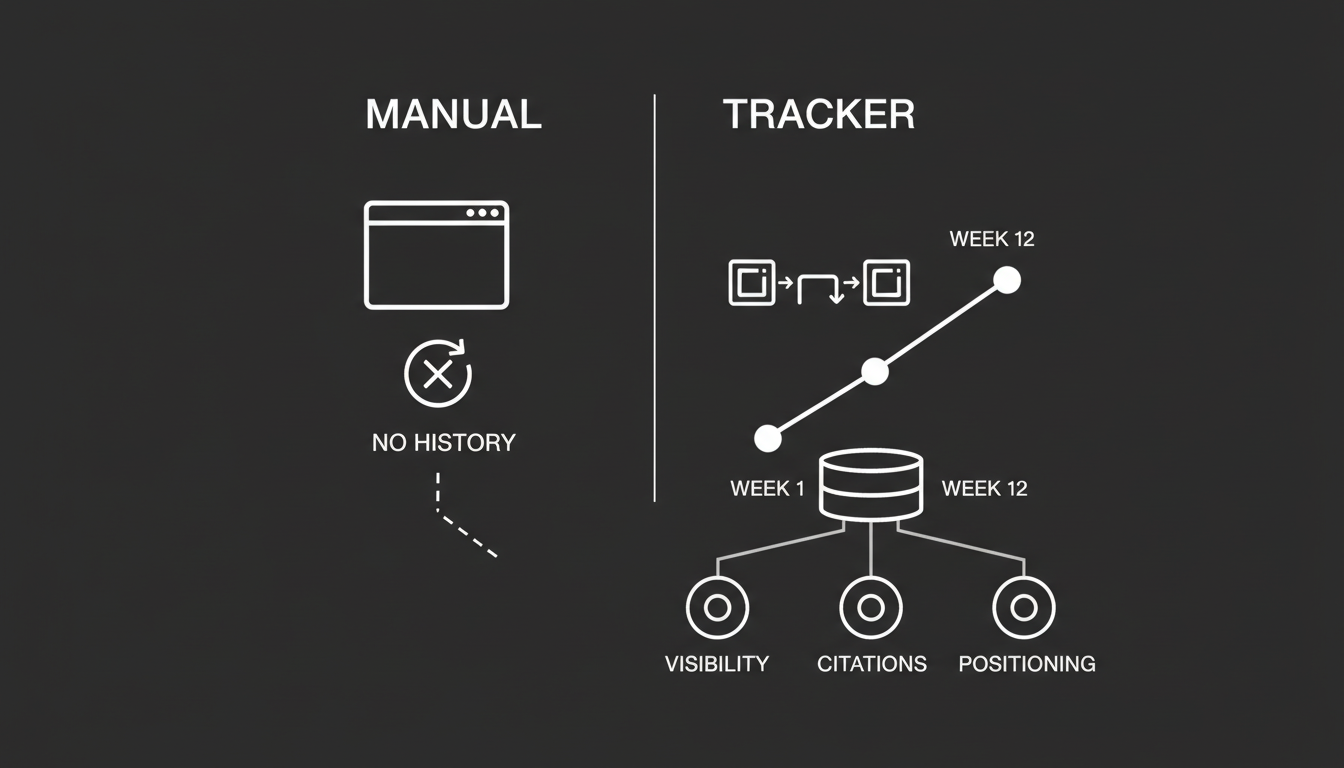
Inconsistent results. You run the same question Tuesday and Thursday and get two completely different answers. Without controls, you can't tell if the model changed, your brand's visibility shifted, or you just got an unlucky draw on how the response was generated. One-off tests create false confidence or false alarm. Both are expensive.
No history. Even if you screenshot every test, you don't have structured data. You can't compare this week to last month. You can't see whether a competitor started appearing more often. There's no baseline, so there's no trend. You're flying blind and calling it research.Manual testing is fine for curiosity. It's useless for decision-making.
The moment you need to report on AI visibility, allocate budget based on it, or understand competitive positioning inside AI answers, you need something that runs consistently, stores results, and lets you compare over time. That's not a spreadsheet exercise. That's a system.
What an AI Search Tracker Actually Does
The concept is straightforward, even if the execution isn't.
An AI search tracker does this on a continuous basis: it runs structured prompts, captures full answers, and tracks changes over time.
It runs prompts. Not randomly. Repeatable, structured prompts that reflect how real users ask questions relevant to your category. "What's the best project management tool for remote teams?" "Which CRM integrates with Shopify?" These are the questions your potential customers are asking AI assistants right now. A tracker fires these prompts on a schedule, across multiple AI models, and captures what comes back.
It captures answers. Full answers, not just whether your brand name appeared. The complete text matters because context matters. Were you mentioned first or last? Were you recommended or just listed? Was a competitor positioned as the better option? The raw answer is the data. Everything else is derived from it.
It tracks changes. This is where the real value lives. A single snapshot is a data point. A series of snapshots over weeks and months becomes intelligence. You can see when a model starts recommending a new competitor. You can see when your brand drops out of answers it used to appear in. Patterns that would be invisible without consistent tracking become obvious.
At Akii, this is exactly what we built. Not a one-time audit tool. A continuous monitoring system that treats AI answers as a living dataset. You can explore our AI Search Tracker to see how this works in practice.
The point isn't to check a box. The point is to build a reliable picture of how AI engines represent your brand, and to update that picture automatically.
What It Should Measure
If you're going to track AI visibility, you need to be specific about what you're measuring. "Are we showing up?" is a starting point, not a strategy.
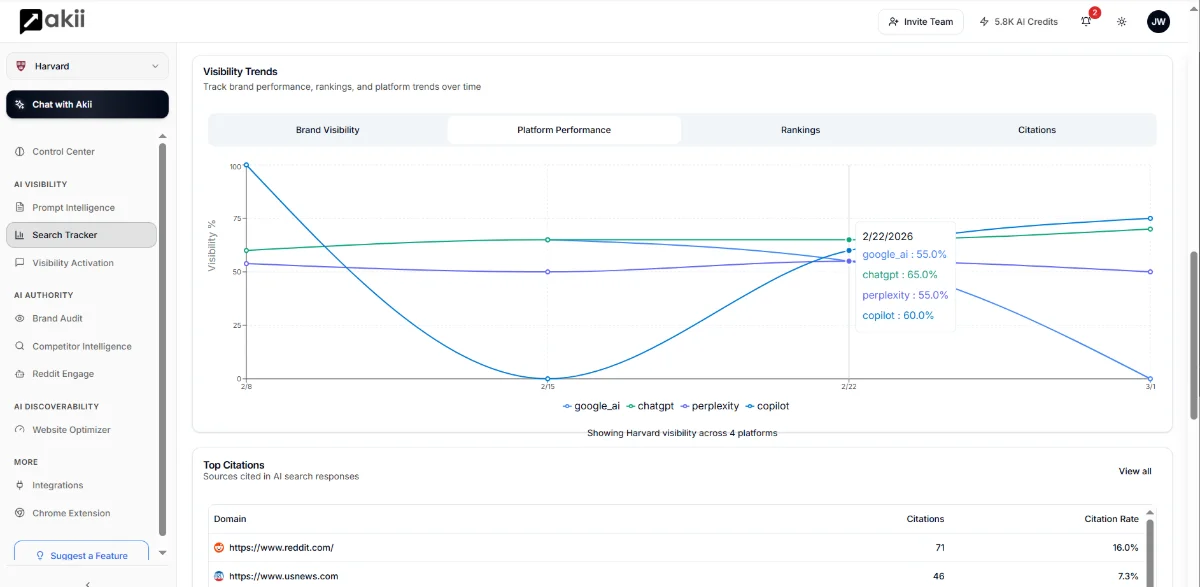
Visibility. Are you present in AI-generated answers for the prompts that matter to your business? This is the most basic metric, but it's not binary. You might appear in 60% of relevant responses on one model and 30% on another. You might show up for product comparison queries but disappear from "best of" lists. Visibility is a distribution, not a yes or no.
Citations. When AI mentions your brand, does it link to your content? Does it reference a specific page or data point? Citations tell you whether the model is pulling from your owned content or from third-party sources. That distinction matters because it affects accuracy and control. If ChatGPT is describing your product based on a two-year-old review site, you have a content problem, not just a visibility problem.
Positioning. Where do you appear relative to competitors? Being mentioned is good. Being mentioned first, or being framed as the recommended option, is better. Are you the default answer or the afterthought? Is the AI's framing aligned with how you actually want to be perceived? Positioning tracks the qualitative shape of your presence in ways raw visibility numbers can't.
I wrote about this in more detail in our AI Visibility Metrics Framework, which breaks down how to think about these measurements systematically. The short version: if you're only tracking whether you show up, you're missing most of the picture.
Why Time-Aware Monitoring Matters
Most people treat AI visibility like a snapshot. It's actually a film.
AI models update. Training data changes. Competitor strategies shift. A brand that dominated AI answers in January might be absent by April, and you'd never know unless you were watching continuously.
Detecting shifts. The most valuable signal in AI tracking isn't where you are today. It's when something changes. A sudden drop in visibility across a category of prompts might mean a model update deprioritized your content. A new competitor appearing consistently might mean they've figured out how to get cited. These shifts are invisible without time-series data, and by the time you notice them through manual testing, you've already lost weeks or months of ground.
Understanding trends. Not every change is a crisis. Some fluctuations are noise. Some are seasonal. Some are the early signal of a structural shift in how a model treats your category. Is this a blip or a trend? You can't answer that without a baseline, and you can't build a baseline without continuous tracking.
This is the core argument I made in The Death of Rank Tracking. Traditional SEO rank tracking assumed a stable index you could check periodically. AI doesn't work that way. The answers are fluid. The only way to understand them is to watch them over time, consistently, with structured data you can actually analyze.
Time-aware monitoring isn't a nice-to-have. It's the difference between catching a problem while it's still small and reacting after it's already compounded.
I've talked to enough teams to see the same mistakes repeating. Two stand out.
Testing once and calling it done. Someone runs an audit, builds a report, presents it to leadership, and moves on. Three months later, the data is stale and the decisions based on it are wrong. AI visibility isn't a project. It's a practice. If you're not tracking continuously, you're not tracking. You're guessing with extra steps.
Focusing on one model. ChatGPT gets all the attention, but it's not the only AI answering questions about your brand. Perplexity, Google's AI Overviews, Claude, Copilot, and others all generate answers from different training data with different biases. Your brand might be well-represented in one and completely absent from another. If you only monitor ChatGPT, you're seeing a fraction of the picture, and that fraction might be the most flattering one.
There's a third mistake worth naming: treating AI tracking as an SEO task. It's related to SEO, but it's not the same discipline. The signals are different. The levers are different. The people who should own it might be different. Bolting AI visibility onto your existing rank tracking workflow is tempting, but it usually means neither gets done well.
So Where Does This Leave You?
Every brand will need an AI search tracker. Not because it's trendy. Because AI is becoming a primary way people get answers, and if you don't know what those answers say about you, you're ceding control to a system you don't understand.
The technology exists to do this well. The question is whether you start now, while the data is still relatively uncrowded and the patterns are still forming, or whether you wait until a competitor's name is the default answer and you're playing catch-up.
I've been through enough technology cycles to know how this plays out. The companies that build measurement infrastructure early don't just have better data. They make better decisions, faster, for years. That's not a theory. It's a pattern I've watched repeat across multiple shifts in how people find and evaluate products.
If you want to see what continuous AI monitoring looks like in practice, take a look at what we've built. And if you want to understand the broader shift happening in how brands get discovered, the blog is where we're documenting it in real time.
The window for getting ahead of this is still open. It won't be forever.