
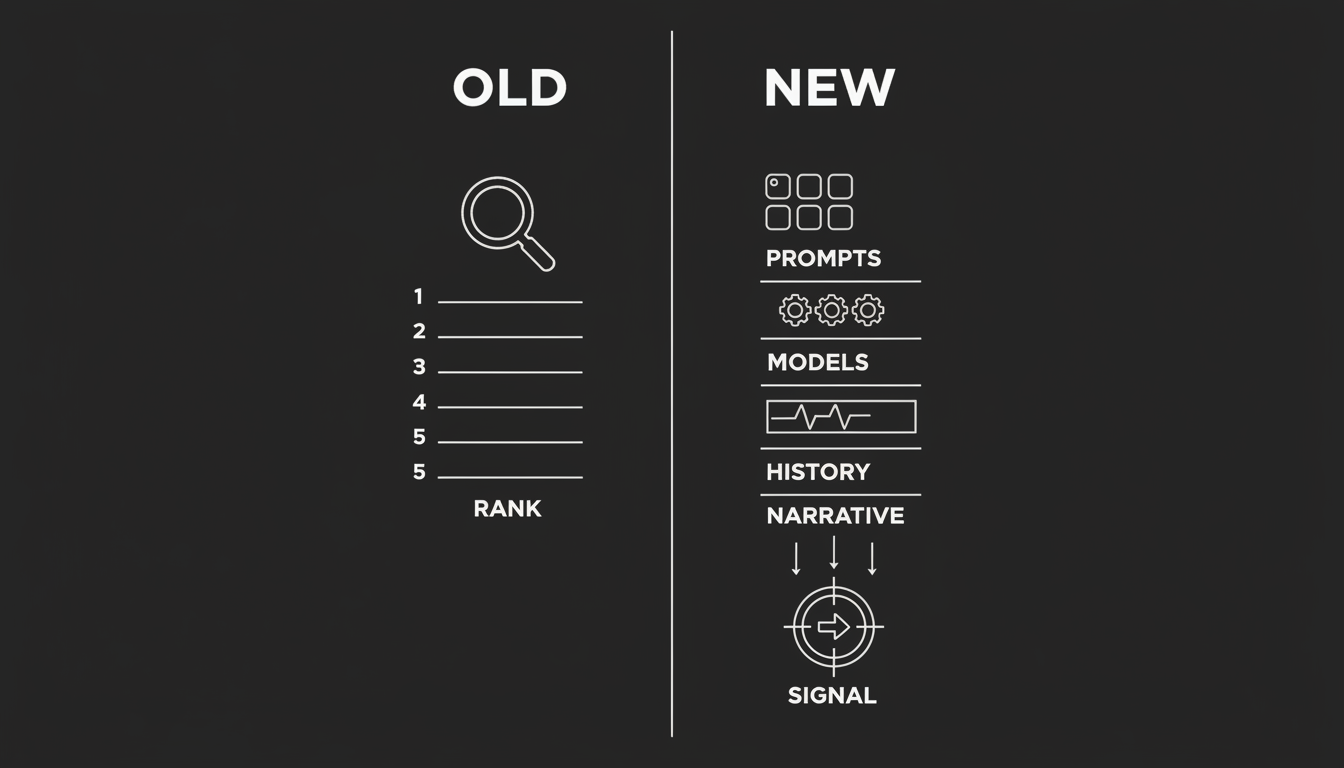
Rank Tracking Is Dead. Here's What Replaces It.
For twenty years, every marketing team in the world anchored its dashboard to one comforting column: Rank.
It made sense. Google was a library. Results were static shelves. Your rank was your shelf position. If you were #1 for "best accounting software," you were winning. If you were #5, you had work to do. The system was deterministic. Input a keyword, get a position, track it weekly, call it a strategy.
That world is gone.
When a buyer asks ChatGPT, Gemini, or Perplexity for a recommendation today, the AI doesn't retrieve a pre-sorted list of links. It generates a new answer from scratch, token by token, based on probability, context, and training data. The concept of "Rank #1" doesn't just fail to apply. It actively misleads.
An AI model might mention your brand first in one answer, third in the next, and exclude you entirely in a third variation based on a slight change in the user's prompt or the model's temperature setting.
If you're still reporting on keyword rankings, you're measuring a ghost. You're applying the logic of 2010 to the technology of 2026.
I've watched measurement shifts before. This one is structural, not incremental. And the replacement isn't another dashboard metric. It's a fundamentally different kind of monitoring.
Why Did Rank Tracking Work in the First Place?
To understand why it's broken, you have to understand the architecture it was built to measure.
Traditional search engines function as indexes. They crawl the web, catalog pages, and rank them based on a relatively stable scoring system. The output is a linear list of blue links. The metric is vertical position, 1 through 10. And the core assumption is simple: if you're #1 today, you'll likely be #1 tomorrow unless something specific changes.
That assumption held for two decades. It made rank tracking reliable, cheap, and easy to report on.
But AI models are non-deterministic. They don't fetch a pre-sorted list. They generate a new sequence of text every time. The output is a synthesized paragraph, a bulleted list, or a comparison table. There is no "position." There's only inclusion (did you make the cut?) and narrative (what was said about you?).
Here's where it gets dangerous. Being the first bullet point in a list of "Risky Alternatives" is technically "Position #1." But it's a business disaster. A traditional rank tracker can't tell the difference. It sees #1 and reports green. Meanwhile, the AI just told your prospect to be careful with you.
Can you afford to run your visibility strategy on a metric that can't distinguish between a recommendation and a warning?
What Does "Selection" Mean When There's No Ranking?
In the age of answer engines, visibility is binary in a way it never was before.
Traditional search had a gradient. Ranking #4 was still valuable. You were above the fold. Users scrolled. You got clicks. In AI search, being outside the top 3 recommendations often means zero visibility. The user gets their answer and moves on. They don't ask for "more options." There is no page two.
So the metric shifts from "Average Position" to something I think of as Inclusion Rate: the percentage of times your brand is cited across a statistically big sample of relevant prompts.
If you appear in 40% of "Best CRM" queries across multiple models and prompt variations, you own 40% of the conversational market share for that topic. That number tells you something real. A rank number in this context tells you almost nothing.
Why Is AI Visibility So Unstable?
Unlike Google, which strives to show the same results to everyone in a specific region, AI models vary their answers based on multiple factors simultaneously.
Prompt phrasing matters. "Best CRM" versus "Top CRM software" triggers different associations in the model's vector space. Small wording changes produce meaningfully different outputs.
Session context matters. The AI remembers previous questions in a conversation, changing its answer based on the flow.
Model temperature matters. This is a randomness parameter that ensures the AI doesn't sound robotic. It means the model may swap out recommendations between runs of the exact same prompt.
A traditional rank tracker that checks one keyword once a week captures a random snapshot of this chaos. It tells you nothing about your actual stability in the market. Checking the temperature outside once in January and deciding you know the climate gives you the same quality of insight.
If I Can't Trust a Single Check, What Do I Trust?
This is the most important concept for anyone managing brand visibility in 2026: AI visibility is volatile by design.
If you check ChatGPT on Monday and see your brand recommended, then check again on Tuesday and see you're gone, the natural reaction is to panic. Change the H1 tags. Disavow backlinks. Call a meeting.
But what if nothing changed on your site? What if ChatGPT pushed a minor model update, or the temperature of the response varied slightly?
Managing AI visibility with single-run testing is like checking the stock market once a year. The data point is real, but it offers no context. Here's the difference between noise and signal:
Noise: "We dropped out of the answer today."
Signal: "We've dropped out of the answer for 7 consecutive days across 50 different prompt variations."
Without time-aware history, you can't tell which one you're looking at. Reacting to noise is often worse than doing nothing, because it sends your team chasing problems that don't exist.
Why Does "Replay" Matter So Much?
To diagnose AI visibility issues, you need what I'd call Perception Memory. You need to be able to replay the tape.
Say your visibility dropped last week. You compare the exact text of the AI's answer from last week versus this week. You find that last week, the AI cited your G2 reviews as evidence. This week, it stopped citing G2 and started citing a negative Reddit thread instead.
You can't find that insight with a rank number. You can only find it by storing and comparing the full text history of the AI's answers over time. The diagnosis lives in the words, not the position.
This is why the entire measurement layer for AI visibility needs to be rebuilt from the ground up. Not tweaked. Rebuilt. At Akii, this is the problem we're focused on, building monitoring infrastructure that captures the actual substance of what AI models say about brands, not just whether they say anything at all.
What Does Time-Aware Monitoring Actually Look Like?
If rank tracking is dead, here's what replaces it. You need to build or buy intelligence infrastructure. Not a dashboard you glance at. A system that monitors the pulse of AI models continuously.
There are four layers to this.
Step 1: High-Frequency Prompt Simulation
You can't rely on one keyword. You have to simulate the cloud of user intent.
Instead of tracking "Project Management Software," you track a basket of 20 to 50 semantic variations:
- Definitional: "What is [Brand]?"
- Comparative: "[Brand] vs [Competitor]"
- Evaluative: "Best project management tools for enterprise"
- Problem-oriented: "How do I manage remote teams more effectively?"
- Persona-specific: "Best tools for a startup CTO"
You run these prompts across multiple models (ChatGPT, Gemini, Perplexity, Claude) on a weekly or daily cadence. This smooths out the randomness of AI and gives you a reliable Inclusion Rate over time.
One prompt, one model, one day? That's a coin flip. Fifty prompts, four models, thirty days? That's intelligence.
Step 2: Cross-Model Delta Detection
In traditional SEO, if you dropped on Google, you likely dropped on Bing. The engines shared similar signals. In AI, the engines are structurally different.
You might be a "Market Leader" in Perplexity because you have strong PR citations, but invisible in Gemini because you lack Google Knowledge Graph data. Or you might appear consistently in ChatGPT but poorly in Claude because of how each model weighs different source types.
The metric here is what I'd call Cross-Engine Delta. Time-aware monitoring flags when a gap opens up between models. If your visibility in Claude drops while ChatGPT stays steady, you know the issue is specific to Claude's training data or source preferences, not your overall brand health.
That distinction matters enormously. It changes what you fix and where you invest. Without cross-model tracking, you're flying blind on which engines are working for you and which aren't.
Step 3: Narrative Change Detection
This is where it gets really different from anything legacy SEO tools can do.
Rank trackers track numbers. Time-aware monitoring tracks stories.
The system analyzes the text of the AI response, not just whether you appeared. It triggers alerts not when you move from #1 to #2, but when the language changes.
"Sentiment Shift Detected. Gemini has moved from describing you as 'Innovative' to 'Complex.'"
"Hallucination Detected. ChatGPT is quoting your pricing as $500 instead of $50."
"Competitor Insertion Detected. Claude has added Brand X to its recommendation set for enterprise queries."
This is qualitative tracking at scale. It turns the black box of AI reasoning into a readable trend line. And it's the kind of monitoring that Akii is purpose-built for.
What Are Rank Trackers Physically Unable to See?
By sticking to legacy SEO tools, you're accepting massive blind spots. Here are specific threats that rank trackers can't detect, no matter how sophisticated they are.
The Drift
AI models rarely flip from "love" to "hate" instantly. They drift. And the drift is subtle enough to miss if you're only watching numbers.
- Week 1: The AI calls you the "Industry Leader."
- Week 4: The AI calls you a "Popular Option."
- Week 8: The AI calls you a "Legacy Tool."
- Week 12: The AI recommends your competitor as the "Modern Alternative."
A rank tracker sees you on "Page 1" for all 12 weeks. It reports green across the board. It completely misses the erosion of your brand equity until it's too late.
Time-aware monitoring plots these semantic shifts on a timeline. It lets you intervene at Week 4 with targeted content and citation-building to reinforce your "innovation" signals before the narrative calcifies.
I've seen this drift happen to established brands in real time. By the time they notice, the AI's perception has already hardened. Reversing it takes months. Catching it early takes days.
Citation Loss
AI models rely on verified nodes, essentially citations, to build trust in their recommendations.
Here's a scenario that plays out constantly: a high-authority article from a major tech publication that the AI was using to verify your brand falls off the model's immediate retrieval window. Or the model de-prioritizes that domain for some internal reason.
The result? The AI suddenly stops recommending you because it lost its "proof."
Your website didn't change. Your backlinks didn't change. Traditional SEO tools show "No Issues." But your knowledge graph support collapsed. Only a system monitoring the citations within the answer itself can detect this.
The Hidden Competitor
In a list of ten blue links, a new competitor appearing at #9 is a minor annoyance. In an AI shortlist of three, a new competitor appearing at #3 is an existential threat. They just took a third of your visibility.
What makes this worse is that AI models often surface brands you don't track because they have low SEO traffic but high entity authority. They might have strong Wikipedia presence, academic citations, or niche community credibility that traditional competitive analysis would never flag.
Time-aware monitoring identifies these breakouts immediately. It tells you: "Brand X has entered the consideration set for enterprise queries this week." That gives you time to reverse-engineer their strategy before they take your market share.
How much of your competitive intelligence is built on assumptions from the old search model?
So What Changes in Practice?
The shift from rank tracking to time-aware monitoring isn't just a tool swap. It changes how you think about visibility.
Old model: Check rankings weekly. React to position changes. Improve pages for keywords.
New model: Monitor inclusion rates daily across models. Track narrative shifts over time. Build citation authority across the sources AI models trust. Respond to perception changes, not position changes.
The old model was about controlling your shelf position. The new model is about shaping what the machine believes about you. Those are fundamentally different problems.
I've spent 25 years watching technology cycles force this kind of rethinking. The pattern is always the same: the old metric keeps getting reported long after it stops being meaningful, because the infrastructure is already built and the reports are already automated. Teams keep improving a number that no longer correlates with business outcomes.
Don't be that team.
From Positions to Perceptions
The death of rank tracking isn't the death of measurement. It's the beginning of better measurement.
We're moving from measuring positions (where we are on a list) to measuring perceptions (who the machine thinks we are). That's a harder problem. It requires more sophisticated infrastructure, more frequent monitoring, and a willingness to track qualitative shifts, not just quantitative ones.
The brands that win in 2026 won't be the ones obsessing over fluctuating rankings. They'll be the ones building intelligence systems that can hear a narrative shift early and correct it before it compounds.
If you want to see what that kind of monitoring looks like in practice, take a look at what we're building at Akii. We built it because the old tools can't see what matters anymore. And what you can't see, you can't fix.
The rank column in your dashboard isn't wrong. It's just measuring something that no longer exists.