
AI Memory Is Not Human Memory
People talk about AI "knowing" their brand like it's a permanent state. It's not.
There's no persistent awareness sitting inside these models, waiting to surface your name when someone asks a relevant question. What actually happens is closer to pattern recall. Pattern recall depends entirely on what the model was trained on, when it was trained, and how strongly your brand was associated with the right concepts at that moment.
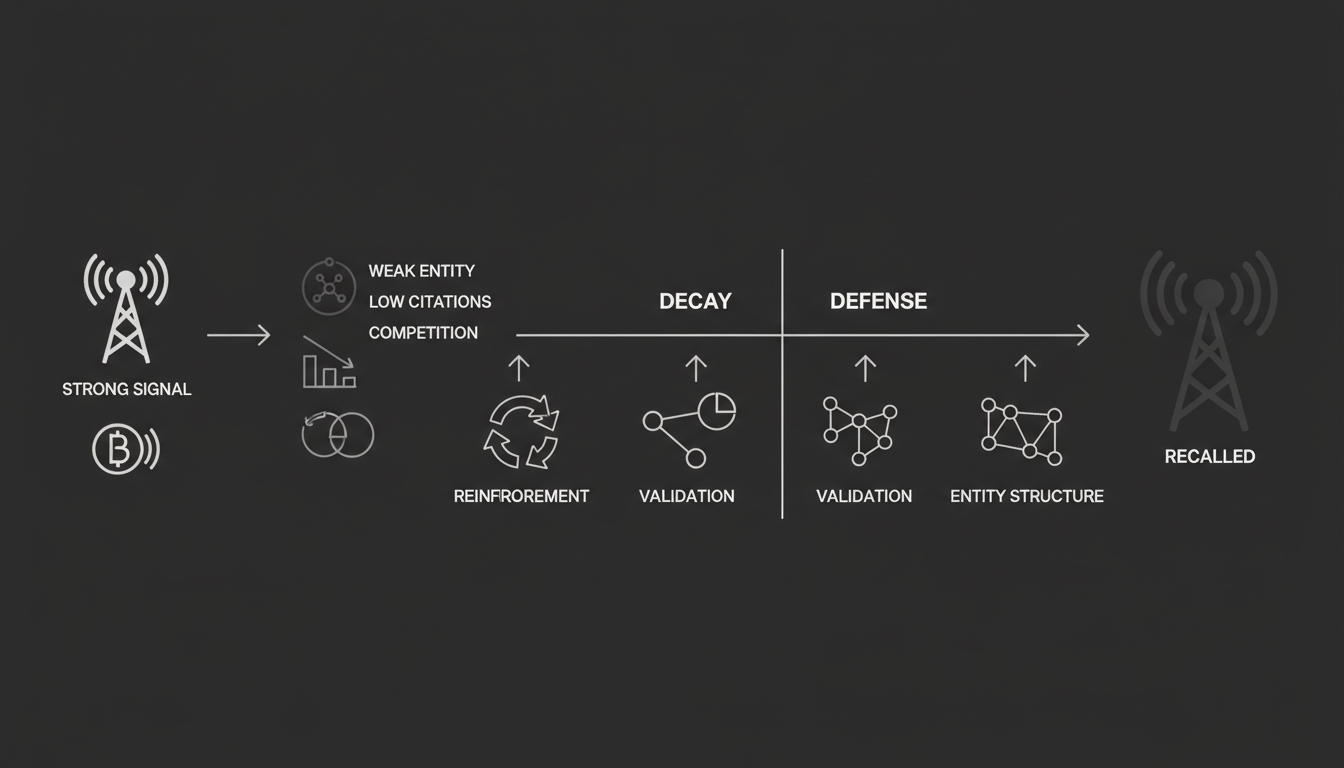
That distinction matters more than most marketers realize. Human memory works through lived experience, emotional weight, and repetition over time. AI memory works through statistical association. If your brand showed up often enough, in the right contexts, connected to the right entities, you get recalled. If not, you don't.
Here's the part that catches people off guard: even if you were recalled last month, that doesn't mean you will be next month. The models update. The retrieval systems re-index. The competitive field shifts. Your visibility isn't a fixed asset. It's a position that decays unless actively maintained.
Think of it this way. You're not building brand awareness in AI. You're maintaining signal strength. The moment you stop reinforcing, the signal weakens.
Why does this matter practically?
Because most companies treat AI visibility like traditional SEO rankings. They check once, see their brand mentioned, and assume the job is done. But unlike a Google ranking that might hold for weeks or months with no intervention, AI recall can shift much faster.
The systems pulling answers for users don't have loyalty. They have recency bias, frequency bias, and authority bias. If your competitors are doing more to stay present in the training and retrieval pipeline, they'll replace you.
This isn't theoretical. I've watched brands go from being the default recommendation in AI answers to being completely absent within a single model update cycle. No warning. No gradual decline. Just gone.
The 3 Causes of Brand "Forgetting"
When a brand disappears from AI responses, it's rarely random. There are three predictable causes, and they usually compound each other.
1. Weak entity reinforcement
AI models understand the world through entities and relationships. Your brand is an entity. Your products are entities. The problems you solve, the categories you belong to, the people associated with your company. All entities.
If those connections are weak or ambiguous in the data the model consumes, your brand becomes fuzzy. A fuzzy entity gets skipped in favor of a clearer one. Simple as that.
Weak reinforcement happens when your brand appears in content but without clear, consistent association to the concepts that matter. You might be mentioned, but not in a way that builds a strong graph connection. The model sees you, but doesn't know what to do with you.
2. Lack of repeated citations
Frequency matters in a way that feels almost unfair. A brand cited 50 times across authoritative sources in a given training window will almost always beat a brand cited 5 times, even if those 5 citations are individually stronger.
This doesn't mean you need to spam the internet. But a single great article or a handful of mentions won't sustain recall over time. The models weight repetition. They interpret frequency as a signal of relevance. If you're not being cited regularly, you're fading.
3. Competitive overwriting
This is the one that surprises people most. You can do everything right and still lose visibility because a competitor did more.
AI models have limited context windows and limited space in their associative networks for any given concept. When a competitor floods the relevant channels with stronger, more frequent, more authoritative content, they don't just gain visibility. They actively displace yours.
It's not a conspiracy. It's math. The model can only associate so many brands with "best project management tool for remote teams." If two competitors are reinforcing that association harder than you are, you get pushed out.
The Role of Source Recency
Most people are treating AI visibility like a one-time optimization problem. Build the content, get the mentions, move on.
That framing is wrong. These systems have a recency bias that makes older content progressively less influential. Fresh data replaces old associations. Not immediately, not all at once, but steadily.
Why does stale content lose influence?
Two reasons. First, retrieval-augmented generation systems, the architecture behind most AI answer engines, actively prefer recent sources. When they pull context to generate an answer, newer content gets weighted more heavily. Your strong blog post from 2022 might have built solid associations during one training cycle, but it's being outweighed by your competitor's post from last month.
Second, model retraining and fine-tuning naturally dilute older signals. Each new training run introduces new data. The proportional weight of your older content shrinks with every cycle. You don't lose it entirely, but its influence decays.
This creates a treadmill effect. You have to keep producing relevant, authoritative, well-structured content just to maintain the position you already earned. Stop for six months, and you'll feel it.
I've seen this pattern across multiple technology cycles. The companies that treat content as a one-time investment always lose ground to the ones that treat it as ongoing signal maintenance.
Competitive Replacement Effect
Visibility in AI isn't absolute. It's relative.
That's the single most important concept people miss when thinking about AI brand presence. You can't evaluate your position in isolation. You can only evaluate it relative to every other entity competing for the same conceptual space.
What does relative visibility actually mean?
If you maintain exactly the same level of content production, citation frequency, and entity reinforcement as last quarter, but two competitors increase theirs by 40%, you've effectively declined. Your absolute output didn't change. Your relative position did.
AI models prefer frequently reinforced entities. When they generate an answer about a category, a problem, or a solution type, they pull from the strongest associations available. "Strongest" is determined by a combination of recency, frequency, authority, and clarity of entity relationships.
If a competitor is being cited more often, in more authoritative contexts, with clearer entity associations, they win the recall. Not because you did something wrong. Because they did more.
This is why I tell founders that AI visibility is a competitive sport, not a checklist. You don't get to finish the work and coast. The moment you stop, someone else fills the space.
How fast does competitive replacement happen?
Faster than you'd expect. In categories with active competitors producing regular content, I've seen meaningful shifts in AI recall within 60 to 90 days. In less competitive spaces, you might have more runway. But the principle holds everywhere: the entity that reinforces most consistently wins the association.
The uncomfortable truth is that many brands are being replaced right now and don't know it. They're not tracking AI visibility. They're not monitoring how models respond to queries in their category. They're flying blind while competitors actively claim their space.
This is exactly the kind of decay that Akii tracks and surfaces before it becomes a crisis.
How to Prevent Visibility Decay
Knowing the problem is useful. Fixing it is better. Here's what actually works.
Reinforcement loops
The most effective defense against AI forgetting is consistent, structured reinforcement. This means regularly publishing content that explicitly connects your brand entity to the concepts, categories, and problems you want to own in AI responses.
Not random content. Structured content that reinforces specific entity relationships. Every piece should strengthen the same core associations. Think of it as training the model, one publication at a time.
Cadence matters more than volume. A steady rhythm of authoritative content beats occasional bursts. Models respond to consistency because consistency signals ongoing relevance.
External validation updates
Your own content isn't enough. AI models weight third-party mentions heavily. Citations in industry publications, mentions in authoritative sources, references in research, reviews on trusted platforms. These external signals carry disproportionate weight.
The fix isn't to manufacture fake mentions. It's to build a system that generates genuine external validation on a regular basis. PR, partnerships, contributed articles, data studies that get cited, tools that get reviewed. All of these feed the external citation pipeline.
If your brand only appears on your own properties, the model treats you as self-referential. When you appear across multiple authoritative external sources, the model treats you as established.
Structured entity persistence
This is the technical layer most companies miss entirely. Your brand needs to exist as a clearly defined entity with explicit relationships to other entities in your space. Not just mentioned in passing. Defined.
What does this look like in practice? Structured data on your site. Consistent naming conventions. Clear category associations. Knowledge panel presence. Wikipedia and Wikidata entries where appropriate. Consistent entity references across all your content and all third-party mentions.
The goal is to make your brand unambiguous to the model. When the AI encounters your name, it should immediately know what you are, what category you belong to, what problems you solve, and how you relate to other entities in the space.
Ambiguity is the enemy. Clear, repeated, well-structured entity definition is the defense.
Putting it together
These layers work together. Reinforcement loops keep you fresh. External validation keeps you authoritative. Structured entity persistence keeps you clear.
Drop any one of them, and you create a gap that competitors will fill. Maintain all of them consistently, and you build what I'd call a visibility flywheel that compounds over time rather than decaying.
The Bottom Line
AI visibility decay is real and predictable. It's not a mystery. It follows clear patterns: weak entity reinforcement, declining citation frequency, competitive overwriting, and source staleness.
The brands that understand this are already building systems to prevent it. The ones that don't are losing ground they can't see and may not recover easily.
I've watched this play out across 25 years of technology shifts. The companies that win aren't always the ones with the best product or the biggest budget. They're the ones that understand how the new system works and build consistent habits around it before everyone else catches on.
AI recall is the new brand awareness. And like all awareness, it requires maintenance. The question isn't whether your brand will be forgotten by AI models. The question is whether you're doing enough to prevent it, and that's what Akii is built for.