
The Growth Model Changed and Most Brands Haven't Noticed
For twenty years, digital marketing growth was roughly linear. You published content, built links, earned rankings, and traffic climbed in proportion to effort. Stop publishing and things plateaued, but they didn't collapse. Cause and effect were clear.
That model is gone.
What replaced it isn't linear. It's a flywheel. The difference between those two things matters more than most marketing teams realize.
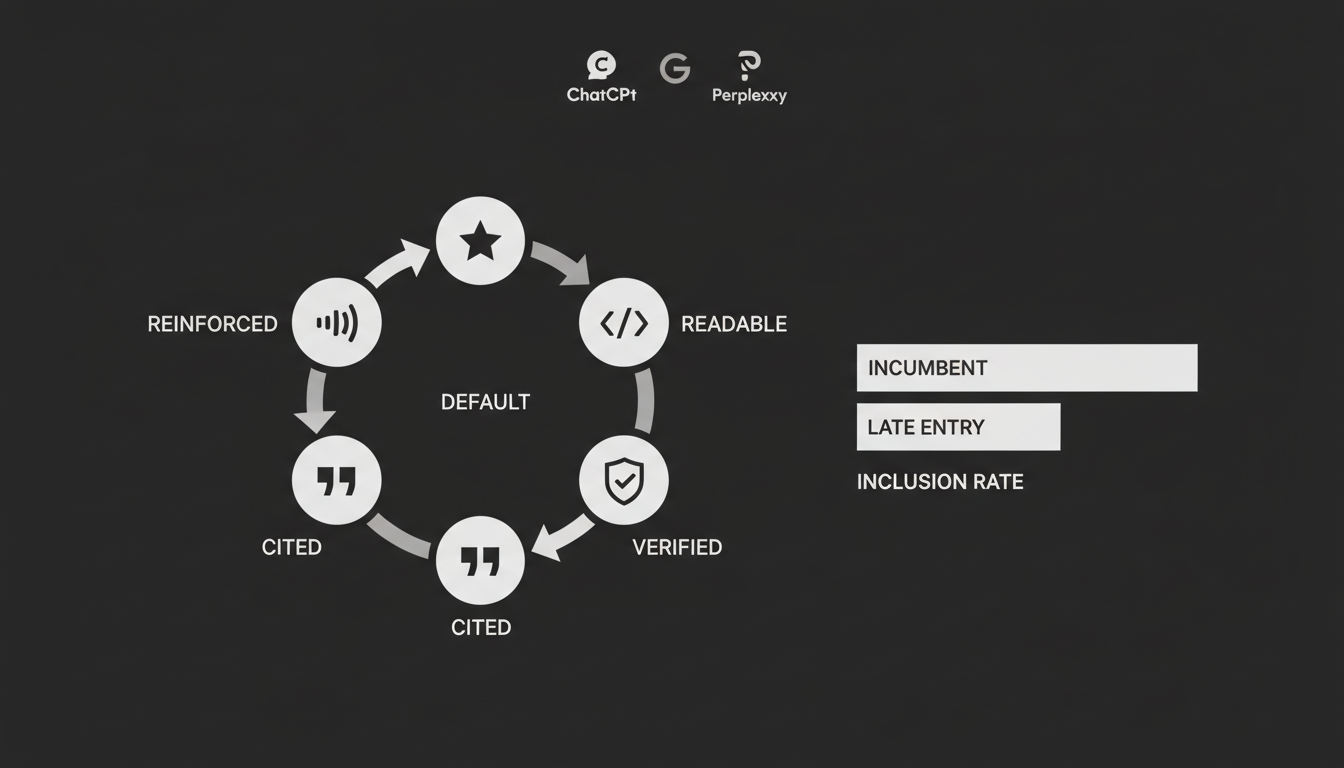
In AI answer engines like ChatGPT, Gemini, and Perplexity, visibility is path-dependent. The brands these models recommend today are statistically more likely to be recommended tomorrow. Not because they're objectively better, but because they've become embedded in the model's reinforced reasoning pathways.
The flip side is equally real. Brands that are invisible today face a compounding penalty. The longer you're absent from the AI's shortlist, the harder and more expensive it becomes to break in.
I've watched this pattern before. In the early days of search, the brands that understood PageRank early built advantages that lasted a decade. The ones that waited paid a premium to catch up, and many never did. This is that moment again, except the compounding effect is faster and the penalty for waiting is steeper.
Why Does AI Visibility Compound Instead of Accumulate?
To understand the flywheel, you need to understand how large language models and answer engines build their picture of reality.
Traditional search engines are indexes. They store pages and retrieve them based on keywords. AI models are reasoning engines. They rely on Knowledge Graphs, which are internal maps of entities (people, companies, products) and the relationships between them.
When someone asks ChatGPT "What's the best CRM for small business?", it doesn't scan the entire internet in real time. It draws from two sources:
Pre-trained knowledge. The patterns and facts baked into its training data.
Retrieval Augmented Generation (RAG). Real-time data pulled from sources the model trusts implicitly. These are what I call Verified Nodes.
Here's where path dependence kicks in.
If your brand establishes itself as a Verified Node early, through consistent entity data and structured schema, the model starts citing you. Every time it cites you in an answer that the user accepts (meaning they don't refine the query or push back), the connection between that user intent and your brand gets reinforced.
The model "learns" that citing your brand leads to a successful outcome. Over time, you move from candidate to default.
This is why incumbents like Salesforce or HubSpot show up in Gemini results with inclusion rates above 60%. It's not just size. It's that they've been verified so many times the model treats them as foundational truths. The rich get richer.
What Are the Five Stages of the Flywheel?
The flywheel has five stages. Each one feeds the next. Skip one and the whole thing stalls.
Stage 1: Machine Readability
The flywheel can't start if the machine can't read your fuel. This is the Answer Engine Optimization phase.
You build Schema markup (Product, Organization, FAQ) and clean up your entity profiles. You stop being unstructured text and become a structured data entity. You go from invisible to readable.
Without this, nothing else matters. The AI literally can't process you as a candidate.
Stage 2: Entity Verification
Once readable, the model needs to verify you. It cross-references your website data with external sources to confirm you're real and consistent.
You align your descriptions across Wikidata, Crunchbase, LinkedIn, and other authoritative sources. The model tags you as a Verified Node. You're now eligible for selection.
Think of it this way: being readable gets you into the building. Being verified gets you past security.
Stage 3: Citation and Inclusion
Now the model starts including you in shortlists and comparison tables. You're a low-risk, high-data citation. Easy for the AI to reference confidently.
You secure mentions in high-trust nodes like G2, TechCrunch, or industry-specific authorities. Your inclusion rate jumps. You move from "mentioned" to "recommended."
Stage 4: User Signal Reinforcement
Users interact with AI answers that feature your brand. They click your citations in Perplexity. They accept the answer in ChatGPT without refining it. Google AI Overviews use these interaction signals to validate the quality of the generated answer.
The system learns that your brand is relevant to specific high-intent prompts. This is where momentum starts to feel automatic.
Stage 5: Probabilistic Preference
This is the final state. Because you're verified, cited, and reinforced, the model assigns a higher probability score to your entity for future queries.
You become the default answer.
Here's the part that should make you uncomfortable: even if a competitor launches a better product, the AI still prefers your brand because it's the safer prediction based on historical data. The moat isn't about product quality. It's about embedded trust in the model's reasoning.
What Happens to Brands That Enter Late?
The most dangerous feature of the flywheel is that it works in reverse. If you're not in the loop, you're paying what I call a Visibility Tax.
The cost of un-learning
If an AI model has spent two years learning that Competitor X is the industry leader for a given category, displacing that "truth" requires significantly more energy than establishing it in the first place. You're not fighting for attention. You're fighting to rewrite the model's probabilistic weights.
This is fundamentally different from traditional SEO. In the old world, you could outrank a competitor by publishing better content and building more links. In the AI world, you're asking the model to unlearn something it believes to be true. That's a much harder problem.
The hallucination barrier
Brands that enter late often suffer from data fragmentation. If you haven't managed your entity profile, the AI might hallucinate that you don't exist, misclassify your product (calling your enterprise tool a "free app"), or confuse you with another entity entirely.
The tax is real: you spend months running visibility campaigns just to reach neutral, while your competitors spend their budget extending their lead.
The authority gap
Models like Gemini display a heavy authority bias. They prioritize brands with deep, historical Knowledge Graph entries. A new brand with better features but zero entity history will lose to a legacy brand nine times out of ten.
The longer you wait to build that history, the wider the gap becomes. Unlike traditional search, where you could sometimes leapfrog with a single viral piece of content, AI models don't have that kind of volatility. They're designed to be stable, which means they're designed to favor incumbents.
How Do You Break Into a Flywheel That's Already Spinning?
If you're currently outside the flywheel, organic growth won't save you. You need intervention points. Specific, high-impact actions that force the flywheel to start turning.
I've seen three that actually work.
Intervention 1: The Technical Jumpstart
Goal: Force the AI to read your data correctly, immediately.
Don't wait for crawlers to figure you out. Deploy FAQ Schema and Product Schema on your core pages now. If you're not sure where to start, Akii's features include tools built specifically for this.
Why it works: Schema provides a shortcut into the model's processing logic. Even if you lack authority, clean structured data makes you an easy candidate for listicle and comparison answers. The AI can extract your specs without effort. You become the path of least resistance for inclusion.
This is the fastest intervention. I've seen brands go from zero AI mentions to appearing in comparison tables within weeks, just by getting their structured data right.
Intervention 2: The Authority Injection
Goal: Borrow trust from nodes the AI already respects.
You need external corroboration. Identify the high-trust nodes in your industry. For SaaS, that's G2. For health, it's Healthline. For finance, it's NerdWallet. Every vertical has its own set.
Then aggressively acquire citations and maintain consistent profile updates on those specific sites.
Why it works: The AI may not trust your website yet, but it trusts G2. By linking your entity to G2, you inject authority into your node. You bypass the need for years of organic history.
This is the equivalent of getting a credible reference when you're new in town. The model doesn't know you, but it knows the people vouching for you.
Intervention 3: The Active Feedback Loop
Goal: Manually stimulate the reinforcement stage.
Use targeted AI visibility activation to systematically educate models like Google AI Search and Perplexity about your brand. This means using geo-targeted queries to prompt the engines to analyze and retrieve your content.
Why it works: It simulates user interest. It forces the model to refresh its cache of your brand data, processing your new Schema and authority signals immediately rather than waiting for a passive update cycle.
Think of it as priming the pump. You're not gaming the system. You're accelerating the natural process by which models discover and validate new entities.
How Do You Know If the Flywheel Is Actually Spinning?
You can't manage a flywheel with a static spreadsheet. You need to measure velocity, not just position.
Four indicators tell you whether you're building momentum or stalling:
Inclusion velocity. Is your inclusion rate increasing week over week? Not just "are you mentioned" but "are you being mentioned more often, in more contexts, over time?" If this number is flat, the flywheel isn't spinning.
Citation quality. Are you moving from uncited mentions to high-authority citations? There's a massive difference between an AI saying "some tools include..." and an AI saying "according to [Your Brand]..." The second one means the model trusts you enough to attribute.
Sentiment trend. Is the AI describing you with increasing confidence? Watch for shifts from "a tool" to "a leading platform" to "the recommended solution." This progression maps directly to your probability score inside the model.
Competitive gap. Are you closing the distance on incumbents, or widening it? Tracking your inclusion rate against two or three direct competitors tells you whether your interventions are working or whether you're falling further behind.
At Akii, we built tracking specifically for these signals because traditional analytics tools don't capture them. You can't see your AI visibility in Google Analytics. You need purpose-built measurement.
What Does This Mean for Budget and Timing?
I'll be direct here, because this is the part most people don't want to hear.
The cost of AI visibility optimization is going up, not down. As more brands wake up to this shift, the competition for Verified Node status intensifies. The intervention points I described above work best when fewer competitors are executing them.
Every quarter you delay, two things happen simultaneously: your competitors' nodes get stronger, and the cost of catching up increases. This isn't speculation. It's the math of compounding systems.
If you're a marketing leader or founder reading this and thinking "we'll get to AI optimization next quarter," I'd push back hard on that. The flywheel doesn't care about your roadmap. It's already spinning for someone in your category. The question is whether it's spinning for you or against you.
The practical starting point is simpler than most people think. Get your structured data right. Align your entity profiles. Start measuring your AI visibility with real tools, not guesswork. Akii's pricing is designed to make the entry point accessible, because the biggest risk isn't spending money on this too early. It's spending money too late.
The Window Is Open, But It Won't Stay Open
I've been through enough technology cycles to know what the early phase of a compounding advantage looks like. It looks like this.
The brands that move now aren't just tuning for a click. They're refining for memory. They're teaching the world's most powerful reasoning systems who they are, so those systems can recommend them at scale, unprompted, thousands of times a day.
That's not a marketing tactic. That's a structural advantage.
Structural advantages, once established, are very hard to undo. That's the whole point of a flywheel. It takes effort to start, but once it's moving, it takes even more effort to stop.
The best time to start was six months ago. The second best time is now. The worst time is after your competitor's node becomes the model's default answer for your category.
Don't let that happen.