
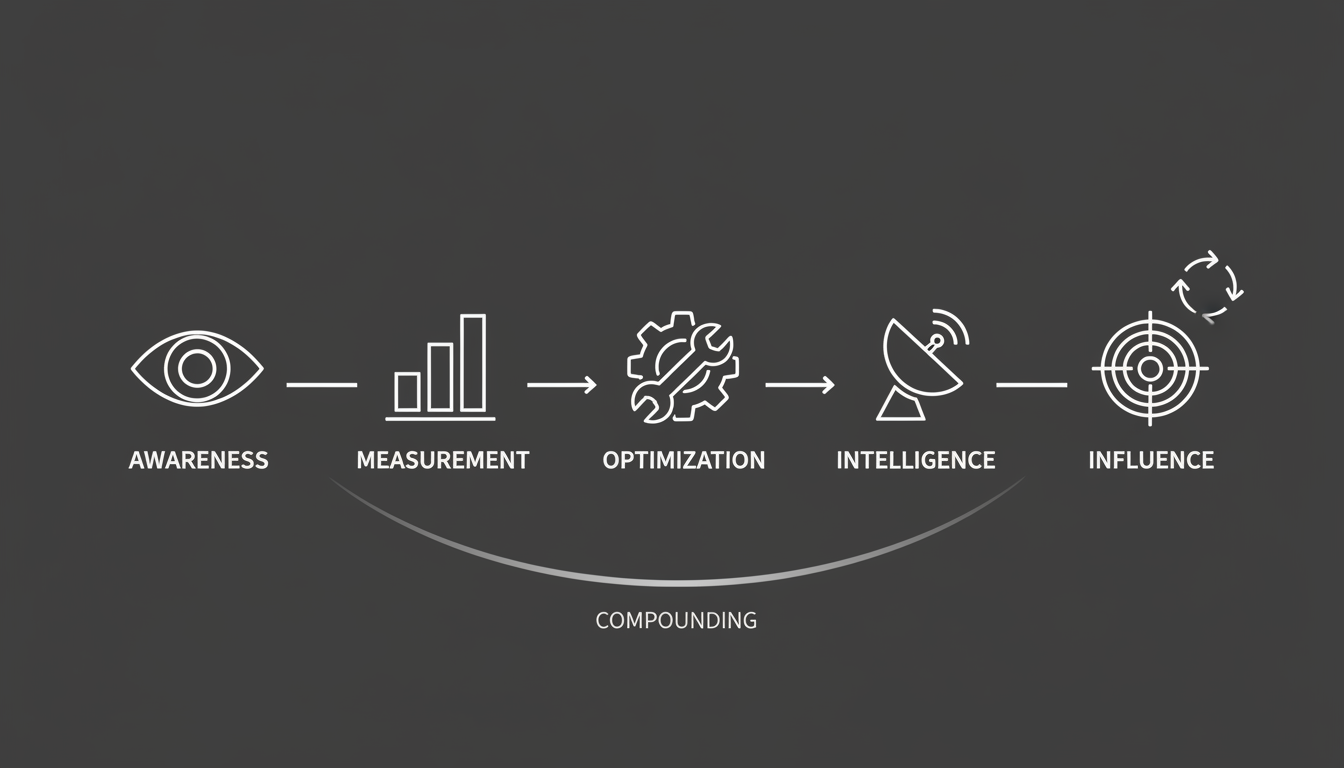
Why AI Visibility Develops in Stages
Most companies treat AI visibility as a single problem to solve. Install a tool, run a report, check the box. That's not how it works.
AI visibility is a capability you build over time. It compounds. Each stage creates the conditions for the next one. Skip a stage and you'll find yourself reacting to problems you can't properly diagnose yet.
I've watched this pattern repeat across every major technology shift I've been part of over the past 25 years. Search engine optimization followed this same arc. Social media marketing did too. First came awareness, then measurement, then strategy, then competitive advantage. The companies that recognized the progression early didn't just adapt faster. They defined the categories.
AI visibility is following the same path right now. Most companies are still at stage one.
How does signal accumulation actually work?
When an AI engine like ChatGPT, Perplexity, or Claude generates an answer, it's pulling from patterns. Those patterns are built from structured data, entity relationships, citation sources, and the overall weight of information connected to your brand.
Every time your brand appears in a credible context, that's a signal. Every time a reliable source references your product in relation to a specific problem, that's another signal. These signals accumulate. Over time, they shape whether AI engines mention you, recommend you, or ignore you entirely.
This isn't a campaign you run for a quarter. It's a position you build over months and years. The earlier you start accumulating the right signals, the harder it becomes for competitors to displace you.
What are reinforcement loops and why do they matter?
Here's what most people miss. AI visibility creates reinforcement loops. When an AI engine starts mentioning your brand in answers, that mention generates downstream effects. People search for you. They visit your site. They write about you. New content gets created. That new content feeds back into the training data and retrieval sources that AI engines use.
The result is a flywheel. The more visible you become in AI answers, the more visible you stay. I wrote about this dynamic in detail in The AI Visibility Flywheel. It's the single most important structural concept in this space.
The flywheel doesn't spin on its own, though. You have to build the foundation first. That's what the maturity model is for.
Stage 1: Awareness
This is where every company starts. You realize that AI engines are answering questions about your market, your category, and your competitors. You start wondering whether your brand shows up at all.
Most companies arrive here after someone on their team asks ChatGPT something like "What's the best [product category] for [use case]?" and notices their company isn't in the answer. That moment of absence is the trigger.
At this stage, the work is simple but important. You're asking the right questions for the first time:
- Are AI engines aware my brand exists?
- When people ask about my category, does my company appear?
- What do AI engines say about me when they do mention me?
- Who are they recommending instead?
You don't need sophisticated tools yet. You need curiosity and honesty. The awareness stage is about accepting that a new channel exists and that you might be invisible in it.
What surprises most people here is how confident AI engines sound when recommending competitors. There's no "we're not sure" or "results may vary." The AI gives a direct answer. If that answer doesn't include you, it feels like a verdict.
It's not a verdict. It's a starting point.
Stage 2: Measurement
Once you know the problem exists, you need to understand its shape. Stage two is about building a consistent, reliable picture of where you stand in AI-generated answers.
This is where most companies stall. They'll do a few manual checks, screenshot some ChatGPT responses, and share them in a Slack channel. That's not measurement. That's anecdote collection.
Real measurement means tracking your presence across prompts, AI engines, and time. It means knowing the difference between a mention and a recommendation. It means understanding which queries matter most to your business and how you perform on those specific queries.
What should you actually be measuring?
I covered this in depth in the AI Visibility Metrics Framework, but here's the short version. You need to track at minimum:
- Mention rate: How often does your brand appear in AI answers for relevant queries?
- Recommendation rate: How often are you positioned as the suggested solution, not just referenced in passing?
- Sentiment accuracy: When AI engines describe you, is the description correct? Favorable? Outdated?
- Competitive share: For the queries that matter most, what percentage of AI answers feature you versus competitors?
- Citation sources: What sources are AI engines pulling from when they talk about your category?
The gap between mention and recommendation is one of the most misunderstood dynamics in this space. Being mentioned is nice. Being recommended is what drives revenue. I wrote about that distinction in From Mentions to Recommendations because it's where so much strategic confusion lives.
At Akii, we built our tracking capabilities specifically to give companies this level of visibility. Not vanity dashboards. Actual signal data they can act on.
Why do manual checks fail at this stage?
Two core reasons, and then a third that compounds both. First, AI answers vary based on context, phrasing, and timing. A single check tells you almost nothing about your actual position. Second, manual checks don't scale. You can't monitor hundreds of relevant prompts across multiple AI engines by hand. And without historical data, you can't spot trends. A snapshot isn't a strategy.
The companies that move past stage two are the ones that commit to systematic, ongoing measurement. They stop treating AI visibility as a curiosity and start treating it as a metric that matters.
Stage 3: Optimization
Now it gets interesting. You have data. You know where you show up, where you don't, and what AI engines are saying about you. Stage three is about closing the gaps.
This is the most tactical stage. It's where you do the actual work of improving your position in AI-generated answers.
What gaps are you actually closing?
The most common gaps fall into a few distinct categories:
Entity gaps. AI engines build understanding through entities and relationships. If your brand isn't clearly connected to the right concepts, categories, and use cases in structured data sources, you're invisible for those queries. Closing entity gaps means ensuring your brand is properly represented in knowledge bases, structured data, and authoritative sources.
Citation gaps. AI engines pull from specific sources when generating answers. If the sources they trust for your category don't mention you, or mention you poorly, that's a citation gap. Closing it means understanding which sources AI engines rely on and making sure your brand has credible, accurate presence in those sources.
Narrative gaps. Sometimes AI engines mention you but get the story wrong. They describe an old product. They associate you with the wrong use case. They position you as a secondary player when you're actually the category leader. Closing narrative gaps means correcting the information system so AI engines have accurate raw material to work with.
Is this just SEO with a new name?
No. I want to be direct about this because I see the confusion everywhere.
SEO is about ranking pages in a list of links. AI visibility is about being included in a synthesized answer. The mechanics are different. In traditional search, you're competing for position on a page. In AI answers, you're competing for inclusion in a narrative. The signals that matter overlap in some areas, like structured data and authoritative content, but the strategy diverges significantly from there.
If you approach AI visibility with a pure SEO mindset, you'll get some things right and miss the most important parts. Entity relationships, citation source mapping, narrative positioning. Those require a different lens entirely.
Stage 4: Intelligence
Stage four is where you shift from reactive optimization to proactive intelligence. You're no longer just fixing gaps. You're reading the field.
At this stage, you're monitoring how AI engines talk about your entire category. You're tracking narrative shifts before they become established positions. You're watching how competitor mentions change over time. You're identifying emerging queries that signal new market opportunities.
What does monitoring narrative shifts look like in practice?
Here's a concrete example. Say AI engines have been recommending your product for "enterprise data security." Over three months, you notice the framing shifting. The AI starts qualifying its recommendation: "for large enterprises with dedicated security teams." A new competitor starts appearing in answers for "data security for mid-market companies."
That's a narrative shift. It's subtle. If you're only checking your own mentions, you might miss it entirely. But it signals that the AI's understanding of the market is segmenting in a way that could shrink your addressable visibility.
Companies at stage four catch these shifts early. They adjust their content strategy, their structured data, their PR efforts. They shape the narrative before it solidifies.
How is this different from traditional competitive intelligence?
Traditional competitive intelligence monitors what competitors do. Stage four AI intelligence monitors what AI engines believe about your market. Those are different things.
A competitor might launch a new feature that gets zero AI visibility for months. Or a small company with strong entity data might start appearing in AI answers ahead of much larger competitors. The AI's model of reality doesn't always match the market's reality. Understanding the gap between those two is where stage four intelligence becomes genuinely useful.
This is the stage where AI visibility stops being a marketing function and starts informing product strategy, positioning decisions, and competitive response.
Stage 5: Market Influence
Stage five is where the flywheel is fully spinning. Your brand consistently appears in AI-generated recommendations for the queries that matter most to your business. You're not just visible. You're the default answer.
Very few companies are here today. That's the opportunity.
What does consistent recommendation dominance actually mean?
It means that when someone asks an AI engine the questions your customers ask before buying, your brand is the one that comes back. Not occasionally. Consistently. Across engines, across phrasings, over time.
The reinforcement loop is working. Your visibility generates attention. That attention generates content and citations. Those citations feed back into AI training and retrieval. Your position strengthens.
Competitors face an increasingly steep climb to displace you. Not impossible, but expensive and slow. The same compounding that works in your favor works against anyone trying to catch up.
Is this actually achievable or is it theoretical?
It's achievable. I've seen the early versions of this play out already. In categories where one brand has significantly better entity data, more credible citations, and clearer positioning, that brand dominates AI answers. It's not random. It's the result of accumulated advantage.
The companies that reach stage five first are the ones building systematically now. Not the ones with the biggest budgets. The ones with the clearest understanding of how AI visibility compounds.
Where Do You Start?
Honestly, most companies reading this are somewhere between stage one and stage two. That's fine. That's where the opportunity is widest.
The mistake is trying to jump to stage four or five without building the measurement and optimization foundation. I've seen companies try to "influence AI narratives" without even knowing what AI engines currently say about them. That's guessing, not strategy.
Here's what I'd recommend:
- Accept that AI visibility is a real channel that affects how your customers discover and evaluate solutions.
- Start measuring systematically. Not screenshots. Structured tracking across prompts, engines, and time.
- Identify your biggest gaps. Entity, citation, or narrative.
- Close them methodically.
- Build the intelligence layer once you have enough data to spot trends.
If you want to see where Akii fits into this progression, take a look at our features and pricing. We built the platform specifically for companies that want to move through these stages with real data instead of guesswork.
The companies that figure this out in 2024 and 2025 will have structural advantages that last for years. Not because they got lucky. Because they recognized the pattern early and built the capability while everyone else was still debating whether AI visibility matters.
It matters. The only question is which stage you're at and how fast you're willing to move.