
Akii.com logo
  • AI Search Visibility
  • Packages
  • About
  • Contact
LoginGet AI Visibility ScoreBook an AI Search Audit
AI Visibility for Agencies: How to Win Clients Through AI Search

AI Visibility for Agencies: How to Win Clients Through AI Search

Josef Holm
May 21, 2026
7 min read

Key Takeaways

  • AI models build agency recommendations from external signals: third-party mentions, reviews, and citations in context, not your own website copy.
  • Positioning clarity is the biggest factor most agencies get wrong; broad 'full-service' messaging gets ignored while specific category ownership gets recommended.
  • Citation patterns across credible sources matter more than backlinks; if only your own site mentions your agency, AI models treat you as invisible.
  • AI visibility data can be used directly in sales pitches as proof of independent, third-party authority that no testimonial can replicate.
  • Early movers have a compounding advantage; consistent positioning and accumulated authority build a flywheel that is hard for late movers to catch.

How AI Recommends Service Providers

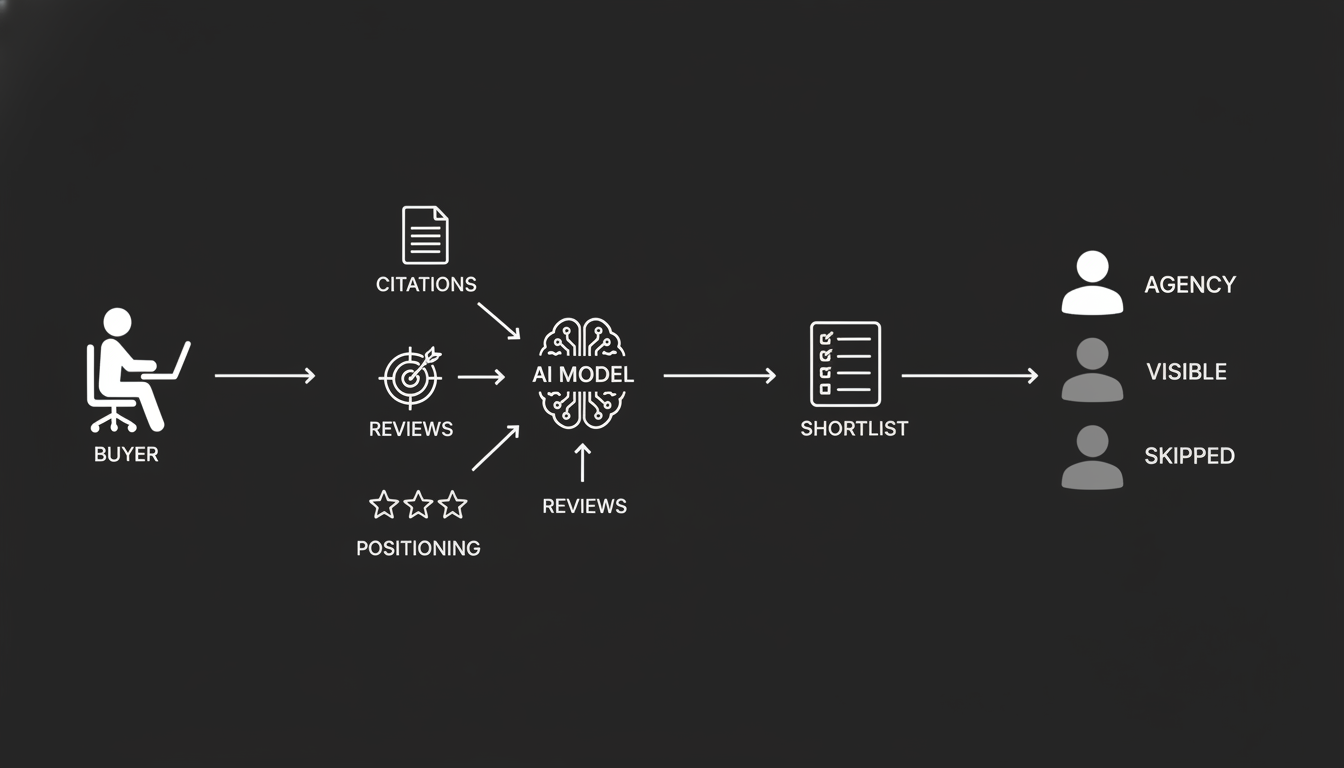
When someone asks ChatGPT, Perplexity, or Claude to recommend a marketing agency, no ad auction runs in the background. No bid price determines who shows up. The AI synthesizes what it knows about the category and returns a short list of names it considers credible.

That's a completely different selection process than what agencies have spent the last decade building for.

So what makes an AI engine trust one agency over another?

It comes down to a few things. Trust signals like consistent client results, published case studies, and third-party recognition. Authority indicators like original content, founder visibility, and clear specialization. And presence across the sources these models actually train on and reference, which is not the same as ranking on page one of Google.

If your agency shows up when a prospect asks an AI "who's the best B2B content agency in Austin," you didn't pay for that placement. You earned it through accumulated credibility. Most agency owners haven't fully absorbed what that distinction means yet.

Why Agencies Are Highly Affected by AI Search

Think about how people actually find agencies today. Not the way it worked five years ago. The way it's starting to work right now.

A VP of Marketing doesn't want to scroll through 47 results. They want a short answer. "Who are the top agencies for SaaS demand gen?" or "Which agencies specialize in Shopify Plus migrations?" People are already typing these prompts into AI tools.

Service discovery is shifting from search results to AI answers. Agencies sit right in the crosshairs of that shift.

Why agencies more than most businesses?

The buying process is prompt-shaped. Agency selection has always been about trust and fit. AI answers compress that evaluation into a single response. If you're not in the answer, you're not in the consideration set.

Local and niche queries hit agencies hard. When someone asks "best PR agency in Chicago for healthcare startups," the AI returns maybe three to five names. You're either mentioned or you're invisible. There's no gradual middle ground.

Referrals are going digital. The old model: ask your network, get a few names, take meetings. The new model: ask an AI, get a few names, take meetings. The mechanics are nearly identical. The input source changed.

I've watched this pattern repeat across multiple technology shifts over 25 years. The businesses that recognize a new distribution channel early don't just survive the transition. They use it to leapfrog competitors who are still building for the old one.

Key Signals That Drive Agency Recommendations

What actually determines whether an AI recommends your agency? It's not a mystery, but it requires a different mental model than traditional SEO.

Reputation across multiple sources. AI models don't just look at your website. They pull from reviews, directories, media mentions, podcast appearances, industry publications, and community discussions. If your agency's name shows up consistently across credible sources with positive context, the models notice. If you only exist on your own domain, you're easy to miss.

Citations that carry weight. Not all mentions are equal. A feature in a respected industry publication matters more than a guest post on a no-name blog. A detailed case study on a recognized platform matters more than a generic testimonial. The models are pattern-matching for quality signals, not just volume.

Clear positioning. This is where most agencies fail. If your website says you do "branding, web design, SEO, paid media, social, content, email, and strategy," what does an AI conclude? That you're generic. AI models are trying to match specific queries to specific expertise. The more clearly you define what you do and for whom, the more likely you are to surface for the right prompts.

Does your agency have a clear, specific answer to "what are you best at and for whom?" If that answer takes more than one sentence, you have a positioning problem. And that problem now directly affects whether AI recommends you.

How Agencies Can Improve Their AI Visibility

This isn't about gaming a system. It's about doing the things that make your agency genuinely easier for AI to understand and recommend.

Get specific about your category

If you're a performance marketing agency for DTC brands, say that everywhere. On your homepage. In your LinkedIn summary. In your directory listings. In your podcast bios. Category clarity isn't just good branding. It's how AI models categorize you.

The agencies that win in AI search are the ones that own a specific category so clearly the models can't ignore them.

Build niche authority through content

Publish original thinking in your area of expertise. Not recycled advice. Not "5 tips for better Facebook ads." Actual perspective on how your category is changing, what you're seeing in client work, and what most people in your space are getting wrong.

AI models learn from content that demonstrates depth. A single well-researched piece about a specific problem in your niche is worth more than twenty generic blog posts. That's not a content strategy opinion. That's how these systems work.

Fix your presence across AI training sources

Where do AI models actually pull information from? Industry publications. Reddit threads. Quora answers. Podcast transcripts. YouTube descriptions. Review platforms like Clutch and G2.

Most agencies have gaps across these sources. Some have no presence at all outside their own website and social profiles. That's a fixable problem, but first you need to know where you stand.

Akii built an AI search tracking system specifically to help businesses understand how they appear across AI engines. For agencies, that kind of visibility data is becoming a core part of competitive intelligence.

Make your results visible and specific

"We helped a client increase revenue by 300%" means nothing without context. AI models respond to specificity. Name the industry. Describe the challenge. Explain the approach. Publish it where it can be found.

The more concrete evidence of your work that exists across the web, the stronger your signal.

Turning AI Visibility Into a Sales Advantage

Here's where this gets interesting for agencies. AI visibility isn't just about getting found. It's a sales tool.

Use AI answers in your pitches

Imagine walking into a prospect meeting and showing them: "When someone asks ChatGPT who the best agency is for your category, here's what comes back." And your name is in the answer.

That's not a vanity metric. That's proof of market position. It's the digital equivalent of a warm referral from a trusted source, except the trusted source is the tool your prospect uses every day.

Agencies that can demonstrate their AI visibility in pitches are closing faster. They're showing something prospects haven't seen before. It's concrete, it's verifiable, and it's hard to fake.

Track your AI visibility like you track other channels

Most agencies obsess over Google rankings, social following, and email open rates. Almost none are tracking how they appear in AI-generated answers. That's a blind spot that compounds over time.

You can use Akii's AI visibility tracking tools to monitor how your agency shows up across different AI platforms, for different queries, over time. That data becomes part of your competitive positioning.

If you're not sure where your agency stands on the AI visibility maturity curve, that's the first thing to figure out. You can't improve what you're not measuring.

Offer AI visibility as a service

This is the bigger play. If you understand how AI visibility works for your own agency, you can offer that same insight to clients. Most businesses have no idea how they appear in AI answers. The agency that can show them, and help them improve, has a real advantage.

It's a new service line built on a real shift in how people find and evaluate businesses. Not a trend. Not a gimmick. A structural change in discovery.

The Window Is Open, But It Won't Stay Open Forever

Right now, most agencies aren't thinking about AI visibility at all. They're still focused entirely on Google rankings, paid ads, and social content. Those channels still matter. But a new one is forming, and it rewards a different set of signals.

The agencies that move early will build a compounding advantage. Their names get embedded in AI training data. Their content gets referenced in AI answers. Their reputation signals grow stronger while competitors wait.

I've seen this exact dynamic play out with SEO in the early 2000s, with social media in the late 2000s, and with content marketing in the 2010s. The early movers didn't just get a head start. They set the terms for everyone who came after.

AI visibility is the same kind of opportunity. The window for establishing yourself is shorter because AI models learn and solidify their knowledge faster than search engines ever did. That's not a reason to hesitate. It's a reason to move.

Start by understanding where you stand. Check how AI engines describe your category and whether your name comes up. Look at the metrics that actually matter for AI visibility. Then build a plan to improve your signals across the sources that AI models actually use.

The agencies that figure this out first won't just get more inbound leads. They'll close them faster, charge more confidently, and build a position that's genuinely hard to replicate. That's not hype. That's just how distribution advantages work.


Frequently Asked Questions

How does ChatGPT decide which agencies to recommend?

It looks for coherence across external sources: client reviews on third-party platforms, mentions in industry publications, and citation patterns that consistently associate your agency with a specific capability. It does not check who ranks on Google or who is running ads.

What can an agency do right now to show up in AI search results?

Pick a specific category you want to own, then make sure every external signal reinforces it. That means directory listings, guest posts, case studies, team bios, and social profiles all saying the same clear thing about what you do and who you serve.

Is AI visibility different from SEO?

Yes. Backlinks help with Google. For AI recommendations, what matters is citations in context: multiple credible sources mentioning your agency in connection with a specific capability. The mechanics are different, so your SEO efforts alone will not get you there.

How do I know if AI models are already mentioning my agency?

Most agencies have no idea. Tools like Akii's AI Search Tracker let you monitor which queries surface your agency name and which do not, so you are not operating blind.

Can I use AI recommendation data to win more clients?

Yes, and it is one of the strongest proof points you can put in a pitch. Screenshot the AI-generated answers that mention your agency and include them in proposals. It shows prospects that an independent system already identifies you as a leader in your category.

How long does it take to build AI visibility for an agency?

It takes time because it depends on accumulated authority across many sources. There is no shortcut. That is exactly why moving early matters; agencies building this now will be the default recommendations in 12 to 18 months, while those waiting will be catching up.

Share this article

TwitterLinkedInFacebookEmail

Share this link:

https://akii.com/blog/ai-visibility-for-agencies

Need Help?

Our AI optimization experts are here to help you succeed

Contact Support

Was this page helpful?

Stay Updated

Subscribe to our newsletter for the latest AI visibility strategies, product updates, and industry insights.

Akii.com logo

Akii Managed AI Search Visibility helps UAE companies find where AI answers recommend competitors instead of them, then fix the website, content, technical, source, and trust gaps behind that loss. Founder-led by Josef Holm and built in Dubai.

Managed AI Search Visibility
  • Overview
  • Packages
  • Book an AI Search Audit
  • AI Visibility Score
Customers
  • Chrome Extension
  • Claude Code Plugin
  • API Docs
  • llms.txt
Models
  • ChatGPT
  • Google AI
  • Claude
  • Gemini
  • Perplexity
  • Copilot
Resources
  • AI Search Visibility
  • AI Visibility Index
  • FAQ
  • Blog
  • Glossary
Company
  • About Us
  • Affiliate Program
  • Press Kit
  • Contact

© 2026 Akii Technologies, LTD. All rights reserved.

TermsPrivacyCookies