
The Old Yardstick Is Broken
For twenty years, digital maturity was simple to measure. Rank #1 on Google for your category keywords and you were doing well. Sit on page two and you had work to do.
That yardstick doesn't work anymore.
We've moved from ten blue links to synthesized answers. When a potential customer asks ChatGPT, Gemini, or Perplexity for a recommendation, the AI doesn't hand them a list of websites. It acts as a gatekeeper, synthesizing reviews, comparing pricing, and delivering a curated shortlist. In that world, "ranking" is the wrong concept entirely. The new currency is inclusion.
Here's what most people miss. Inclusion in AI answers isn't a binary switch you flip. It's a spectrum. Many brands exist in a dangerous middle ground: visible enough to be mentioned, misrepresented enough to lose the sale.
I've watched companies celebrate getting named by ChatGPT only to discover the AI was quoting outdated pricing or describing features they'd deprecated two years ago. That's worse than being invisible. That's active damage.
What follows is what I'm calling the AI Visibility Maturity Model. It's a framework for diagnosing exactly where your brand sits in the knowledge graph of modern AI, and the specific steps required to move up.
Why Is This a Maturity Problem and Not a Tactic?
The fundamental mistake most marketing teams make is treating AI visibility like traditional SEO hacks. Stuff keywords. Manipulate text. Trick the system.
This fails for a straightforward reason. AI models are not search engines. They're reasoning engines. They don't index pages based on keyword density. They build knowledge graphs based on entities, people, places, products, and the relationships between them.
If an AI model excludes your brand, it isn't because you missed a meta tag. It's usually one of three things:
Data Gaps. The model can't find structured facts about your pricing or features.
Inconsistency. Your brand description varies across the web, so the model loses confidence in what's true.
Risk Aversion. You lack the external authority the model needs before it feels safe recommending you.
I've seen this pattern across every technology cycle I've worked through. The companies that win aren't the ones who find a clever shortcut. They're the ones who build the right foundation and layer on sophistication over time.
AI visibility works the same way. You have to evolve from simply having a website to becoming what I'd call a Verified Node: an entity that is machine-readable, consistent, and authoritative across the entire digital web. That's a maturity journey. Not a campaign.
What Are the Five Levels of AI Readiness?
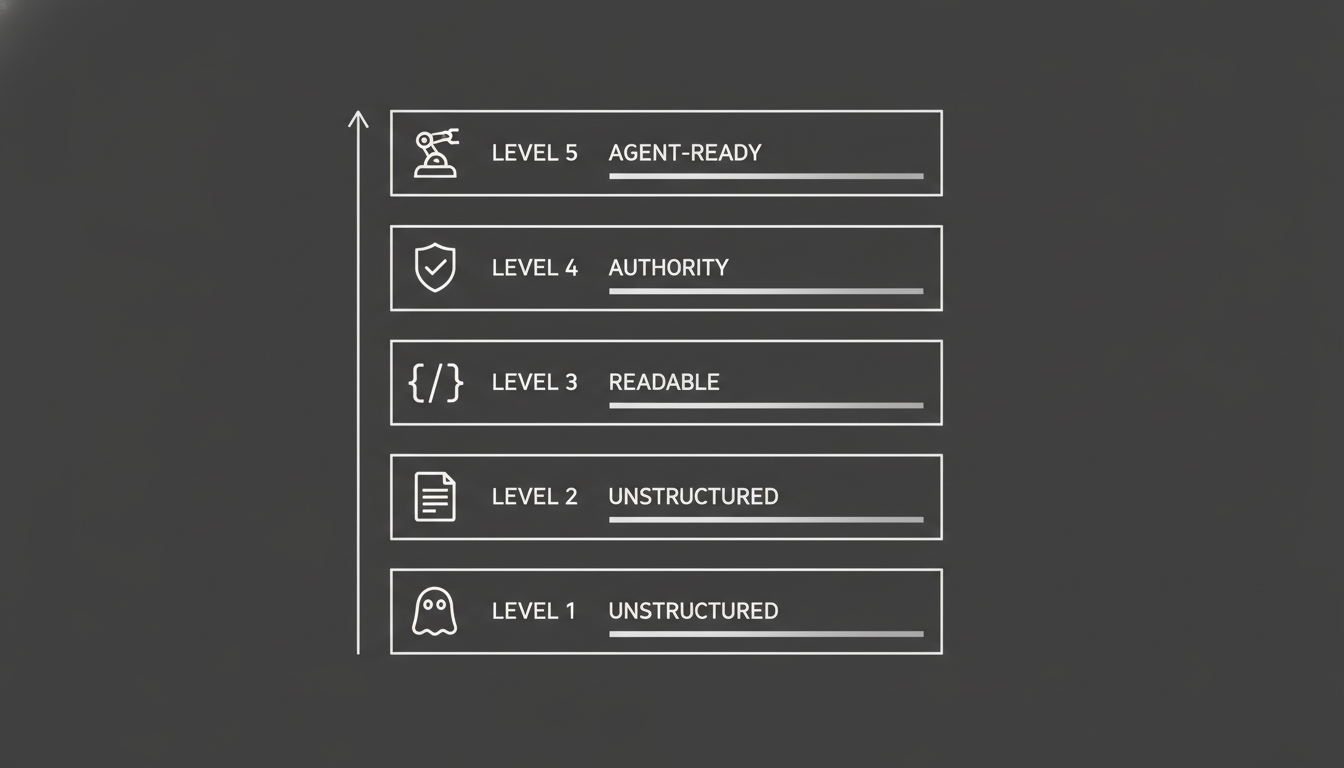
Based on data from the Akii AI Visibility Index, brands generally fall into five distinct levels. Understanding where you stand is the first step to fixing anything.
Level 1: The Invisible Brand
At this level, AI models simply don't know who you are. When a user asks about your brand, the AI might say "I don't have information on that," or worse, it might hallucinate. Make something up entirely.
How AI sees you: It doesn't. You're not a node in the knowledge graph.
The risk: Total exclusion from the consideration set. Even if you rank #1 on Google, users querying ChatGPT will never see your name. You're winning a game that fewer people are playing each quarter.
What's missing: A consistent Master Entity Profile. Your presence is fragmented, with different descriptions on LinkedIn, your website, and third-party directories. The AI has no single source of truth, so it trusts nothing.
Level 2: The Unstructured Participant
The AI knows you exist. It can answer "What is [Brand Name]?" but it fails on specific questions like "How much does it cost?" or "Does it integrate with Salesforce?"
How AI sees you: A string of text rather than a structured entity. The model has read your homepage but can't parse your pricing or specific features because they're trapped in unstructured paragraphs and marketing copy.
The risk: Technical obsolescence. You appear in broad searches but get filtered out of high-intent queries like "Best CRM under $50." The AI defaults to competitors with better structured data. You lose the deals that matter most.
What's missing: Schema.org markup. You lack the code that translates your content into the language AI crawlers actually understand.
Level 3: The Machine-Readable Brand
You've achieved Answer Engine Optimization. Your content is structured with schema: Product, FAQ, Offer. When a user asks about your features, the AI quotes your site directly.
How AI sees you: A trusted data source. You have what I call Quotable Canonicals: concise, declarative summaries the AI can easily lift and present.
The risk: You're accurate but not necessarily recommended. You might be listed as an "alternative" rather than a "leader" because you lack external authority. Accuracy without advocacy.
What's missing: Generative Engine Optimization. You need external citations to validate your claims. What you say about yourself isn't enough.
Level 4: The Corroborated Authority
You've achieved GEO. Your claims aren't just on your website. They're corroborated by high-trust sources like G2, Crunchbase, TechCrunch, and Wikidata.
How AI sees you: A Verified Node with strong trust signals. The AI feels safe citing you because third-party sources confirm your expertise.
The status: You consistently appear in "Best of" lists and comparative tables. When someone asks "Brand A vs. Brand B," you're Brand A.
What's missing: Granular, real-time data for autonomous agents. You're winning today's game but not yet ready for tomorrow's.
Level 5: The Agent-Ready Brand
This is the future state. Your brand is prepared for autonomous agents that perform tasks: booking, buying, negotiating. Your pricing, stock status, and API availability are exposed via structured feeds and advanced schema.
How AI sees you: A functional tool it can use to solve a user's problem. Not just a recommendation. A capability.
The status: The AI doesn't just recommend you. It executes transactions with you.
Most brands I talk to are somewhere between Level 1 and Level 3. Very few have reached Level 4. Almost none are at Level 5. That's not a criticism. It's an honest read of how early we are in this shift.
How Do You Score Yourself Right Now?
Don't guess. Test. Here's a practical checklist you can run through in about fifteen minutes.
Level 1 Check
- Does ChatGPT know who you are? (Prompt: "What is [Brand Name]?")
- Is your brand description identical on your website, LinkedIn, and Crunchbase?
If the answer to either is no, you're at Level 1. Start there.
Level 2 Check
- Can Gemini or ChatGPT accurately quote your pricing? (Prompt: "How much does [Brand Name] cost?")
- Can the AI list your top integrations accurately?
If the AI knows you exist but gets the details wrong, you're at Level 2.
Level 3 Check
- Have you implemented FAQ Schema on your core pages?
- Do you have "TL;DR" summaries at the top of your blog posts and key pages?
- Do you have an /llms/ directory or llms.txt file?
If you've done the technical work but aren't getting recommended, you're at Level 3.
Level 4 Check
- Are you cited in responses to "Best [Category] tools" prompts?
- Does the AI reference third-party sources when recommending you?
If yes, you've reached corroborated authority. Now the question is whether you can maintain it.
Level 5 Check
- Is your SKU-level data accessible to the AI via schema?
- Can an autonomous agent complete a transaction with your brand without human intervention?
If you're here, you're ahead of 99% of the market. The work becomes about staying ahead.
What Does It Actually Take to Move Up One Level?
This is where most frameworks fall apart. They diagnose well but prescribe vaguely. I want to be specific.
From Level 1 to Level 2: Unify Your Entity
The goal: Stop hallucinations and ensure the AI recognizes your brand as a real, coherent entity.
The action: Create a Master Entity Profile. Write one unified description and one taxonomy for your brand. Then replicate this exact text across your website "About" page, your LinkedIn Company Page, your Crunchbase profile, and Wikidata.
Exact. Not "similar." Not "on-brand." Identical.
Why it works: AI models penalize inconsistency. When your descriptions match perfectly across trusted sources, the model assigns a higher confidence score to your entity. You move from "unknown" to "known." This is the single highest-ROI action a Level 1 brand can take, and it costs nothing but discipline.
From Level 2 to Level 3: Build Technical AEO
The goal: Make your data extractable so you stop missing out on specific, high-intent queries.
The actions:
Deploy Schema.org markup across your site:
- Use Organization Schema to define your logo, social profiles, and contact info
- Use Product and Offer Schema to explicitly tag your pricing, currency, and stock status
- Use FAQ Schema on your features pages to provide question-and-answer pairs the AI can ingest
Rewrite key sections with Quotable Canonicals. Start your high-traffic pages with a direct definition. Use question-based headings like "How much does X cost?" immediately followed by the answer.
Why it works: AI crawlers don't read like humans. They extract data. Schema provides the labels that tell the AI "this number is a price" or "this text is an answer to this specific question." Without those labels, your content is just noise.
This is the kind of technical foundation that Akii's features are designed to help you build and verify.
From Level 3 to Level 4: Build External Authority
The goal: Move from being "listed" to being "recommended" by building trust outside your own domain.
The actions:
Secure external corroboration. Focus your PR and content efforts on what I call High-Trust Nodes. A mention in a Gartner report, a detailed review on G2, or a profile in a major industry publication gives the AI the ground truth it needs to verify your claims.
Audit your review velocity too. AI models use sentiment analysis to gauge whether a brand is current and trusted. Stale reviews signal a stale brand.
Why it works: Generative engines are risk-averse. They prefer to cite what others say about you rather than what you say about yourself. This isn't a bug. It's a feature of how these systems manage reliability. External citations validate your internal schema. Without them, you're a well-organized brand that nobody else vouches for.
From Level 4 to Level 5: Prepare for Agents
The goal: Be ready for the autonomous economy that's coming faster than most people expect.
The actions:
Ensure every product variant has its own unique URL and schema definition. SKU-level clarity matters because agents need to make purchasing decisions, not just browsing decisions. Create an llms.txt file that gives AI agents a roadmap to your most critical documentation and API specs.
I'll be honest: most brands don't need to worry about Level 5 today. But the companies that start preparing now will have a structural advantage when autonomous purchasing becomes mainstream. Based on the trajectory I'm seeing, that's closer than the market thinks.
How Do Tools and Processes Map to Each Level?
You can't manage this maturity journey with spreadsheets and manual ChatGPT prompts. As you move up the ladder, your tool stack has to evolve.
Phase 1: Diagnosis (Levels 1 and 2)
At the start, you simply need to know if you're visible and if your data is accurate.
Run a baseline scan to check your brand recognition and brand understanding. This tells you immediately whether you're suffering from hallucinations or shallow data. You can start with Akii's free AI Visibility Score to get that baseline.
Don't skip this step. I've seen teams spend months on technical implementation only to discover they were solving the wrong problem. Diagnosis first. Always.
Phase 2: Technical Foundation (Levels 2 and 3)
Once you identify the gaps, fix the infrastructure.
Use automated analysis to audit your pages and generate the Schema.org markup and AI-friendly robots.txt files you need to become machine-readable. This is the fastest path from Level 2 to Level 3.
Phase 3: Authority and Defense (Levels 3 and 4)
Now that you're readable, you need to win the competitive battle for recommendations.
Identify the hidden competitors the AI loves. These aren't always the brands you think of as competitors. Sometimes a niche blog or a smaller player with better structured data is eating your share of AI recommendations. Reverse-engineer their citation patterns to see which external sources are powering their visibility, then replicate that strategy.
Phase 4: Active Management (Levels 4 and 5)
Maintaining dominance requires constant monitoring and active education of the models.
Set up ongoing surveillance to catch sentiment drops or new hallucinations immediately. Systematically educate models like Perplexity and Google AI Search about your new content. Your Verified Node status doesn't stay fresh on its own. It requires active maintenance.
This is where the work shifts from project-based to operational. Most brands currently have a gap here. They treat AI visibility as a one-time fix rather than an ongoing discipline. If you're evaluating tools for this phase, Akii's pricing page breaks down what's available at each tier.
Where Does This Leave You?
The shift to AI search isn't a temporary trend. It's a structural change in how the web works. In 2010, you won by having the most backlinks. In 2026, you win by being the most machine-readable, consistent, and authoritative entity in the knowledge graph.
I've watched enough technology transitions to know that the window for building advantage is always shorter than people assume. The companies that moved early on mobile, on cloud, on SaaS platforms didn't just get a head start. They got compounding returns that late movers could never fully close.
This follows the same pattern.
Your brand is somewhere on this maturity curve right now. You can find more thinking on this shift across the Akii blog. But reading isn't the hard part. The hard part is being honest about where you actually stand, not where you wish you stood, and then doing the work to move up.
One level at a time. Starting today.