
Why AI Visibility Is Naturally Unstable
Most people treat AI visibility like a destination. Get mentioned by ChatGPT or Perplexity once, and you're done.
That's not how it works.
AI visibility is a dynamic system. Not a static position you earn and hold. Three forces are constantly working against you, and they don't take breaks.
Model updates. Every time an AI model retrains or refreshes its weights, your position can shift. Not because you did anything wrong. The entire information environment the model draws from has changed. What was true about your brand's representation last month may not hold after the next update cycle.
Source drift. The content AI models reference isn't fixed. New articles get published. Old ones lose authority. Competitors publish better material. The sources that once reinforced your brand get diluted or replaced by fresher content. Your visibility erodes not because you failed, but because the ground moved.
Competitor reinforcement. While you're standing still, competitors are actively strengthening their signals. Publishing. Getting cited. Earning mentions in the exact contexts where AI models form their answers. Every time a competitor gets reinforced, your relative position weakens.
Here's what most people miss: these forces operate simultaneously and without pause. There's no grace period after you "win" a mention. No plateau where you get to rest.So why do most companies still treat AI visibility like a one-time project?
The Failure of Linear Optimization
People bring their SEO-era thinking to a fundamentally different problem. That's where things go wrong.
In traditional search, you could fix a page, build some links, and hold a ranking for months. The system was relatively stable. Updates happened quarterly. You had time to react.
That mental model is broken for AI visibility.
The "fix once" approach goes something like this: discover you're not being mentioned, create some content, maybe update your structured data, see an improvement, move on. Six weeks later, the improvement has decayed. You're back where you started, or worse.
Why? Linear optimization assumes a stable environment. It assumes your fix will persist, that the system won't change around your intervention. None of those assumptions hold in AI-generated answers. The models update. The sources shift. Competitors keep pushing.
I've watched companies go through this cycle three or four times before they realize the approach itself is the problem. Their tactics aren't necessarily wrong. Their operating model doesn't match the system they're trying to influence.
The shift isn't tactical. It's structural. You need a loop, not a line.
The Control Loop Model
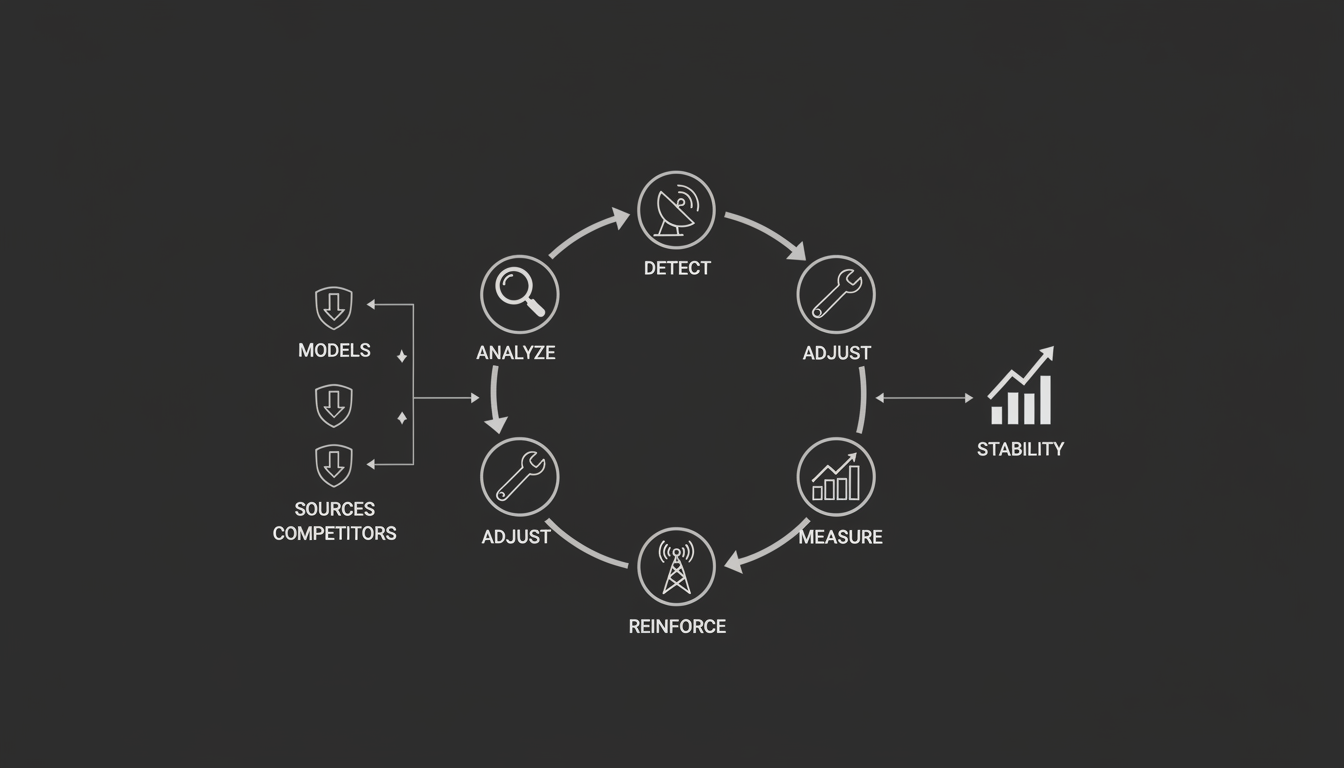
The brands that maintain consistent AI visibility aren't doing anything magical. They're running a closed-loop system.
Detect what's happening. Where are you being mentioned? Where are you absent? What prompts surface your brand, and which ones surface competitors? This baseline needs to be continuous, not periodic.
Analyze what's driving the results. Why did a mention appear or disappear? Which sources are being referenced? What entity associations is the model making? This is where you move from data to understanding.
Adjust your signals based on what you learned. Update content. Strengthen entity associations. Publish in contexts that reinforce the positioning you want. This intervention step only works when it's informed by real data, not guesswork.
Reinforce the changes through repetition and consistency. A single adjustment isn't enough. You need sustained signal strength across multiple sources and contexts until the model sees your brand consistently associated with the right topics and use cases.
Re-measure to confirm the adjustment worked and to establish your new baseline. Then the loop starts again.
Detect. Analyze. Adjust. Reinforce. Re-measure.
Not complicated in concept. But it requires a fundamentally different operating rhythm than most marketing teams are built for. It's not a campaign. It's a system.
The difference between brands that stay visible and brands that fluctuate? The ones that stay visible are running this loop continuously. The ones that fluctuate run it once, declare victory, and wonder why things degraded.
Does your team have the infrastructure to run this loop, or are you still operating in campaign mode?
Where the Loop Breaks in Most Companies
I've seen this pattern enough times to name the failure points clearly.
No monitoring baseline. You can't run a control loop if you don't know where you stand. Most companies have no systematic way to track how AI models represent their brand across different prompts, contexts, and engines. They check manually once in a while. Anecdotal reports. No real baseline.
Without a baseline, you can't detect drift. Without detecting drift, you can't respond. The loop never starts.
If you're looking to establish that baseline, the Akii AI Search Tracker is built specifically for this. It tracks how AI engines mention your brand in real answers across prompts and over time.
No prioritization logic. Even when companies detect changes, they don't know which ones matter. Not every mention drop is big. Not every competitor gain requires a response. Without a framework for deciding what to fix first, teams either chase everything and finish nothing, or freeze and fix nothing.
The analysis step requires judgment. Which signals are decaying fastest? Which contexts matter most to revenue? Which competitor gains are structural versus temporary? Most teams don't have this logic built into their process.
I wrote about building this kind of signal-to-action system in From Monitoring to Action. It covers how to turn raw monitoring data into prioritized decisions.
No reinforcement mechanism. This is the most common failure. A team makes an adjustment, sees a short-term improvement, and stops. They don't reinforce. They don't sustain the signal. They don't build the repetition that models need to solidify an association.
Reinforcement isn't glamorous. It's consistent publishing. Maintaining entity associations across multiple sources. Showing up in the same contexts repeatedly until the model treats your presence as a given, not an anomaly.
Without reinforcement, every gain is temporary. The loop breaks at the most critical step.
How High-Performing Brands Close the Loop
The companies that maintain stable AI visibility share certain practices. None of them are secret. All of them require discipline.
Continuous prompt testing. They don't check their AI visibility quarterly. They test regularly across a range of prompts that represent real buying contexts. They know exactly which questions surface their brand and which don't. When a model stops mentioning them in a context where they were previously strong, they catch it early, before it becomes a problem.
This isn't vanity monitoring. It's an early warning system.
Entity reinforcement cycles. High-performing brands treat entity associations as something they actively maintain, not something they build once. They publish content that reinforces the connections they want models to make. Each reinforcement cycle makes the next one stronger. Over time, the model's association between your brand and your key contexts becomes harder to displace. I've written more about how this compounds in The AI Visibility Flywheel.
External signal strengthening. They don't rely solely on their own content. They actively work to appear in third-party sources that AI models reference. Industry publications. Expert roundups. Comparison content. Review sites. Anywhere the model might look when forming an answer about their category.
This is where most companies underinvest. They control their own site, their own blog, their own structured data. But they neglect the external signals that models weigh heavily. The brands that stay visible are playing both sides: owned content and earned presence.
What This Means in Practice
The control loop isn't a framework to admire. It's a system to run.
If you're a marketing leader reading this, the question isn't whether this model makes sense. It probably does. The question is whether your team is structured to execute it.
Most marketing teams are built for campaigns. Plan, execute, measure, move on. The control loop requires a different cadence. It's always running. There's no "done" state. Only the current cycle and the next one.
That's an operational shift, not just a strategic one.
Here's what I'd recommend if you're starting from zero.
First, establish your baseline. Know where you stand across the prompts that matter to your business. Not vanity prompts. The ones that represent real buying intent in your category.
Second, identify your biggest gaps. Where are competitors showing up and you're not? Where have you lost ground recently? Pick the top two contexts to address first and go deep rather than spreading thin.
Third, build the reinforcement habit. Don't just fix things once. Build a recurring process for strengthening your signals in those contexts. Monthly at minimum.
Fourth, re-measure and adjust. Close the loop. Confirm your interventions worked. Identify the next set of priorities.
If you want to see how Akii supports this kind of continuous visibility work, our features page breaks down what we've built and why.
The Stability Question
Visibility stability doesn't come from a single brilliant move. It comes from running the loop faster and more consistently than your competitors.
That's the real competitive advantage here. Not who has the best single piece of content. Not who got lucky with one model update. Who has the system in place to detect changes early, respond quickly, reinforce consistently, and measure continuously.
The brands that figure this out first will be the ones that stay visible as AI answers become the primary way people discover solutions. The ones that keep treating it like a campaign will keep wondering why their results fluctuate.
It's a systems problem. Build the system.