
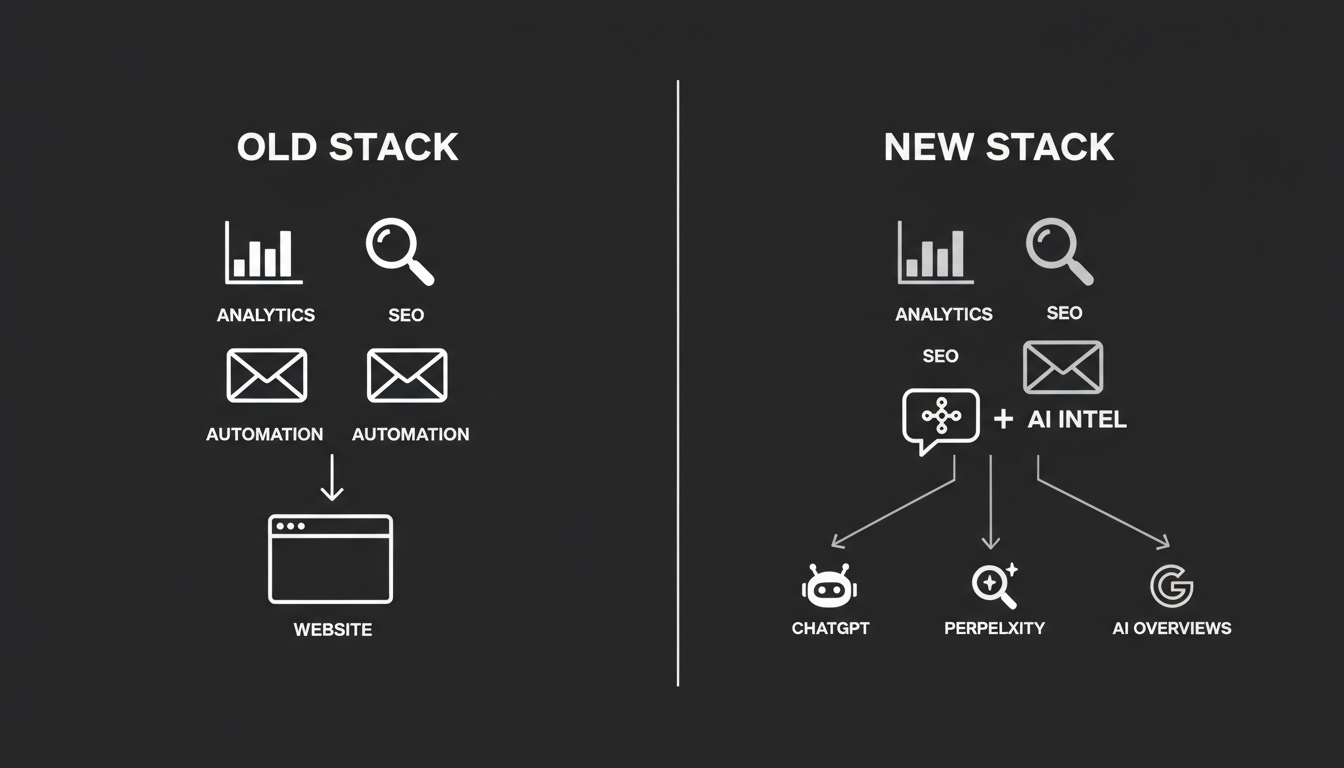
How Martech Stacks Were Built for the Pre-AI Internet
Most marketing technology stacks were designed for a world that's already disappearing.
Think about when the core layers were built. SEO tools emerged to track keyword rankings on Google's ten blue links. Analytics platforms were designed to measure website traffic, page views, and conversion funnels. Marketing automation was built to nurture leads through email sequences and score them based on clicks and form fills.
Every one of these tools assumes the same thing: that a human will visit your website before making a decision.
That assumption held for roughly 20 years. It shaped how we think about measurement, how we allocate budgets, and how we define visibility as a concept. The entire martech industry, thousands of tools, billions in spend, was built on the premise that your website is the center of the customer journey.
I'm not saying these tools are useless. They still matter. But they were designed for a specific version of the internet, one where search engines sent traffic and humans clicked through to evaluate options themselves.
That version is fading faster than most marketing teams realize.
What Changed, and Why Most Teams Haven't Noticed
Here's what's actually happening. When someone asks ChatGPT, Perplexity, Claude, or Google's AI Overviews a question about a product category, they often get a direct answer. Not a list of links. An answer.
That answer might mention your brand. It might not. It might describe your product accurately, or it might describe it wrong. It might recommend a competitor and explain why.
Here's the part that should concern every marketing leader: you have no idea what it's saying.
Your SEO tool can tell you that you rank #3 for a keyword. Your analytics can tell you that organic traffic dropped 12% last month. But neither one can tell you what an AI engine said about your brand when a potential customer asked it a direct question this morning.
This isn't a small gap. It's a structural blind spot in how marketing teams understand their market position.
What Is AI Brand Intelligence, Actually?
Let me be specific, because this term is going to get thrown around loosely.
AI Brand Intelligence is the practice of systematically monitoring how AI systems perceive, describe, and recommend your brand in real answers to real questions.
It breaks down into a few distinct capabilities.
AI answer monitoring means tracking what AI engines actually say when users ask questions relevant to your category. Not what they link to. What they say. The words, the framing, the recommendations.
Competitive perception tracking means understanding how your brand is positioned relative to competitors inside AI-generated answers. Are you mentioned first? Last? Not at all? Are you described as the premium option, the budget option, or the one people have moved on from?
Narrative shift detection means identifying when the way AI engines talk about your brand changes over time. Maybe last month, ChatGPT described your product as "a strong option for mid-market teams." Maybe this month it says "better suited for smaller organizations." That shift matters. Almost nobody is watching for it right now.
These aren't abstract ideas. They're specific, measurable capabilities that don't exist in the standard martech stack today.
I wrote about this distinction in more depth in why AI visibility is not a dashboard. The short version: a dashboard that shows you rankings is not the same thing as a system that shows you how AI engines actually understand your brand.
Why Traditional Tools Can't Solve This
This is where people get it wrong. The instinct is to assume existing tools will adapt. That your SEO platform will add an "AI tab" and the problem gets solved.
It won't. The reason is structural, not just a feature gap.
Rank trackers measure positions. They tell you where your URL appears in a list of results. But AI answers don't always produce a list. Sometimes there's no link at all. The answer is the answer. Measuring your "rank" in a system that doesn't always rank things is like measuring your radio ad's click-through rate.
Analytics platforms measure traffic. They tell you who came to your site, what they did, and whether they converted. But if an AI engine answers a customer's question without ever sending them to your site, your analytics show nothing. Not a drop in traffic. Not a missed visit. Just silence. The interaction happened. Your tool didn't see it.
Neither of these tools measures what an AI said about you. They can't, because they weren't built for that. They were built to track human behavior on the open web, not to monitor machine-generated answers in conversational interfaces.
I've been building and evaluating marketing technology for over 25 years. I've watched multiple platform shifts create this exact pattern: existing tools try to stretch to cover a new model, and they can't, because the underlying data model is wrong. When social media arrived, people tried to measure it with web analytics. When mobile arrived, people tried to measure it with desktop tools.
It's happening again now.
If you want a clearer picture of what should actually be measured, the AI visibility metrics framework lays out the specific signals that matter in this new layer.
So What Does the Future Stack Actually Look Like?
The martech stack of the next five years will have a layer that doesn't exist in most organizations today. Call it AI Brand Intelligence. Call it AI perception monitoring. The label matters less than the function.
The function is this: a system that continuously tracks how AI engines understand, describe, and recommend your brand, and alerts you when something changes.
This isn't a reporting tool you check once a quarter. It's infrastructure. It sits alongside your SEO tools, your analytics, and your CRM, not replacing any of them, but covering the gap that none of them can reach.
Consider this. You wouldn't run a marketing operation without knowing your search rankings. You wouldn't run one without knowing your website traffic. So why would you run one without knowing what AI engines are telling your potential customers about you?
Right now, most teams don't know this gap exists. They're still measuring the world they're used to. By the time the impact shows up in their existing dashboards as declining traffic, fewer inbound leads, or shrinking brand awareness, the damage has already been compounding for months inside AI-generated answers they never saw.
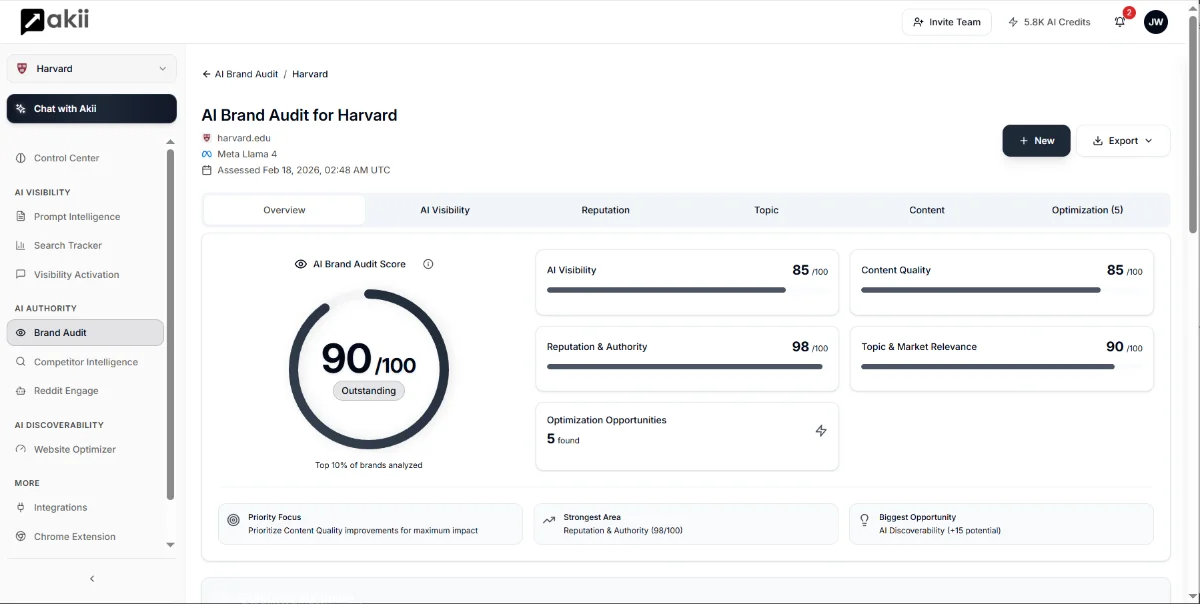
This is exactly why we built Akii. Not to replace what's already in your stack, but to cover the layer that's missing. The layer that tracks how AI engines actually talk about your brand when humans ask them questions.
If you want to understand where your brand stands right now, the AI brand audit is a practical starting point. It walks through what to look for and how to establish a baseline before you can improve anything.
I want to be direct about the stakes here, because they're easy to underestimate.
The risk isn't that your competitors adopt AI Brand Intelligence tools before you do. That's a competitive concern, sure. The deeper risk is that AI engines are already shaping how your market perceives your brand, and you have zero visibility into it.
Every day, potential customers are asking AI systems questions like "What's the best tool for X?" or "How does Company A compare to Company B?" Those systems are generating answers. Those answers are forming opinions. And those opinions are influencing buying decisions before a single person visits your website, reads your blog, or enters your funnel.
Your existing martech stack sees none of this.
That's the blind spot. Not a feature gap in a specific tool. A missing layer in how marketing teams understand their own position in the market.
The teams that recognize this early won't just have better data. They'll have a fundamentally different understanding of where their brand actually stands. They'll be able to act on shifts in AI perception while those shifts are still small and correctable, instead of reacting months later when the downstream effects finally show up in metrics they're used to watching.
I've seen enough technology cycles to know that the biggest advantages don't come from being first. They come from seeing clearly while others are still looking at the wrong screen.
Right now, most marketing teams are looking at the wrong screen. The question is how long that continues before the cost becomes obvious.
The tools to see clearly are starting to exist. The category is forming. The layer is real. Build it into your stack now, or wait until the gap is too wide to ignore. That's the only decision left.