
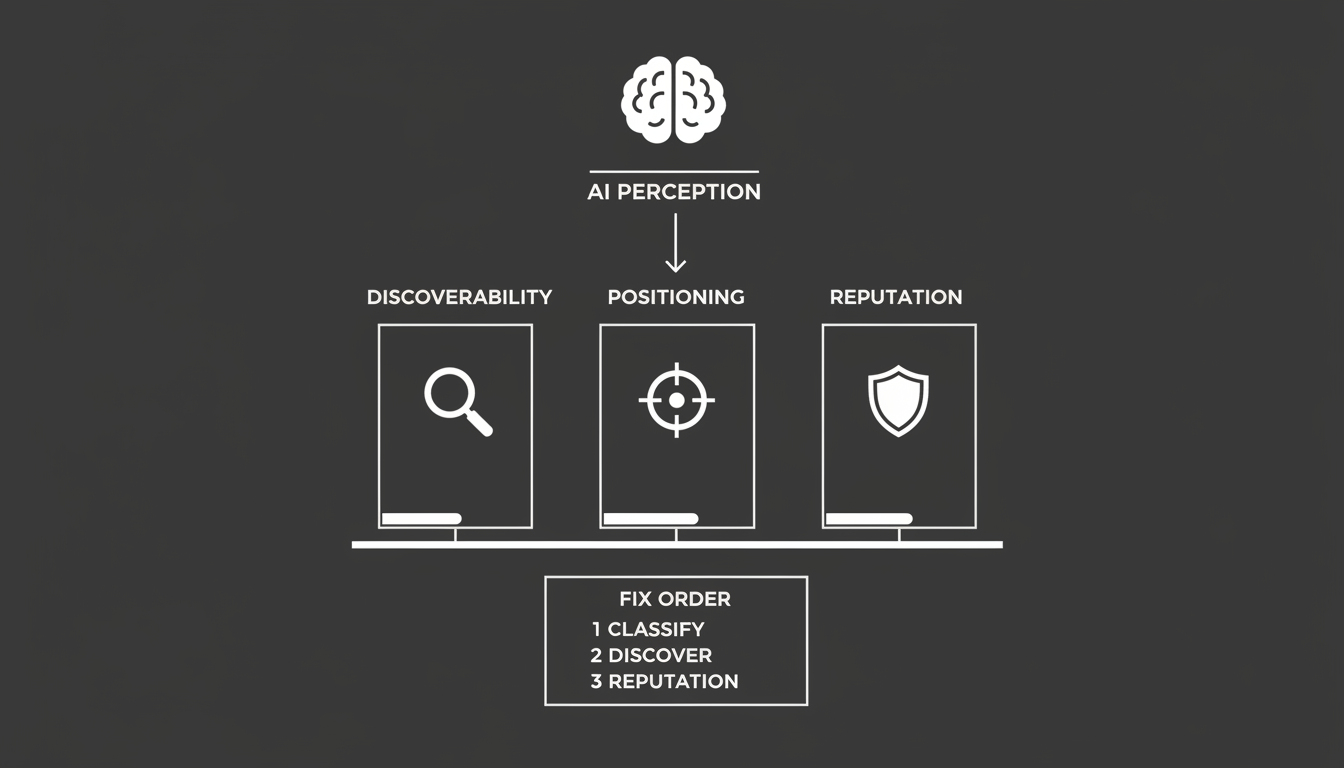
Why AI Perception Is Not Obvious
Most companies assume they know how they show up in AI. They don't.
The signals AI uses to form an opinion about your brand are not the same signals you've been managing for years. Your website copy, your PR wins, your SEO rankings. Those things matter to Google. They matter less, or differently, to the large language models now answering questions about your category.
AI doesn't read your brand the way a customer reads your homepage. It reads the entire information environment around you. It synthesizes, infers, and the conclusions it draws can be wildly different from what you'd expect.
I've seen companies with strong market positions show up in AI answers as second-tier players. I've also seen startups with thin web presences get positioned as category leaders because the right signals happened to exist in the right places. The relationship between what you've built and what AI "thinks" about you is not linear.
The hidden narrative
Every AI model has already formed a narrative about your company. Not because someone programmed it in, but because it assembled one from the data it trained on and the information it retrieves.
That narrative includes what category you belong to, who your competitors are, what you're known for, and whether you're trustworthy. You didn't write that narrative. You probably haven't even read it.
This is what I call the AI perception gap. The distance between what your brand actually is and what AI systems believe it to be.
Indirect signals
AI perception isn't built from direct statements alone. It's built from context. From how other sources describe you, from the structure of information around your brand, from what's missing as much as what's present.
If your competitors have clearer, more consistent information architectures, AI will favor them. Not because they're better. Because they're easier to understand.
What an AI Brand Audit Evaluates
An AI brand audit is a structured assessment of how AI systems currently perceive your company. It's not a vanity exercise. It's a diagnostic.
There are three core dimensions worth evaluating.
Discoverability
Does AI know you exist? When someone asks a question in your category, do you appear in the answer?
This sounds basic. But many established companies are simply invisible in AI-generated responses. They rank well in traditional search. They have brand recognition among humans. The AI still doesn't surface them. That's a discoverability problem, and it's more common than most people expect.
Positioning
When AI does mention you, how does it position you? What category does it place you in, what attributes does it associate with your brand, and who does it compare you to?
Positioning in AI is not something you control directly. It's inferred. And the inferences can be wrong. I've seen B2B companies positioned as consumer brands. I've seen premium products described as budget alternatives. The model isn't lying. It's working with incomplete or skewed information.
Reputation
What's the sentiment? When AI talks about your company, is the framing positive, neutral, or negative?
Reputation in AI answers carries weight because people increasingly trust those answers. If an AI assistant tells someone your product has reliability issues based on a three-year-old forum thread, that's your reputation now. Whether you fixed the issue or not is beside the point.
Common Issues Found in AI Audits
After running enough of these diagnostics, patterns emerge. The same problems show up across industries, company sizes, and maturity stages.
Misclassification
This is the most common issue. AI puts your company in the wrong bucket.
You're a cybersecurity company, but AI describes you as an IT services firm. You sell to enterprise, but AI positions you as an SMB tool. Why does this happen? Usually because the clearest, most structured information about your company doesn't emphasize the distinction. Or because your competitors have claimed the category language more effectively.
Missing signals
Sometimes the problem isn't that AI gets it wrong. It's that AI doesn't have enough to work with.
Your company has no strong presence in the data sources AI relies on. No structured content that clearly states what you do, for whom, and why it matters. No consistent terminology across sources. The result: AI either ignores you or makes guesses. Neither is good.
Weak authority
AI assigns authority based on how the information environment treats you. Are you cited by others? Are you referenced in contexts that signal expertise?
Weak authority means AI might mention you but won't recommend you. It might include you in a list but rank you last. It might describe what you do but hedge on whether you're any good at it.
How to Interpret Audit Results
Getting the data is step one. Knowing what to do with it is where most people stall.
Prioritize issues
Not every finding in an AI audit requires immediate action. Some issues are cosmetic. Some are structural. The difference matters.
A structural issue is one where AI fundamentally misunderstands what your company does or who it serves. That needs to be fixed because every other signal builds on a broken foundation. A cosmetic issue is one where the framing is slightly off but the core understanding is correct. Those can wait.
Ask yourself one question: is this causing me to lose opportunities right now? If AI is actively sending potential customers to competitors because it doesn't understand my positioning, that's urgent. If it's describing my product in slightly different language than I'd prefer, that's a refinement.
Connect to actions
An audit that produces a report but no action plan is a waste of time.
Every finding should connect to something you can actually do. Misclassified? Strengthen category signals in the information sources AI draws from. Missing signals? Create structured, clear content that AI can easily interpret. Weak authority? Build third-party validation and consistent presence in relevant contexts.
This is where the work moves from monitoring to action. The audit tells you where you stand. The action plan tells you what to change.
What to Fix First
If everything looks broken, start with the highest-impact gaps. Here's how I think about priority.
Fix misclassification before anything else. If AI doesn't understand what you are, nothing else you do will compound. You can't improve your positioning in a category AI doesn't think you belong to. Get the foundation right first.
Fix discoverability before reputation. If AI doesn't mention you at all, reputation doesn't matter yet. You need to exist in the conversation before you can shape how you show up in it.
Fix structural content before promotional content. AI doesn't care about your marketing copy. It cares about clear, factual, well-structured information it can reliably interpret. Your "About" page matters more than your latest campaign.
Fix what you control before what you don't. You can update your own content, your structured data, your knowledge bases. You can't directly control what third parties say about you. Start where you have agency.
Most companies have never done this work. They've invested years in how humans perceive them and nothing in how AI perceives them. That gap is only going to get more expensive to close.
An AI brand audit isn't a one-time project. It's the starting point for understanding a new layer of brand management that didn't exist two years ago. The companies that treat it as a diagnostic, act on the findings, and build ongoing awareness of their AI perception will have a real advantage over those who don't.
Not because they're gaming a system. Because they're making it easier for AI to tell the truth about them.