
Why Most AI Visibility Advice Fails
Search "how to improve AI visibility" and you'll find the same advice recycled everywhere. Add structured data. Publish more content. Build authority.
None of it is technically wrong. Almost all of it is incomplete.
Here's the pattern I keep seeing: someone reads a generic checklist, applies a few tactics at random, and has no way to tell if anything changed. Three months later, they're still invisible in AI answers and wondering what happened.
The problem isn't effort. It's the absence of a system.
Most AI visibility advice fails for the same core reasons. It's generic, treating every brand's problem as identical when recognition gaps, positioning gaps, and citation gaps each require different responses. It has no prioritization, so everything feels equally urgent and nothing gets done well. And there's no measurement loop, which means you're back to guessing after every change.
I've watched this play out across companies of all sizes. The ones who break out of it aren't doing anything exotic. They just work through the problem in order, with a way to track what's actually moving.
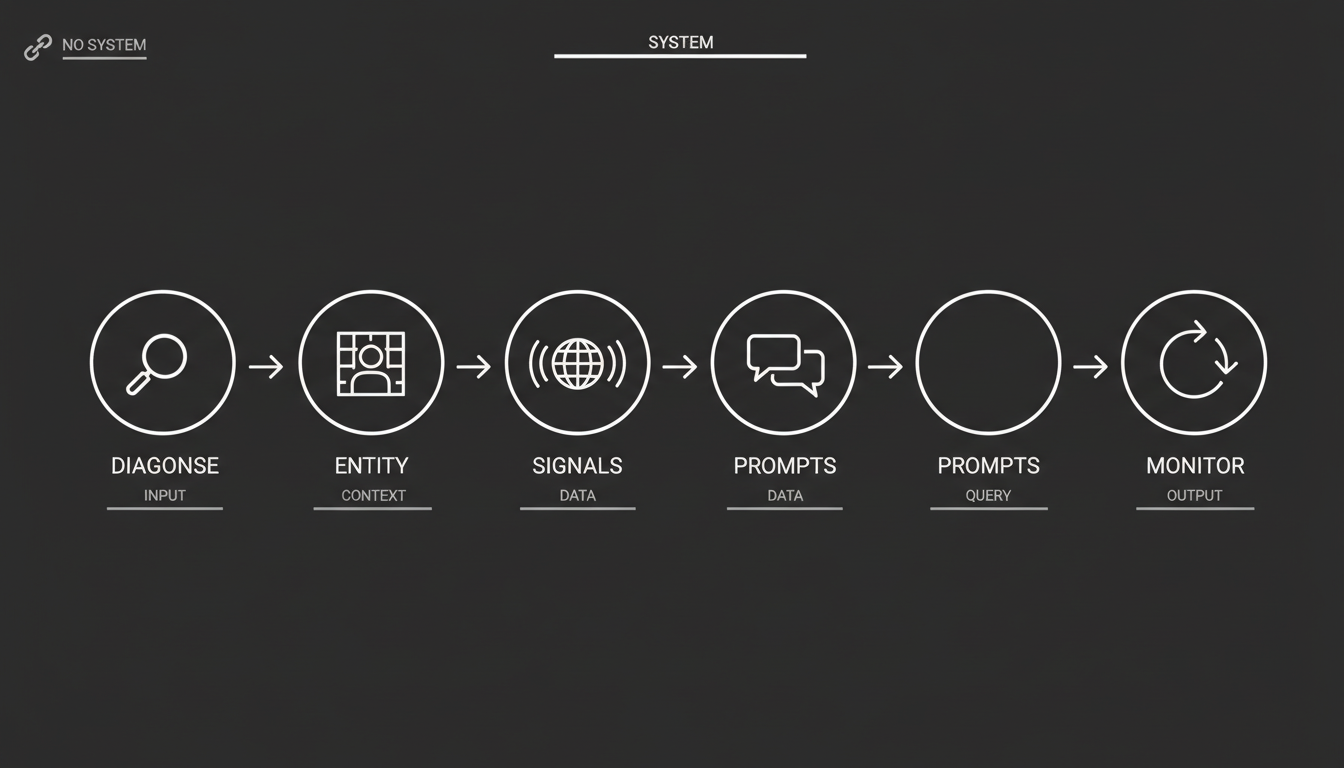
That's what this lays out. Five steps, in sequence, with a clear logic behind each one.
Step 1: Diagnose Before You Fix
What would you think of a doctor who prescribed medication before asking a single question? You'd walk out. So why do most brands skip diagnosis entirely when it comes to AI visibility?
Before you change anything, you need to understand where your brand actually stands in AI-generated answers. Not where you assume it stands. Not what your SEO dashboard shows. Where it actually shows up when real people ask real questions.
That means getting specific answers to a few things.
Does the AI recognize your brand at all? Some brands simply don't exist in the model's understanding. That's a recognition problem, and it's the most fundamental one you can have.
Does the AI understand what your brand does? Recognition without understanding can be worse than invisibility. If an AI mentions your brand but gets the category wrong or blurs you with a competitor, that's a separate layer with its own fix.
Does the AI recommend you in relevant contexts? You might be recognized and understood but still left out when someone asks "what's the best tool for X." That's a preference problem.
Is the information accurate? Sometimes the AI knows you exist, gets the category right, and still says something wrong about your product or pricing.
Each layer requires a different response. Treating them the same is exactly why generic advice doesn't work.
At Akii, we built our AI Visibility Optimization Stack around this layered model because matching the fix to the actual problem is the only approach that holds up. You can't fix what you haven't diagnosed.
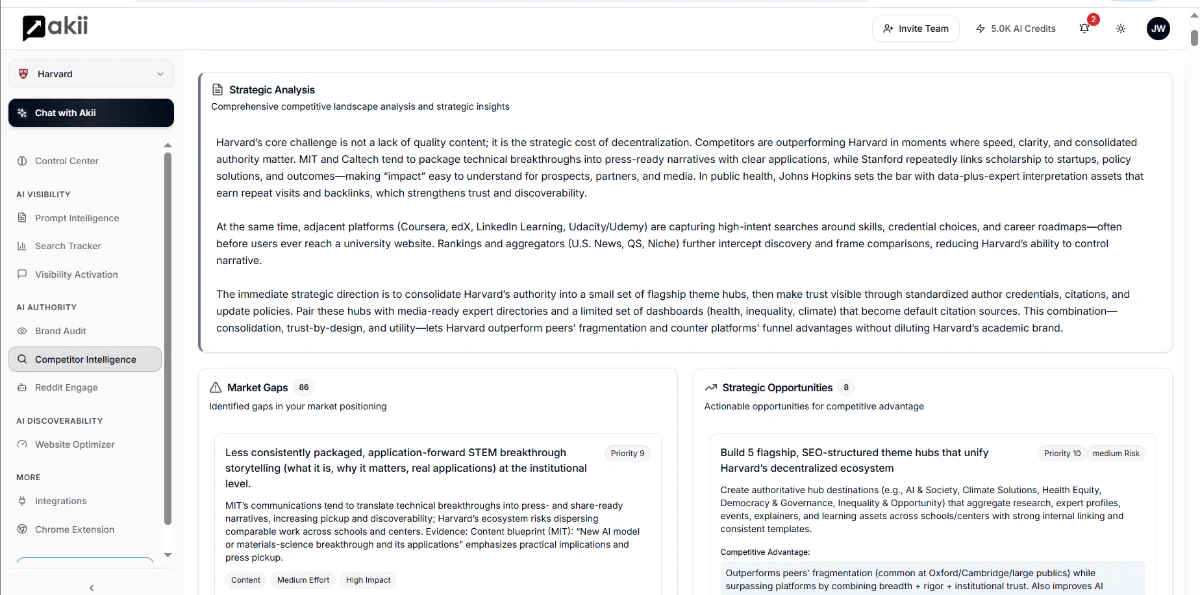
Once you know where the gaps are, start here. Entity clarity is the foundation everything else builds on.
What does entity clarity mean? It's whether AI models can cleanly identify what your brand is, what it does, who it serves, and how it differs from alternatives. If that picture is blurry, nothing downstream will work.
Think about it from the model's perspective. It's trained on enormous amounts of text. If your brand appears in that text with inconsistent descriptions, vague positioning, or conflicting claims, the model builds a fuzzy picture. Fuzzy pictures don't get recommended.
Clear Positioning
This starts with your own messaging. Can someone read your homepage and immediately understand what you do and for whom? If your positioning requires three paragraphs of context to make sense, AI models will struggle with it too.
I'm not talking about taglines or brand voice exercises. I'm talking about the core claim: what you are, what you do, who it's for. State it clearly, consistently, and in plain language across every surface your brand controls.
Structured Data
Structured data helps AI systems parse your brand information more reliably. Schema markup, knowledge panels, properly formatted metadata, all of it contributes to how cleanly a model can extract facts about your brand.
This isn't glamorous work. But it matters. If your website tells search engines one thing and your LinkedIn profile says another, you're creating noise. AI models inherit that noise.
Consistency Across Sources
This is the one most brands underestimate. Your website, your About page, your social profiles, your directory listings, your press mentions, they all need to tell the same story.
Not identical language. The same core facts. Same category. Same positioning. Same key claims.
When I look at brands struggling with AI visibility, inconsistency across sources is one of the most common root causes. It's also one of the easiest to fix once you can actually see it.
Akii's Website Optimizer was built specifically to help brands identify and close these gaps on the surfaces they control. It's the fastest path from scattered information to clean information.
Step 3: Strengthen External Signals
Here's what most people miss. Your own website is only part of the equation, and often the smaller part.
AI models form their understanding of brands from a wide range of sources. Industry publications, review sites, comparison articles, expert roundups, forum discussions, news coverage. If your brand only exists on your own properties, you have a thin signal. Thin signals get overlooked.
Third-Party Validation
When independent sources describe your brand, it carries more weight than your own marketing copy. This is true for humans and it's true for AI models.
Ask yourself: if someone who's never heard of your brand searched for your category, would they find you mentioned by credible third parties? If the answer is no, that's a priority worth addressing now.
This doesn't require a PR campaign. It means being deliberate about where your brand shows up outside your own channels. Guest contributions to industry publications. Inclusion in relevant directories and comparison lists. Participation in communities where your category gets discussed.
Citation Sources
AI models pull from specific sources when generating answers. Understanding which sources get cited in your category helps you focus your efforts where they'll actually register.
Not every mention matters equally. A citation in a well-regarded industry report might carry more weight than fifty blog comments. A detailed review on a trusted platform might matter more than a generic press release. The principle is straightforward: be present in the places AI models actually look.
Step 4: Reinforce Across Prompts
You've fixed your entity clarity and strengthened your external signals. Most brands stop here. They treat AI visibility like a one-time project, fix the data, build some links, move on.
But AI answers aren't static. They vary based on how questions are asked, what context is provided, and which model is generating the response.
Expand Coverage
Your brand might show up when someone asks "what is [your brand]" but disappear when they ask "what's the best tool for [your category]." Those are different prompts that trigger different retrieval patterns.
Think about the full range of questions a potential customer might ask an AI. Category questions. Comparison questions. Problem-specific questions. Use-case questions. Each one is a surface where your brand either appears or doesn't. Expanding coverage means ensuring your brand's information is structured and available in ways that match these different query patterns.
Align Messaging
Here's a subtle but important point. If your marketing says one thing and your product documentation says something slightly different, AI models might present inconsistent information about you across different prompts.
Alignment doesn't mean everything sounds identical. It means the core claims, the key differentiators, and the factual details stay consistent regardless of where the model pulls from.
This is where the work from Steps 2 and 3 compounds. Clean entity data plus consistent external signals equals reliable AI answers across a wider range of prompts.
Step 5: Monitor and Iterate
Do Steps 1 through 4 and then stop paying attention, and you'll drift back to where you started.
AI models update. New content gets ingested. Competitors improve their own signals. The answers change over time. What worked three months ago might not be working now.
Continuous Tracking
You need a way to see how your brand appears in AI answers on an ongoing basis. Not a one-time audit. A continuous signal.
This is where most brands hit a wall. Traditional analytics tools don't track AI visibility. Your Google Analytics dashboard won't tell you whether ChatGPT is recommending your competitor instead of you.
We built Akii to solve exactly this problem. The platform tracks how AI engines mention, describe, and recommend brands in real answers over time, which gives you the feedback loop that makes everything else in this process actually work. You can explore the full set of capabilities on our features page.
Adjust Based on Signals
Monitoring without action is just expensive observation. The point of tracking is to see what's changing and respond to it.
Maybe your entity clarity improved but you're still missing from comparison queries. That tells you Step 3 needs more work. Maybe you're showing up in the right contexts but the AI is getting a key detail wrong. That tells you there's an inconsistency somewhere in your source data.
The pattern is simple: measure, identify the gap, fix the specific layer, measure again. No mystery involved.
I wrote about this feedback loop in more detail in our piece on moving from monitoring to action. If you're past the "understand the problem" stage and into "fix things systematically," that's a good next read.
The Honest Version of This
I've been building technology products for over 25 years. Every major platform shift creates the same dynamic: early confusion, a flood of generic advice, and then the people who approach the problem systematically pull ahead of everyone else.
AI visibility is in that early confusion phase right now. Most of the advice out there is directionally correct but practically useless because it doesn't give you a sequence, a measurement system, or a way to prioritize.
The five steps above aren't complicated. Diagnose. Fix your entity clarity. Strengthen external signals. Reinforce across prompts. Monitor and iterate.
What makes it work isn't any single step. It's doing them in order, with real data, and closing the loop so you can see what's actually changing.
If you want to see where your brand currently stands, Akii is the fastest way to get that baseline. From there, everything becomes a structured fix instead of a guess.
Stop guessing. Start fixing.