
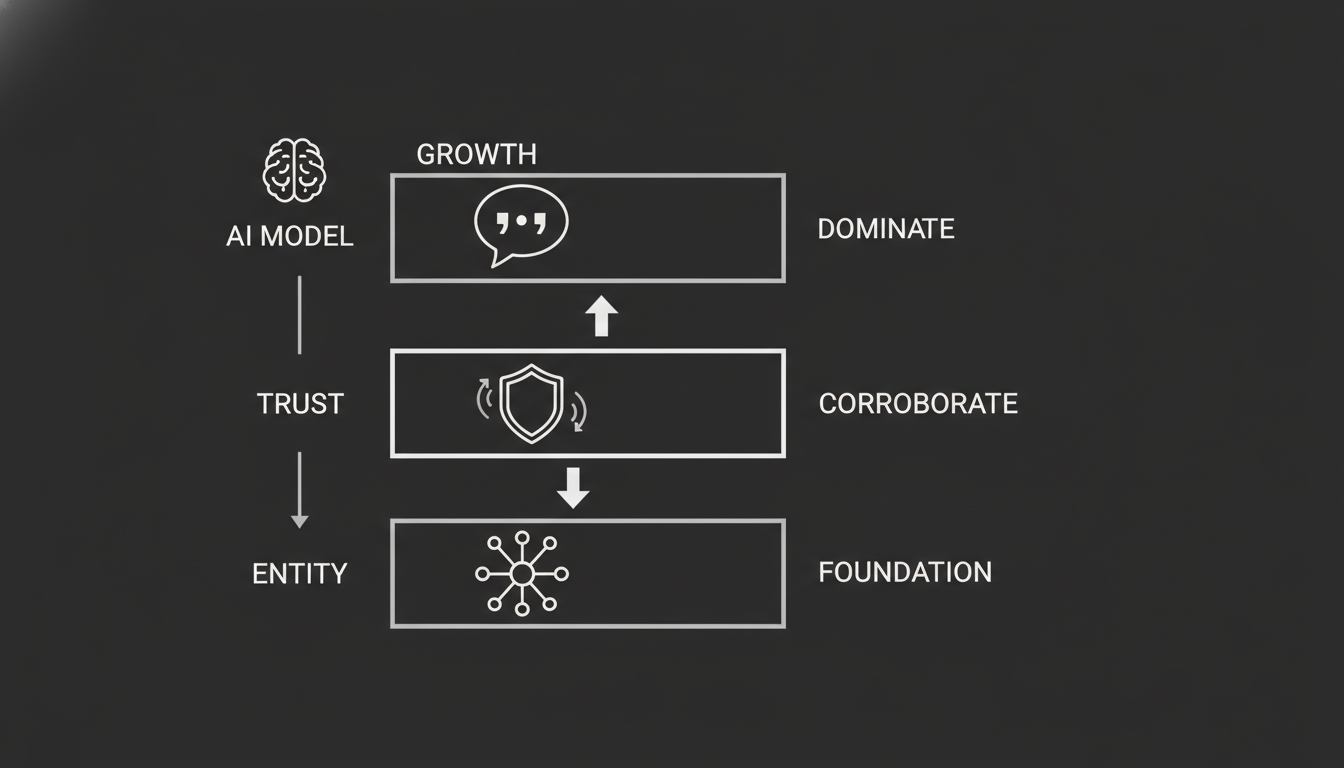
Most Teams Are Improving in the Wrong Order
I've watched this pattern repeat across every technology shift I've been part of over the past 25 years. New platform emerges. Teams panic. They apply yesterday's playbook to tomorrow's problem. Months get wasted before anyone admits the fundamentals changed underneath them.
Right now, it's happening with AI visibility.
A CMO realizes their brand is invisible in ChatGPT. Or worse, Gemini is actively misrepresenting what they do. The immediate reaction? Flood the zone. Write 50 blog posts. Rewrite the homepage. Try to hand-craft prompts that trick the model into noticing you.
This fails because it applies 2010 SEO logic to 2026 technology.
AI models don't rank content based on keyword density or publication volume. They're reasoning engines that build understanding through layers of data validation. If you try to get recommended before you've established your basic identity, the model will simply ignore you to avoid the risk of getting it wrong.
You have to fix things in the right order. That's what this piece is about.
Why Does Sequencing Matter So Much With AI?
In traditional SEO, you could run tactics in parallel. Build backlinks while fixing site speed while publishing content. All of it contributed to a roughly linear rise in rankings.
AI models work differently. They rely on knowledge graphs, which are internal maps of entities and the relationships between them. Before a model recommends your brand, it passes through a logical gate:
- Does it know this entity exists? (Recognition)
- Does it understand what this entity does? (Understanding)
- Does it trust this entity enough to cite it? (Authority)
Most teams skip straight to step 3. They try to get cited as a market leader when the AI doesn't even know their correct pricing model.
Here's what most people miss. If your entity data is unstructured or inconsistent, the AI treats you as a hallucination risk. To protect its user, it filters you out entirely. No amount of thought leadership content fixes a broken entity node.
You have to build the stack from the bottom up.
Tier 1: What to Fix First (Entity and Understanding)
Goal: Stop hallucinations and ensure the AI recognizes you as a verified node.
Status: Non-negotiable. Fail here and you're invisible.
Before you write a single new word of content, fix the infrastructure that allows AI crawlers to read your brand. This is the domain of Answer Engine Optimization, or AEO. Making your brand machine-readable.
Is the AI confused about what you actually are?
Ambiguity kills AI visibility. If your LinkedIn profile describes you as a "Consultancy" but your website says "SaaS Platform," the AI can't resolve the conflict. It defaults to the lowest-risk categorization, or excludes you from specific queries entirely just to avoid being wrong.
I've seen this with companies that have perfectly good products but sloppy profile management. The fix isn't complicated, but it requires discipline.
The fix: Create a Master Entity Profile.
Draft one unified boilerplate description, roughly 150 words. Define your taxonomy clearly. "AI Search Intelligence Platform" is useful. "Marketing Tool" is vague. Then replicate that exact text across your website's About page, your LinkedIn Company Page, your Crunchbase profile, and your Wikidata entry.
Consistency forces the model to accept your definition as ground truth. It resolves the disambiguation problem so the AI knows exactly which entity you are.
Are you speaking the language AI actually understands?
AI agents don't read pages like humans do. They extract data. If your pricing is just text on a page ($99/month), the AI might miss it or confuse it with a different number elsewhere. Wrap that same price in Schema markup and the AI treats it as a hard fact.
The fix: Deploy the "Core Three" schemas.
Organization Schema tells the AI who you are, where you're located, and links your social profiles using sameAs tags to verify your identity.
Product Schema is critical for SaaS and eCommerce. It explicitly tags your product name, description, and SKU.
Offer Schema tags your pricing, currency, and availability. If Gemini says "Pricing unavailable" for your brand, missing Offer Schema is almost always why.
Akii's Website Optimizer can analyze your pages and generate these schema packages automatically. It creates the code that translates your website into the language LLMs actually process.
Is the AI putting you in the wrong category?
AI models sort brands into buckets: CRM, HRIS, Email Tool, and so on. Wrong bucket means you never appear in the right queries. Does that matter? Only if you care about being found when someone asks for exactly what you sell.
The fix: Use explicit tagging, not clever marketing copy.
Review your homepage H1 and metadata. Are you using creative jargon like "We power connection" instead of explicit category labels like "Enterprise CRM Software"?
Make sure your primary category keywords appear in your H1 and your Organization Schema description field. This helps the AI's reasoning engine map your node to the correct user intents. Creative copy works fine for humans. The AI needs to categorize you before it can recommend you.
Tier 2: What to Fix Second (External Corroboration)
Goal: Move from "Known" to "Recommended."
Status: Critical for competitive queries.
Once the AI knows who you are, it needs to know whether it can trust you. AI models are programmed to be risk-averse. They rely on external corroboration to validate claims. This is where Generative Engine Optimization, or GEO, comes in.
Why won't the AI recommend you even though your site is clean?
Because saying you're great isn't enough. An AI model is far more likely to cite you if a trusted third party vouches for you than if you vouch for yourself.
Models weigh citations from high-trust nodes heavily in their probability calculations. Think about it from the model's perspective. If it recommends your brand and gets it wrong, the user loses trust in the AI. Minimizing that risk is the model's entire job.
The fix: Run an Authority Audit.
Identify where the AI learns about your industry. For B2B and SaaS, that means G2, Capterra, Crunchbase, and Gartner. For consumer brands, it means major media outlets and review platforms like Trustpilot.
Don't just aim for a link. Aim for a definition. Get these sources to describe your brand using the same taxonomy you established in Tier 1. That alignment is what creates real signal.
Are your external profiles contradicting your website?
This is where many brands quietly fail. They update their website but forget to update their external profiles.
If your G2 profile lists an old pricing model while your website lists a new one, the AI detects a data conflict. The result? It will either hallucinate by mixing the two prices, or flag the data as unreliable and move on.
The fix: Build a Chain of Trust.
Audit your top 10 external profiles. Align every single one with the entity data you established in Tier 1. Same pricing. Same description. Same taxonomy.
This sounds tedious. It is. But it's the difference between being cited and being filtered out.
How fresh are your reviews?
Here's something I don't think enough teams appreciate. A brand with 500 reviews from 2022 is less trusted by AI models than a brand with 50 reviews from last month.
Models like Perplexity and Google's AI Overviews prioritize freshness. Recent positive sentiment signals that the entity is active and reliable. Old reviews, even lots of them, suggest a brand that may have changed or declined.
The fix: Set up recency management.
Run a campaign to generate fresh reviews on your primary industry platforms. Not fake reviews. Not incentivized junk. Real, recent feedback from real customers.
Freshness isn't a nice-to-have. It's a trust signal the models actively weight.
Tier 3: What to Do After the Foundation Is Solid (Reinforcement and Growth)
Goal: Dominate the conversation and win specific user intents.
Status: The accelerator. Do this only after Tiers 1 and 2 are solid.
Now you can play offense. Tier 3 is about shaping the conversation and winning specific comparisons, like "You vs. Competitor X."
What kind of content do AI models actually want to quote?
AI agents don't read 2,000-word fluff pieces. They scan for answers. They prefer what I'd call "Quotable Canonicals," which are concise, declarative statements that act as perfect summaries.
The fix: Apply a TL;DR strategy to your key pages.
Rewrite the introductions of your high-traffic pages. Start with a direct definition. Use question-based headings like "How much does [Product] cost?" followed immediately by the answer.
That structure increases the probability that the AI will lift your exact sentence to construct its response. You're not writing for a human skimming a blog. You're writing for a reasoning engine that needs a clean, quotable fact.
Are you winning the prompts that matter?
You need to appear not just for your brand name, but for the problems you solve. If someone asks an AI "What's the best CRM for enterprise teams?" and you're not in the answer, your Tier 1 and Tier 2 work isn't translating into coverage.
The fix: Map user intents to dedicated content.
Use tools like Akii's Competitor Intelligence features to see which prompts your competitors are winning. Are they winning "Best [Category] for Enterprise"? Create dedicated pages or schema-marked FAQ sections specifically targeting those intents.
If you want to win "Best for Enterprise," you need content that explicitly connects your brand entity to the attribute "Enterprise." The AI won't infer it. You have to state it.
Can you accelerate the model's learning?
Sometimes the model's training data is simply stale. You can wait for the next crawl. Or you can push it.
The fix: Active education through reinforcement loops.
Akii's AI Visibility Activation systematically educates models about your updated content. It runs automated, geo-targeted queries that prompt models like Perplexity and Google AI Search to re-analyze your specific pages.
This creates a reinforcement loop. By simulating user interest and querying the model about your new attributes and external citations, you accelerate the model's learning process. Instead of waiting months for a crawl cycle, you're actively pulling the AI's attention to your updated data.
What Should You Ignore Right Now?
In the AI era, some traditional SEO tactics have become low-value distractions. If you're limited on resources, cut these first.
Stop over-producing blog content.
Writing 10 AI-generated blog posts a week will not help your AI visibility if your entity data is broken. Full stop.
The trap is thinking more content equals more keywords. AI models value verified facts over volume. One page with perfect Schema is worth 50 pages of unstructured text. Fix your structure before you scale your content.
I've seen teams burn entire quarters on content production that moved nothing because the foundation wasn't there.
Stop chasing individual prompts.
Don't obsess over ranking for every long-tail variation of a question. The trap is trying to "rank" for thousands of specific question phrases.
AI search is probabilistic. If you win the entity battle, meaning the model knows you are the best option in your category, you will automatically win thousands of long-tail prompts associated with that entity. Fix the concept, not the string of words.
Stop obsessing over cosmetic on-page tweaks.
Spending hours tweaking meta descriptions or exact keyword density in H3 tags is a legacy game. AI agents parse code and data.
They care about your price tag in Schema far more than they care about the adjective you used in your meta description. Copy matters for humans. But if you're choosing between polishing a meta description and deploying Product Schema, the Schema wins every time.
The Order of Operations, Simply
Don't randomize your efforts. Execute the stack in order.
Tier 1 (Foundation): Define your entity. Unify your descriptions, deploy Schema, and ensure the AI knows what you are. This is where Akii's Website Optimizer and AI Visibility Score do the diagnostic work.
Tier 2 (Trust): Build corroboration. Align your external profiles with your website to build a chain of trust. Run a brand audit to find the gaps.
Tier 3 (Growth): Drive engagement. Create quotable content and use reinforcement tools to push the model to recognize your authority.
By following this stack, you stop trying to impress a search crawler that matches keywords. You start building for a reasoning engine that evaluates trust.
Where Is Your Stack Broken?
Most teams I talk to are working on Tier 3 problems while their Tier 1 is full of holes. They're writing thought leadership when the AI doesn't even know their correct product category. They're chasing prompt rankings when their entity data contradicts itself across five different profiles.
The fix isn't more effort. It's the right effort, in the right order.
If you're not sure where your foundation stands, run a free AI Visibility Score to diagnose whether your Tier 1 is solid or whether you need to start fixing your entity data today. The answer might save you months of wasted work.