

The Moment Brands Discover the Problem
It usually starts the same way. Someone on the team types a question into ChatGPT or Perplexity. Something like "What's the best project management tool for remote teams?" or "Which CRM should a mid-size B2B company use?"
Their brand isn't in the answer.
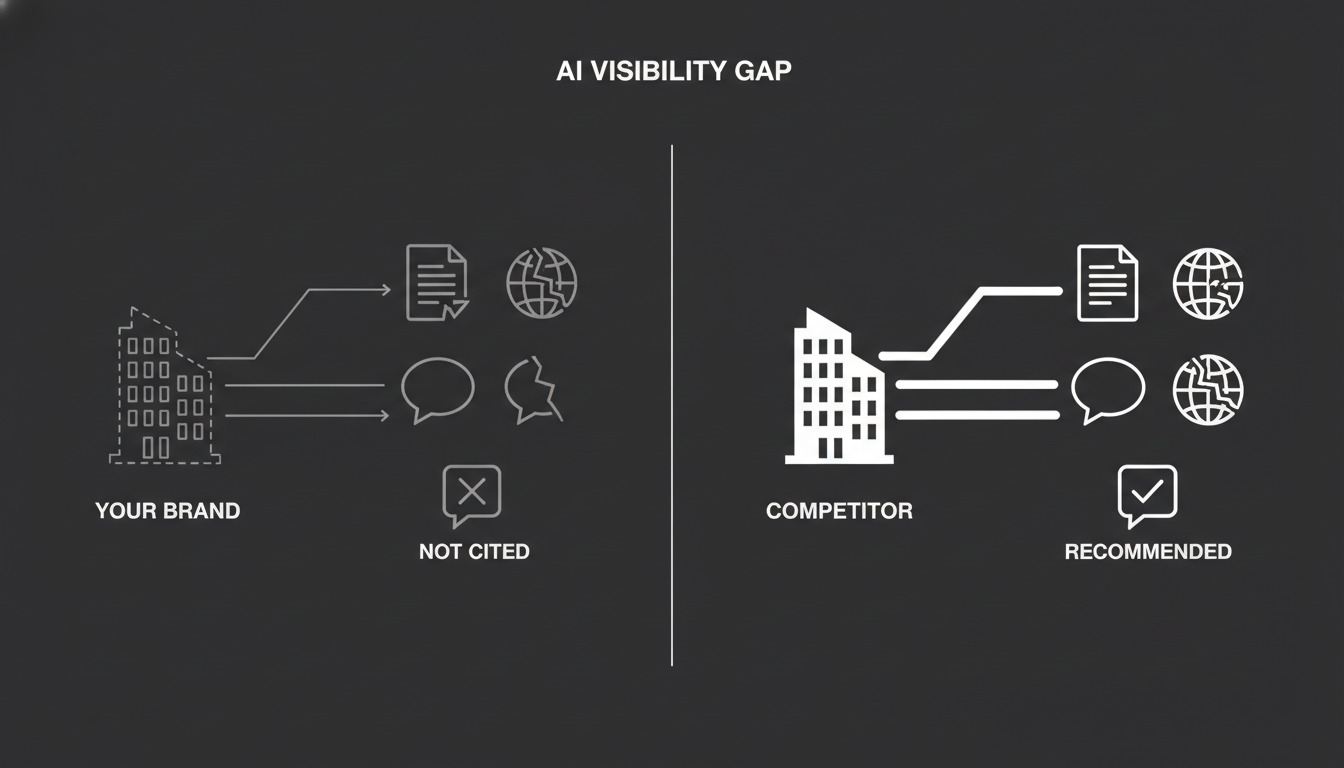
A competitor is. Sometimes two. The brand that shows up first isn't always the biggest or the best-known. But it's there, presented with a confidence that makes it feel like the obvious choice.
This hits differently than dropping a few spots in Google rankings. There's no page two here. No "we're still on the first page, just lower." The AI either names you or it doesn't. Either frames you as a credible option or treats you like you don't exist.
Testing Prompts Reveals the Truth
Most teams discover this by accident. A product marketer is researching something unrelated. A founder is testing a new AI tool. Someone in sales asks an AI assistant for a competitive comparison, and the response reads like a brochure for the other guys.
Once you see it, you can't unsee it. Start testing more prompts and the pattern sharpens fast. Ask "What are the top tools for X?" and you're missing. Ask "Compare Brand A vs Brand B" and the AI has a clear preference. Ask "Which company is best for Y use case?" and someone else owns the answer.
This isn't random. It's structural.
Unexpected Competitor Dominance
Here's what surprises people most: the brands dominating AI recommendations aren't always the ones with the most market share or the biggest ad budget.
They're the brands AI models understand best.
I've seen smaller companies consistently recommended over category leaders. Not because some algorithm is broken, but because those smaller companies have clearer, more consistent signals across the sources AI models draw from. The models aren't picking favorites. They're reflecting what they've absorbed. What they've absorbed depends on what was available, structured, and reinforced during training and retrieval.
If that doesn't describe your brand's content strategy, you have a problem you probably didn't know existed.
Why AI Recommends Some Brands Over Others
People get this wrong in a specific way. They assume AI recommendations work like search rankings, just powered by a different algorithm. They think strong Google performance should translate to strong ChatGPT performance.
That's not how it works. The mechanics are fundamentally different.
Entity Familiarity
AI models don't index web pages. They build internal representations of concepts, companies, and relationships based on training data and, increasingly, real-time retrieval from trusted sources.
When a model knows a brand well, it can describe what that brand does, who it serves, and how it compares. When it doesn't, it either omits the brand entirely or generates vague, hedging language that makes the brand sound like an afterthought.
Entity familiarity is the foundation. Can the AI explain what your company does in one sentence, accurately, without hallucinating? If not, you haven't crossed the familiarity threshold. You won't show up in recommendations.
Citation Density
Where does the AI get its information about your brand? Training data comes from a wide range of public sources. Retrieval-augmented models pull from specific, trusted sources in real time.
If your brand appears in a handful of places with thin descriptions and limited context, the model has very little to work with. If your competitor appears across dozens of authoritative sources with rich descriptions, comparisons, and use-case framing, the model has a deep well to draw from.
This isn't about backlinks. It's about how densely and consistently your brand is represented across the sources AI models actually reference. Industry publications, comparison sites, technical documentation, community discussions, structured data repositories. The breadth and depth of your presence in these places directly shapes whether an AI includes you in a recommendation.
Narrative Reinforcement
Here's the part that really matters. AI models don't just count mentions. They absorb narratives.
If every source that mentions your competitor frames them as "the leader in X" or "the go-to solution for Y," the model internalizes that framing. It becomes part of how the model talks about that brand. Not because the model has an opinion, but because the pattern in the data is overwhelming.
Your competitor isn't being recommended because the AI likes them. They're being recommended because the narrative around them is consistent, repeated, and clear. The model reflects the story that already exists across its sources.
If your brand's narrative is fragmented, inconsistent, or simply quieter than the competition's, the AI will reflect that too. Silence doesn't get recommended.
Why Traditional SEO Metrics Miss This
Strong rankings. Healthy traffic. High domain authority. If you're running a solid SEO program, you might assume you're covered.
None of that tells you whether AI models are recommending your brand.
Rankings Don't Equal Recommendations
Search rankings measure how well your pages perform against a specific query in a specific index. AI recommendations are generated from a model's understanding of your brand as an entity, informed by training data and retrieved sources that may or may not overlap with what Google indexes.
You can rank first for "best CRM software" and still not appear when someone asks ChatGPT the same question. Different systems. Different inputs. Different logic.
I've watched companies with dominant SEO positions discover they're invisible in AI answers. It's genuinely disorienting for teams that have invested years in search performance. But the gap is real, and it's growing as more people shift their research behavior toward conversational AI.
Traditional SEO metrics tell you how you're performing in a system that's losing share of the discovery process. They don't tell you anything about the system that's gaining share. That's the blind spot.
Understanding how AI visibility metrics actually work is becoming a prerequisite for any brand that wants to stay competitive in discovery. Not because SEO is dead. It isn't. But because a second, parallel system now influences how people find and choose products.
Identifying Recommendation Gaps
You can't fix what you can't see. Before you do anything else, you need to understand where you stand in AI-generated recommendations relative to your competitors.
You don't need sophisticated tooling to start. You need structured curiosity.
Comparison Prompts
Start by asking AI models to compare you directly to competitors. "Compare [Your Brand] to [Competitor A]." "What's the difference between [Your Brand] and [Competitor B]?" "Which is better for [specific use case], [Your Brand] or [Competitor C]?"
Pay attention to a few things. Does the AI describe your brand accurately? Does it frame the comparison fairly, or does it default to recommending the competitor? Does it hedge on your brand while speaking confidently about theirs?
The patterns you find here tell you exactly how the model perceives your brand relative to the competition. This is the starting point for competitive intelligence in AI visibility.
Solution Prompts
Now test broader queries where you should appear but your brand isn't named. "What's the best tool for [your category]?" "Which companies should I consider for [your use case]?" "Recommend a solution for [your customer's problem]."
If your brand doesn't appear, you have a recommendation gap. If it appears but is listed last, described vaguely, or qualified with caveats while competitors get clean endorsements, you have a positioning gap.
Both are fixable. But you need to see them clearly first.
The shift from simple mentions to actual recommendations is where the real value lies. Being mentioned in passing isn't the same as being recommended with confidence. That distinction matters enormously when someone is using an AI to make a purchase decision.
How Brands Close the Recommendation Gap
Once you've identified the gaps, the work is surprisingly clear. Not easy, but clear. It comes down to two things: making your brand easier for AI to understand, and making sure the sources AI relies on tell a consistent story about you.
Strengthen Entity Signals
The AI needs to know what your brand is, what it does, who it serves, and how it's different. That sounds basic. Most brands still communicate this inconsistently across their public presence.
Your website says one thing. Your LinkedIn says something slightly different. Industry listings describe you in generic terms. Comparison sites have outdated information. Community discussions reference features you deprecated two years ago.
Every inconsistency weakens the model's understanding of your brand. Every gap gives the model a reason to skip you or hedge.
What actually works: make sure your core positioning is consistent everywhere your brand appears publicly. Not identical copy, but consistent framing. Same core value proposition. Same key differentiators. Same target customer description.
Structure your content so AI models can extract clear facts about your brand. Product pages, feature descriptions, use-case pages, comparison pages. These aren't just for human visitors anymore. They're source material.
Build content that directly answers the questions people ask AI. If you're the right answer to "What's the best X for Y?", make sure the evidence exists for the model to find.
Reinforce Authoritative Sources
The sources AI models trust most tend to be authoritative, well-structured, and frequently referenced. Industry publications, established review platforms, technical documentation hubs, knowledge bases, high-quality community discussions.
If your brand has a weak presence in these sources, you're handing recommendation real estate to competitors who show up there consistently.
This isn't about gaming anything. It's about making sure the places where AI looks for information actually contain accurate, current, compelling information about your brand. If the model is going to form a picture of you based on what it finds, you want what it finds to be good.
Get your brand accurately represented on comparison and review sites. Contribute to industry publications with clear, substantive content. Make sure your structured data, your knowledge panels, your Wikipedia presence if applicable, all reflect your current positioning.
None of this is manipulative. It's the same principle as keeping your Google Business Profile accurate. You're just doing it for a different system.
The Real Stakes
Let me be direct about what's happening here.
The way people discover and evaluate products is shifting. Not someday. Now. Every month, more research happens through conversational AI. Every month, more purchase decisions are influenced by what an AI recommends.
If your competitor is the one getting recommended, they're getting a form of endorsement that's genuinely powerful. It's not an ad. It's not a ranking. It's a direct answer to a direct question, delivered with the authority of the AI itself.
And unlike a search result, there's no list of ten options. There's often one or two. The AI picks, and the user trusts the pick.
Recommendation bias in AI isn't a bug. It's a structural feature of how these systems work. The brands that understand this early will build a compounding advantage. The brands that wait will find the gap harder to close as AI models reinforce existing patterns over time.
I've watched this dynamic play out across multiple technology shifts over 25 years. The window where awareness matters more than scale is always shorter than people expect.
If you want to understand where your brand actually stands in AI-generated recommendations, Akii gives you the visibility to see it clearly and the intelligence to act on it. Not vanity metrics. Not guesswork. Real data on how AI models perceive and recommend your brand versus the competition.
The brands that win the next era of discovery won't be the ones with the biggest ad budgets. They'll be the ones the AI actually knows.