
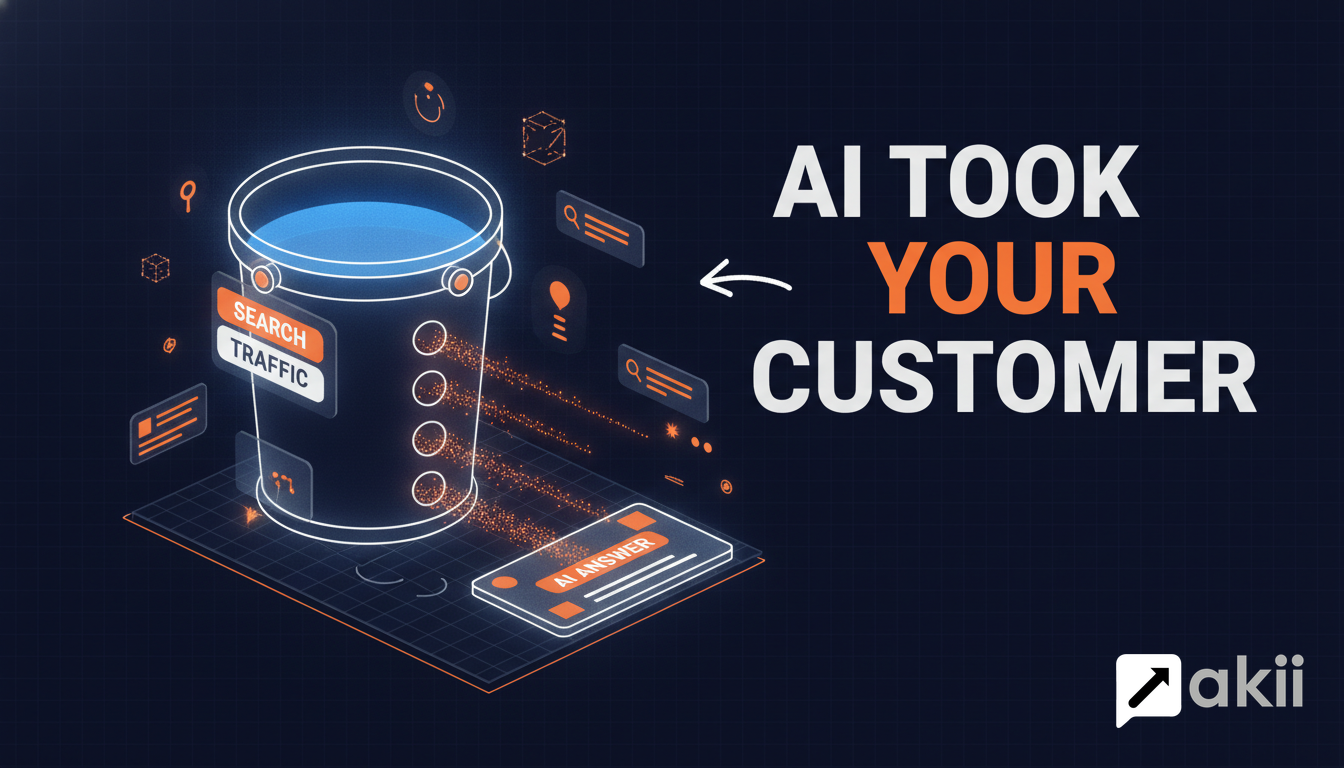
Your clicks are disappearing. Not because your SEO is broken, but because the answer is being given before anyone reaches your site.
That's the shift. AI engines now answer buyer questions directly. When a shopper asks ChatGPT "best accounting firm in Dubai" or a procurement manager asks Gemini to compare cloud providers, the AI gives a recommendation. If your business isn't in that answer, you didn't lose a ranking. You lost a customer you'll never see in your analytics.
This isn't a future problem. It's happening right now.
What's actually happening to search behavior?
The numbers are pretty clear. When an AI summary appears on a search results page, click-through rates drop from roughly 15% to 8%, and about 26% of sessions end with no click at all (Pew Research Center, 2025). Those clicks didn't go to a competitor's website. They went nowhere. The user got what they needed from the AI answer and moved on.
In the UAE, this matters more than almost anywhere else. 64% of the UAE working-age population uses AI, the highest rate in the world (Microsoft, 2025). 80% of UAE consumers already use AI to shop, and 41% use it specifically for product research (Visa, 2025). Google still holds 95.44% of traditional search share in the UAE (StatCounter, 2026), but the behavior layer sitting on top of Google is changing fast. Google's own AI Overviews are eating its own clicks.
And in B2B? 51% of B2B software buyers now start their research with an AI chatbot more often than they start with Google (G2, 2026). That's not a trend. That's a majority.
Is traditional SEO dying?
No. But its role is shifting.
Some industry commentary has claimed traditional SEO demand is down 30% year-over-year. I can't verify that specific number from a reliable source, so I won't repeat it as fact. What I can tell you from 25 years of watching technology cycles is this: the underlying need doesn't disappear. The mechanism changes.
Here's the pattern I've seen play out across every major platform shift. The old channel doesn't die overnight. It gets layered. Email didn't kill direct mail. Google didn't kill email marketing. Social didn't kill Google. AI search won't kill traditional SEO either. But each new layer captures the highest-intent moments first, and the businesses that adapt early capture disproportionate value.
Right now, traditional SEO still matters for getting indexed, building domain authority, and structuring your content so AI engines can read it in the first place. You don't abandon it. You build on top of it.
The real risk isn't that your Google rankings drop. It's that your Google rankings become less relevant because the buyer already made their decision before they ever typed your brand name into a search bar.
85.7% of completed Akii scans scored below 40/100.
| Metric | Share of scans |
|---|---|
| Under 10 | 34% |
| 10-19 | 27.8% |
| 20-39 | 23.9% |
| 40-59 | 9% |
| 60+ | 5.3% |
Akii · n=94,408 completed scans · Jun 2026
What does AI search visibility actually look like today?
Most businesses are invisible to AI engines. That's not opinion. That's data.
Across 94,408 completed AI Visibility Score scans in Akii's dataset, 85.7% of businesses scored below 40 out of 100. Only 5.3% scored 60 or above. The average AI Visibility Score for the 7,772 UAE .ae businesses scanned was 25.6 out of 100.
Think about that for a second. The UAE has the world's highest AI adoption rate, and the vast majority of its businesses are barely registering in AI answers.
When we look at brand visibility across individual AI answer engines, the picture gets starker. Average brand visibility in Google AI answers was just 1.6% across Akii's 1.8 million brand-platform-day observations. The other engines aren't much better.
The weakest dimension across all scans? Content coverage. Most businesses simply haven't built the kind of content that AI engines pull from when they construct answers. And 98.2% of AI responses about businesses in our sentiment sample were neutral, meaning AI isn't saying anything bad about most companies. It's just not saying anything useful about them at all.
Neutral is not safe. Neutral means forgettable. When a buyer asks an AI engine who to trust, "neutral" means you don't get mentioned.
What are AEO and GEO, and should you care about the acronyms?
The industry has spawned new terminology. AEO stands for Answer Engine Optimization. GEO stands for Generative Engine Optimization. You'll also hear AISEO, LLM optimization, and a dozen other variations.
I'll be direct: the acronym doesn't matter. What matters is the outcome.
Can an AI engine find your business when a buyer asks a relevant question? Does it cite you? Does it recommend you? Does it describe you accurately?
If the answer to any of those is no, you have a problem regardless of what you call the solution.
The practical work breaks down into a few clear areas.
Making your content readable by AI. Not just indexable by Google. AI engines synthesize information differently than search crawlers rank pages. They look for clear, authoritative answers to specific questions, pulling from structured data, trusted sources, and content that directly addresses the query.
Getting cited in the sources AI trusts. AI engines lean on sources and increasingly cite them. They still get things wrong, so the sources they find matter. If the directories, review sites, industry publications, and reference sites that AI engines rely on don't mention your business accurately, you're invisible.
Building trust signals AI engines can verify. Schema markup, consistent business information, authoritative backlinks, and clear entity data all feed into whether an AI engine considers your business credible enough to recommend.
Akii observations show single-digit average visibility across major AI answer surfaces.
| Metric | Average visibility |
|---|---|
| Google AI | 1.6% |
| ChatGPT | 3.4% |
| Perplexity | 3.5% |
| Copilot | 4.3% |
Akii · 1.8M brand-platform-day observations
Why the "win one micro-category" approach works
Here's something I think most businesses get wrong about AI search. They try to be visible for everything at once. That's exactly backwards.
AI models don't rank pages. They synthesize answers. When someone asks "best creatine for vegans" or "top family lawyer in Abu Dhabi" or "most reliable freight forwarder from Jebel Ali," the AI engine builds a recommendation from the strongest signals it can find for that specific question.
If you try to be the answer for your entire industry, you'll lose to specialists who own a specific slice. But if you build deep authority around one specific buyer question, then another, then another, you create a compounding effect. Pick the most commercially valuable question your buyers ask. Build the most complete, accurate, trustworthy answer to that question across your website, your profiles, your directory listings, and the third-party sources AI engines read.
Keep going until AI engines consistently recommend you for that query. Then move to the next one.
This is slower than broad-spectrum SEO campaigns. It's also dramatically more effective in a world where AI gives one or two recommendations instead of ten blue links.
How do you measure something you can't see in Google Analytics?
This is the part that frustrates most business owners, and I understand why.
The modern buyer journey often looks like this: a prospect asks ChatGPT for recommendations, watches a couple of YouTube reviews, checks TikTok for social proof, then goes to Google and searches your brand name to buy. Google Analytics records a branded search conversion. Looks like SEO worked. But ChatGPT did the actual selling.
You can't track what you can't see. And the AI-driven portion of the buyer journey is largely invisible to traditional analytics.
So what do you measure instead?
AI Share of Voice. When someone asks a commercial-intent question in your industry on ChatGPT, Claude, Gemini, or Perplexity, does your brand appear in the answer? How often? In what position? This is the new version of keyword rankings, and it requires different tools to track.
Source citation. Is your website being pulled as a source when AI engines construct answers? Are the third-party sites that AI engines trust mentioning your brand?
Characterization accuracy. When AI does mention you, is it saying the right things? Wrong descriptions or outdated information in AI answers can be worse than no mention at all.
This is exactly the gap Akii was built to close. We track where AI engines cite or recommend competitors instead of you, find the buyer questions where your company is missing or described wrong, then ship the fixes: content, structured data, source mentions, and the trust signals AI engines actually read. You can see how that works in practice for Dubai-based companies.
The weakest Akii-scored dimensions point to content coverage and reputation clarity.
| Metric | Average score |
|---|---|
| Content coverage | 22.8 |
| Brand sentiment | 23.5 |
| Executive summary | 28 |
| Brand recognition | 30.3 |
| Brand understanding | 35.2 |
Akii · ~101.7k scored scans
What should you actually do this quarter?
Here's the practical version. Five things you can start this week.
1. Audit your AI visibility. Ask ChatGPT, Claude, and Gemini the top five questions your buyers ask before purchasing. See if you're mentioned. See what's said about you. See who gets recommended instead. This takes 30 minutes and will tell you more than your last month of analytics reports.
2. Fix your entity data. Make sure your business name, description, services, and location are consistent across your website, Google Business Profile, industry directories, and any review platforms. AI engines cross-reference these signals. Inconsistency means lower trust.
3. Build answer-ready content. For each high-value buyer question, create content that directly and completely answers it. Not keyword-stuffed blog posts. Clear, structured, authoritative answers that an AI engine would want to pull from.
4. Strengthen your source presence. Identify which third-party sources AI engines cite most often in your industry. Get mentioned accurately on those sources. This might mean industry publications, review platforms, directories, or professional associations.
5. Start tracking AI metrics. Even if it's manual at first. Check your AI visibility monthly. Note changes. Build a baseline so you can measure improvement.
The window is open, but it's closing
PwC projects that roughly 14% of UAE GDP will come from AI by 2030, about US$96 billion (PwC, 2030 projection). The infrastructure, the consumer behavior, and the business adoption are all moving in one direction.
Right now, most businesses are invisible to AI search. That's the bad news. The good news is that your competitors are probably invisible too. The 5.3% of businesses that have figured this out are capturing a disproportionate share of AI-driven recommendations while everyone else is still arguing about whether this matters.
I've watched this pattern repeat across every technology cycle. The early movers don't just get an advantage. They get a compounding advantage, because AI engines build trust over time. The longer your business is consistently cited, recommended, and accurately described, the harder it becomes for a competitor to displace you.
The businesses waiting for AI search to "mature" before adapting are making the same mistake businesses made in 2005 when they waited for Google to "prove itself" before investing in SEO.
The shift isn't coming. It's here. The question is whether you'll be visible when your next customer asks an AI engine who to trust.
If you want to know where you stand, book an AI Search Audit or reach out through our contact form. We'll show you exactly where you're visible, where you're missing, and what to fix first.