

Google IO 2026 Just Broke the Marketing Funnel. Here's What Actually Matters.
Three announcements in a single week. Any one of them would deserve serious attention. Together, they change how customers find you, how they decide, and how they buy.
The infrastructure is shipping this summer. This is not a prediction about some distant future.
Here's what happened, what it means, and what to do about it.
What did Google actually announce?
At Google IO 2026, three things landed at once:
- A core search algorithm update that can move sites from page one to page four overnight, with no warning and no clear recovery path.
- Universal Cart and the Agent Payments Protocol (AP2), which lets AI agents find products, compare options, and complete purchases on a customer's behalf across multiple stores in a single click.
- Omni, a video model with AI avatars good enough that viewers on Facebook couldn't tell a full commercial was entirely synthetic.
Each of these is big on its own. The compounding effect is what actually matters.
The old playbook: rank in Google, run ads to a landing page, convince a human to buy. All three steps got disrupted in the same week.
Why does the SEO change matter so much?
For 15 years, SEO was the most predictable channel in marketing. Write good content. Build links. Pick the right keywords. Rank. Repeat.
That era is over.
Google's own documentation now states that recovery from a core update can take "several months, sometimes longer." No clear recovery path. No guaranteed fix. You could be on page one today and page four tomorrow, and you might not even notice for weeks until you check Search Console and see the cliff.
I've watched businesses built entirely on organic Google traffic. Some of them are genuinely good businesses. But if your entire acquisition model depends on one channel that just became the least predictable it's been in a decade, you have a structural problem that won't fix itself.
The question isn't whether SEO still works. It's whether it's safe to treat it as your primary source of buyers.
It's not.
What is Universal Cart and why should I care?
This is the announcement most people will underestimate.
Google built a shopping cart directly into its AI. Not a product listing. Not a comparison page. A cart that finds deals across multiple retailers, anticipates needs based on past purchase behavior, runs real-time compatibility checks, suggests alternatives, selects the best payment method, and completes checkout across multiple stores in one click.
Think about what that list replaces. Every item on it used to be a brand touchpoint. The product page. The reviews. The checkout flow. The upsell. The trust signals on your site.
Universal Cart collapses all of those into a single agent action. Your customer doesn't visit your site. Doesn't read your copy. Doesn't see your checkout page. The agent handles it.
What is AP2 and when does it go live?
AP2 is the Agent Payments Protocol. It's the financial infrastructure that lets AI agents actually spend money on a customer's behalf, within limits and approval flows the customer sets.
This isn't theoretical. AP2 is rolling out in the United States in summer 2026, with Canada and Australia following within months.
Here's the shift that matters: your customer's next purchase decision may not be made by your customer. An agent acting on their behalf will compare you to 14 other options at 3 a.m. while your customer sleeps.
That changes everything about how you need to show up.
How does the Omni video model fit into this?
A creator named Jay Vix posted a full-length commercial on Facebook where every character, including a version of himself, was AI-generated. Every voice, face, and gesture was synthetic.
Nobody noticed. The top comment praised the audio quality, assuming it was a real production.
There are current limits. Standard tiers cap clips at 10 seconds. Longer clips need the $200/month Google AI Ultra plan. But the technology is already inside Gemini natively, and these limits will keep loosening.
What does this mean practically? The production advantage that used to separate well-funded brands from everyone else is gone. Anyone with roughly $30/month and a decent script can match what used to require a studio, professional lighting, and a real production crew.
Production value is no longer a moat. It's table stakes.
So what's the real problem here?
The real problem isn't any single announcement. It's that all three hit the same pressure point at the same time.
SEO rankings just became unreliable. The buyer increasingly isn't a human browsing your site. And the content quality that used to differentiate your brand can now be matched by anyone with a subscription.
The traditional funnel assumed a human at every stage. A human searching. A human clicking. A human reading. A human deciding.
That assumption is breaking.
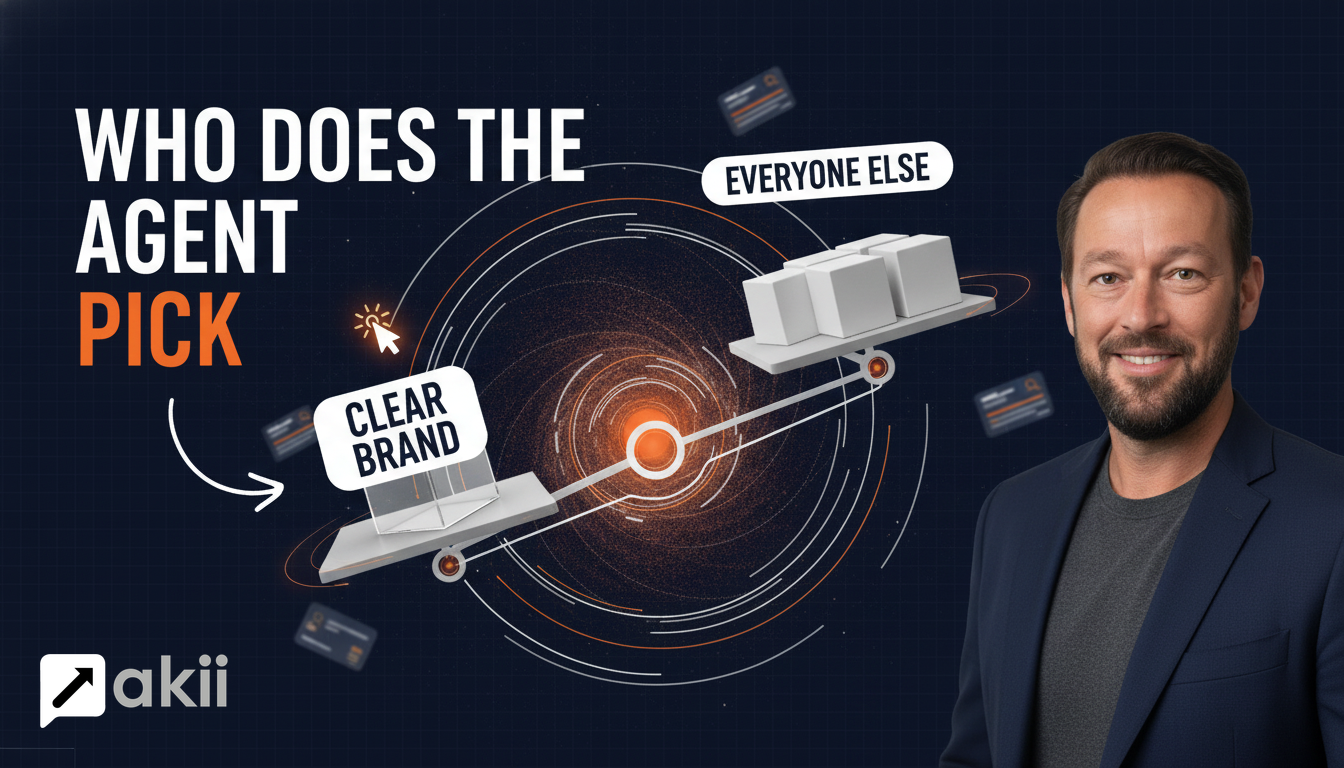
The new question isn't "How do I convince a person to buy from me?" It's "How does an agent decide I'm the obvious answer when it's comparing me to 14 competitors in four seconds?" That's a fundamentally different problem. Most businesses aren't set up to solve it.
What should founders actually do about this?
I've been through enough technology cycles to know that the window between "early signal" and "new default" is shorter than people think. Here are four shifts that matter right now.
Stop treating Google rankings as your primary strategy
This doesn't mean abandon SEO entirely. It means stop building your business on the assumption that rankings are stable and predictable. They're not anymore.
Build a brand specific enough that an AI agent selects it without needing to run a comparison. Specificity is now an algorithmic asset. Not a creative preference, not a branding exercise. A structural advantage in how agents make decisions.
If an agent is scanning options and your positioning sounds like five other companies in your category, you're a comparison result. If your positioning is distinct and clear, you're a recommendation.
Fix your positioning before agents make it irrelevant
Vague brands lose in the agentic era. Full stop.
AI agents can't pattern-match to a company that sounds like every other company in its space. They need clear signals. Who is this for? What does it do? Why is it the right choice?
Here's a simple test: could your positioning be swapped with five competitors without anyone noticing? If yes, you have a problem that's about to get worse.
This is something I think about constantly with the work we do at Akii. When AI agents are the ones deciding which brands to recommend, the companies that show up clearly and specifically in AI-generated answers win. The ones that blend in disappear. We built Akii's AI visibility service specifically because this shift was coming and most businesses aren't prepared for it.
Show up consistently with a recognizable presence
Production value has been commoditized. What hasn't been commoditized is consistency and recognizability.
The brand that shows up the same way, everywhere, every week, builds the kind of pattern recognition that matters to both humans and agents. Humans remember you. Agents learn to associate you with your category.
This doesn't require a studio. It requires showing up. Same voice. Same positioning. Same frequency. Week after week.
Clean up your product data. Now.
This is the most underrated shift on this list.
An AI agent scanning your site in four seconds needs to immediately understand what you sell, who it's for, and why it's the right choice. Specs, comparisons, reviews, structured information. All of it needs to be clear and accessible.
Here's the test: if a smart human scanning your site for four seconds would be confused, an agent will move on even faster.
Structured data, clean product information, and clear differentiation aren't nice-to-haves anymore. They're the interface between your business and the agents that are about to start buying on behalf of your customers.
This is exactly the kind of gap Akii's packages are designed to find and fix. We track where AI engines cite or recommend your competitors instead of you, find the buyer questions where your company is missing or described wrong, then prepare and ship the fixes: content, schema, source mentions, and the structured signals that agents actually read.
How much time do founders actually have?
I'd estimate 12 to 18 months of clear runway before these dynamics become the default. AP2 ships this summer. Universal Cart is live. Omni is inside Gemini.
The founders who act in the next 90 days will have a real head start. Not because the technology is hard to understand, but because most competitors will wait. They'll wait until conversion rates drop. They'll wait until they notice traffic declining. They'll wait until 2027, when the shift is obvious and the advantage is gone.
I've seen this pattern across multiple technology cycles over 25 years. The window between "this seems early" and "this is just how things work now" is always shorter than people expect.
What does this mean for how buyers discover brands?
This is the part that should keep founders up at night.
When an AI agent handles the buying process, there's no click to your website. No impression in your analytics. No abandoned cart to retarget. The customer you lose may never appear in your data at all.
That's the nature of zero-click buying. The decision happens inside the agent. The transaction happens inside the agent. Your brand either gets selected or it doesn't, and you may never know the difference.
Traditional analytics can't measure what you're losing here. You need to understand how AI engines see your brand, what they say about you when someone asks, and where they recommend your competitors instead.
The bottom line
In one week, Google made SEO slower and less predictable, gave AI agents the financial infrastructure to buy on behalf of customers without a browser ever being opened, and dropped the content production floor to zero.
The marketing funnel assumed a human at every stage. That assumption just broke.
Founders who build specific, recognizable, well-structured brands in the next 90 days position themselves as the obvious answer when agents come shopping. The ones who don't risk becoming a comparison result on a screen their customer never sees.
This isn't about panic. It's about recognizing a structural shift and moving before the window closes.
If you want to know where your brand stands in AI search right now, book an AI Search Audit and we'll show you exactly what agents see when someone asks about your category. Prefer to start with a question? use the contact form. No pitch. Just clarity on where you stand.