


AI made it dramatically easier to build software. It did not make it easier to build a durable software business.
That difference is shaping the next phase of Akii Technologies.
I describe my work as founder, investor, and AI venture builder because those roles have increasingly become one job. A small team can now move from idea to working software at a speed that would have been hard to imagine a few years ago.
The harder questions start immediately after.
Does the problem matter enough? Can the product survive contact with real customers? Who funds and operates it? Who handles billing, support, administration, and governance?
Most importantly: how will it earn distribution?
A demo can prove that an idea is technically possible. It cannot prove that the idea deserves a business around it.
What does Akii Technologies actually do?
Akii Technologies Ltd repeatedly creates, directly owns, and operates AI businesses and products from Dubai.
The products are not spun into separate companies. Akii provides the common operating structure behind them: corporate structure, product development and operation, billing, licensing, funding, administration, and governance.
That distinction matters. We are not a development agency building ventures for outside founders. We build and operate our own businesses, accepting the long-term responsibility that comes with them.
Akii.com remains an active part of that work. It operates at the practical edge of generative engine optimization, SEO, and AI commerce, helping agencies organize approved business facts, offers, policies, sources, and customer actions into a Commerce Graph so AI systems can understand them more reliably and guide buyers toward the right next step.
The scale of the problem is real. Across 94,414 completed diagnostics in the Akii Agentic Commerce Coverage Index, 85.7% of scanned businesses scored under 40 out of 100 on readiness for AI commerce. Content coverage was the weakest measured dimension. Most businesses simply are not structured for how buyers are starting to find and choose services.
That matters more than it used to. 51% of B2B software buyers now start research with an AI chatbot more often than Google (G2, 2026). In the UAE specifically, 80% of surveyed consumers use AI to shop (Visa, 2025). The shift is not theoretical. It is already changing who gets found and who gets skipped.
Akii.com is active and continuing. Marquorum and Revenue Scout are expansions of Akii Technologies, not a pivot away from Akii.com.
Why does infrastructure compound across ventures?
The advantage of venture building is not simply that infrastructure can be reused. Learning compounds too.
Billing systems, operational controls, product judgment, customer support, and governance get more capable with every product, instead of being rebuilt from scratch each time.
But there is one capability that most product builders still try to add too late.
Distribution.
85.7% of completed Akii scans scored below 40/100.
| Metric | Share of scans |
|---|---|
| Under 10 | 34% |
| 10-19 | 27.8% |
| 20-39 | 23.9% |
| 40-59 | 9% |
| 60+ | 5.3% |
Commerce Graph Index · 94,414 completed diagnostics · Jun 2026
What is wrong with how most affiliate programs work?
The conventional sequence is familiar:
- A company selects an idea.
- It builds the product.
- It decides how to position it.
- It recruits affiliates to distribute what has already been created.
By the time partners enter the process, the most expensive decisions have already been made.
The company is effectively asking the market to rescue its assumptions. Partners may know their audiences need something different, but their role begins only after the product is finished.
I've seen this pattern repeat across multiple technology cycles. The builder assumes demand. The distributor inherits the consequences. And the feedback that could have prevented a bad bet arrives too late to matter.
I wanted to reverse that relationship.
How does Marquorum change the sequence?
Marquorum is a creator-powered affiliate network for useful AI software. It is also Akii Technologies' partner-powered venture-selection and distribution platform.
Both descriptions matter.
Marquorum gives partners production-ready products to evaluate and promote. It also gives active partners a direct role in determining which Marquorum-distributed product Akii builds next.
What does "active partner" mean?
Active means a partner has generated tracked traffic and/or sales during the preceding 30 days. A passive account does not receive the same influence as a partner currently doing the work of understanding an audience, testing offers, and building distribution.
This is deliberate. Voting rights belong to people with skin in the game, not just an account.
How does the proposal and voting process work?
Active Marquorum partners can propose future product opportunities and vote on eligible ones.
Akii qualifies opportunities before they reach the ballot. That is an important responsibility. A proposal must be sufficiently legal, technically feasible, and economically credible before it can become the subject of a binding vote.
Once an eligible result is certified, Akii follows the result and builds what the partners selected.
That is the essential difference. Partners do not merely comment on an internal product roadmap. Within the Marquorum model, active partners help originate the opportunities and determine which qualified project goes forward.
What happens if something goes wrong after a vote?
Akii can stop a selected project if a previously unknown legal, technical, or economic problem emerges. No responsible operator can promise to ignore facts that make a product unlawful, infeasible, or commercially impossible.
But that exception cannot become a quiet way to disregard the vote. The original result, the new information, and the reason for changing course must remain visible through the published governance process.
Who owns what?
Partners do not invest in the products, receive equity, or take responsibility for operating them. Akii funds, builds, owns, and operates the products. Marquorum gives qualifying partners proposal and voting rights, then supplies the distribution system through which suitable products reach relevant audiences.
The division of work is clean:
- Partners contribute opportunities, market judgment, votes, audience knowledge, and distribution.
- Akii assumes the capital, development, operational, commercial, and governance responsibility.
- Customers decide whether each product creates enough value to keep using it.
Each side contributes something the other cannot manufacture alone.
Akii observations show single-digit average brand presence across major AI answer surfaces.
| Metric | Average presence |
|---|---|
| Google AI | 1.6% |
| ChatGPT | 3.4% |
| Perplexity | 3.5% |
| Copilot | 4.3% |
Commerce Graph Index · 1,800,000 brand-platform-day observations
Why does building distribution into the process matter?
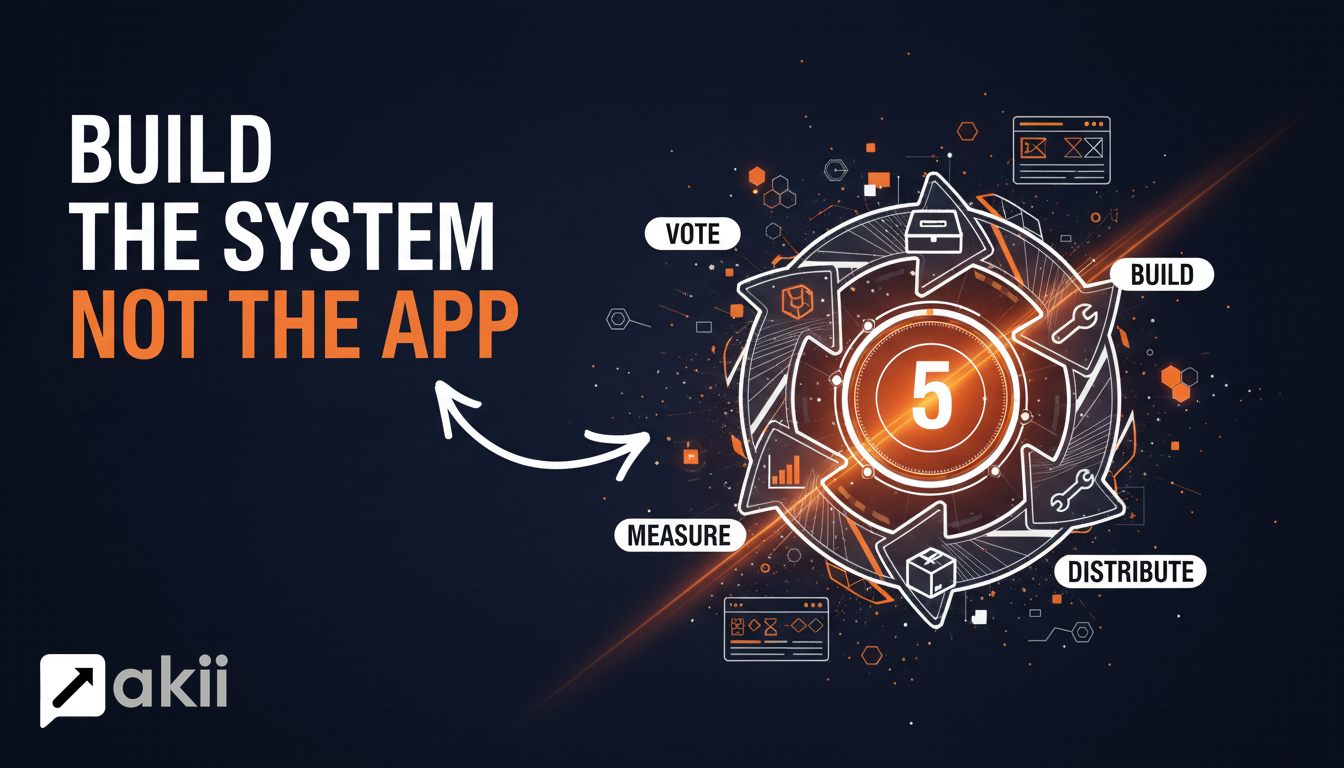
The model is designed to work as a loop:
- Active partners propose product opportunities for the Marquorum portfolio.
- Akii qualifies which opportunities are suitable for a binding ballot.
- Active partners vote on the eligible choices.
- Akii builds, owns, and operates the certified winner.
- Marquorum distributes it through partners whose audiences genuinely fit.
- Customer behavior and partner performance inform the next cycle.
This does not guarantee that every product will succeed. Nothing does.
What it does address is one of the most common forms of startup blindness: building in isolation, then treating distribution as a launch-day problem. The people closest to relevant audiences participate before the product is selected. The company responsible for delivery still performs the diligence and accepts the operating risk. The vote has practical consequence, but it does not confuse participation with ownership.
What is Revenue Scout and why is it first?
Revenue Scout is the first new product we are bringing to market through Marquorum.
It solves a problem that is easy to recognize and difficult to handle consistently. Potential customers discuss needs, ask for recommendations, compare alternatives, and describe broken workflows across public social platforms every day. Most businesses miss those conversations because finding the useful ones requires hours of repetitive searching and filtering.
Revenue Scout monitors supported public platforms, vets conversations for current need and offer fit, and prepares replies for the strongest matches. The customer reviews and edits every reply before posting manually from their own account.
The product handles repetitive discovery. The customer keeps control of the conversation.
Revenue Scout is deliberately focused. It has its own customer experience and commercial logic, while benefiting from Akii's operating capabilities and Marquorum's distribution system.
It is the first practical test of whether this venture-building model can create a stronger loop between opportunity selection, product operation, partner participation, and customer demand.
The weakest Akii-scored dimensions point to content coverage, merchant clarity, and source quality.
| Metric | Average score |
|---|---|
| Content coverage | 22.8 |
| Brand sentiment | 23.5 |
| Executive summary | 28 |
| Brand recognition | 30.3 |
| Brand understanding | 35.2 |
Commerce Graph Index · 101,700 scored diagnostics
What is the real compounding asset here?
The long-term value of Akii Technologies will not come from producing the largest possible number of AI apps.
Volume is easy to imitate, especially now.
The more durable asset is the system around the products:
- 1. The ability to qualify product opportunities before big capital is committed.
- 2. Active partners who can propose, select, and distribute relevant products.
- 3. Shared operating infrastructure that turns a focused idea into a dependable subscription business.
- 4. Disciplined measurement of activation, retention, contribution, and real customer value.
- 5. Direct ownership that keeps accountability with the company responsible for execution.
- 6. Market intelligence created when partner performance and customer behavior meet.
Each product should make that system more capable. Each launch should improve the next qualification decision. Each strong partner relationship should be able to outlast an individual offer.
That is the difference between collecting apps and building ventures.
Why Dubai, and why does it matter?
Dubai is a natural base for this work. It combines international reach, ambitious technology adoption, and a practical appetite for building new businesses.
The numbers back this up. 64% of the UAE working-age population use AI, the highest rate in the world (Microsoft, 2025). PwC projects roughly 14% of UAE GDP will come from AI by 2030, about US$96 billion. This is not a market waiting for AI to arrive. It is already here.
Akii Technologies Ltd operates from the Dubai International Financial Centre. The location matters, but the ambition is global: identify focused opportunities, build useful AI products, operate them responsibly, and connect them to a distribution system that gets stronger over time.
AI made software faster to build. Our job is to build the operating and distribution system that gives the right products a better chance to become durable businesses.
If you are a creator or publisher interested in the Marquorum model, the application is open at marquorum.com.