
The Revenue Signal Nobody's Watching
More organic traffic meant more pipeline. That was the operating assumption for the past decade, and it held up long enough that most revenue teams stopped questioning it.
That assumption is breaking now.
Buyers are using answer engines. When someone asks ChatGPT, "What's the best CRM for a 50-person sales team?", the AI doesn't hand back a list of links to browse. It reads reviews, compares pricing, evaluates features, and delivers a shortlist. Four or five names. Maybe three.
If your brand isn't on that list, you don't get the traffic. No lead. No deal. You were filtered out before the funnel even started.
I've watched this pattern play out across multiple technology cycles. The companies that recognize the shift early build durable advantages. The ones that wait spend years trying to catch up, usually without understanding why they fell behind in the first place.
For founders, CROs, and RevOps leaders, this isn't a marketing problem. AI visibility is a leading indicator of future revenue health. It measures whether your brand survives the first filter in the modern buyer's journey.
What Actually Changed in How Buyers Discover Products?
The mechanical shift in discovery is what makes this different from previous SEO cycles.
The AI as first filter
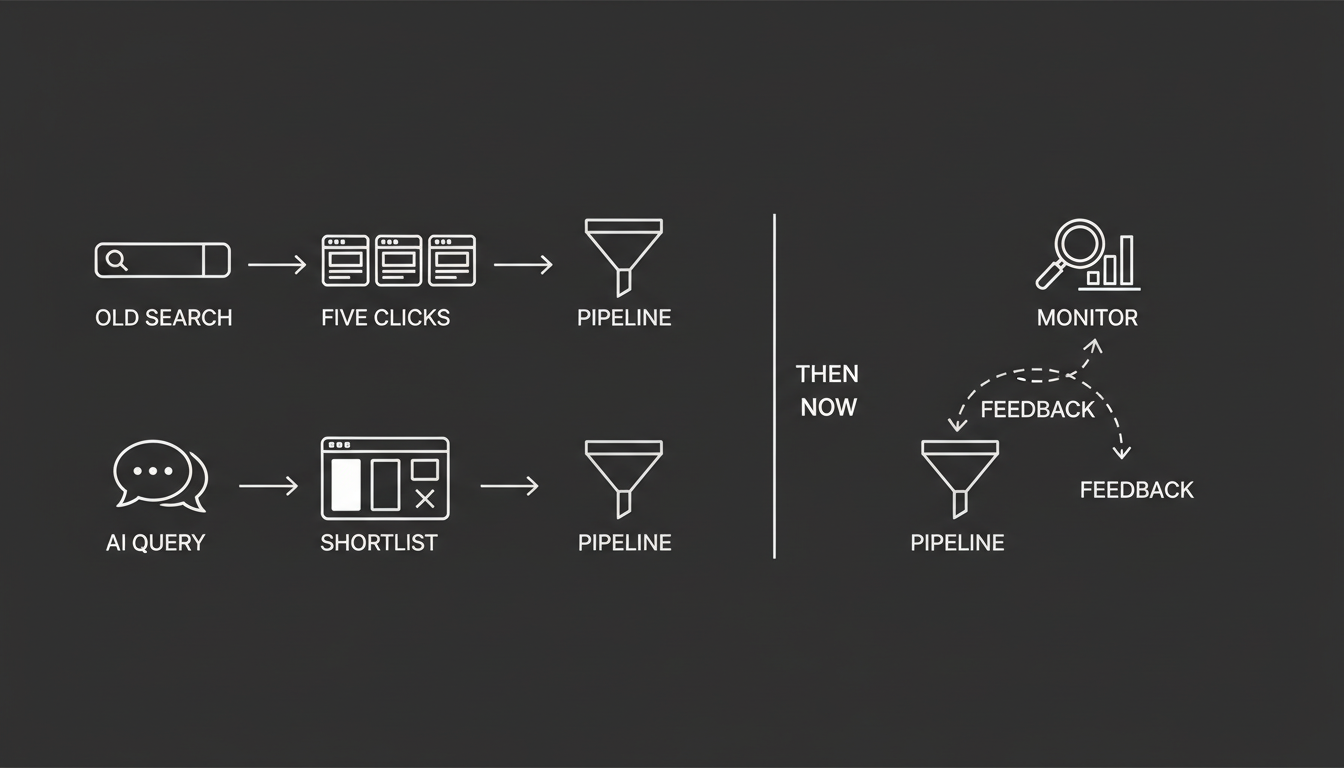
Traditional search engines work like libraries. They index pages and let users browse the shelves. Success meant ranking. Are we on the shelf?
AI models work like analysts. They read the entire library, synthesize it, and hand back a single report. Success means inclusion. Did we make the report?
That difference is big.
The old world: A buyer searches "Top HR Software," clicks five links, and browses five sites. Five chances to make your case.
The new world: A buyer asks, "Compare the top HR platforms for remote teams," and the AI delivers a summary. You either made the cut or you didn't.
If your brand is excluded from that summary, you've been filtered out before the funnel begins.
What does zero-click actually mean for revenue?
Industry analysis suggests roughly 68.5% of web traffic is now influenced by AI search. But "influenced" often means the user got their answer without clicking anything at all.
For a revenue leader, that should be alarming. Demand is being captured inside the chat interface itself. If an AI model calls your competitor the "industry leader" and frames you as a "legacy alternative," that narrative is set in the buyer's mind before they ever visit your site.
You aren't just losing a click. You're losing the framing battle. And framing determines whether a prospect shows up ready to buy or never shows up at all.
How Does AI Visibility Actually Affect Pipeline Quality?
Most people think AI visibility is about volume. It's not. It's about context. How the AI describes your brand directly shapes the quality of leads that reach your sales team.
Pre-qualified demand is real
When an AI model accurately understands your brand, it acts as a pre-qualification engine. Two scenarios make this concrete:
Poor visibility: The AI describes your enterprise platform as a "free tool." You get flooded with low-quality leads who churn immediately when they see your pricing.
High visibility: The AI describes you as "best for enterprise security." The leads who arrive already understand your value proposition and price point.
AI visibility reduces downstream friction. When the machine has correct data on pricing and features, it sets the right expectations before the human conversation starts. That's not a marketing win. That's a sales efficiency win.
Fewer "Why you?" conversations
In traditional sales cycles, the first call is often spent explaining who you are and why you exist. I've sat through hundreds of those calls over 25 years. They're expensive and they slow everything down.
High AI visibility changes the starting line. If Perplexity or ChatGPT has already cited you as a top recommendation alongside market leaders, the prospect arrives with borrowed authority. The credibility check already happened during the search phase.
The conversation moves from "Who are you?" to "How do we set up?"
How much is that worth per deal? Do the math on your average sales cycle length and cost per rep hour. The number will get your attention.
What's the Most Dangerous Revenue Leak Nobody's Talking About?
Category misclassification. It's quiet, invisible to your existing dashboards, and it's costing companies deals they'll never know they lost.
AI models rely on knowledge graphs to understand what things are. If a model fundamentally misunderstands what you sell, it will exclude you from the exact queries that drive revenue.
Being defined correctly vs. incorrectly
Consider a specialized B2B software company.
The reality: They sell AI-powered procurement automation.
The AI's understanding: Due to inconsistent data across LinkedIn and Crunchbase, Gemini categorizes them as "accounting software."
When a buyer asks for "procurement automation," the AI excludes this brand. Not because they lacked features. Because the AI thinks they're an accounting tool.
The brand loses the deal and never knows it happened. No "lost opportunity" record in the CRM. No declined proposal. Just silence where pipeline should have been.
I've seen this exact pattern with companies I've worked with. The fix is usually straightforward once you know the problem exists. Most teams don't know, because they're not looking.
Why Can't Your Current Attribution Stack Capture This?
If AI visibility is this critical to revenue, why isn't it already in the weekly RevOps dashboard? Because traditional attribution tools are structurally blind to it.
The lagging analytics problem
Tools like Google Analytics and HubSpot track clicks. They rely on UTM parameters and cookies.
Here's the gap: when a user reads a Perplexity summary and then types your URL directly into their browser, it registers as "Direct Traffic." No context. No source. No signal.
The consequence is worse than a data gap. Revenue teams see a spike in direct traffic but can't explain it. They cut budget for brand awareness because they can't prove ROI, unknowingly shutting off the fuel for their AI visibility.
I've watched teams make exactly this mistake. They improve what they can measure and starve what they can't. In this case, what they can't measure is the thing actually driving demand.
The "dark influence" problem
You can't track a specific ChatGPT session to a closed-won deal the way you track a Google Ad. But you can track the correlation between AI visibility and pipeline velocity.
Watch this signal: if your brand understanding score drops, indicating AI hallucinations about your product, you'll likely see a dip in lead quality 30 days later. If your inclusion rate rises, you'll see a lift in direct traffic and demo requests.
The signal is there. You just need the right instrument to read it. That's exactly why Akii exists.
How Should Revenue Teams Actually Think About This?
For the C-suite, AI visibility comes down to two things: risk mitigation and conversion efficiency.
Risk mitigation
Your digital reputation is an asset, whether your accountants recognize it or not.
If ChatGPT is telling its 200 million weekly users that your product is "overpriced" or "lacking support" based on ingested negative sentiment, that's an active liability working against your sales team in real time, in conversations you can't see or control.
Revenue leaders should treat AI hallucinations the way they'd treat a PR crisis. It requires immediate correction through entity-level optimization and active AI engagement to protect the brand's integrity.
Conversion efficiency
Here's the practical math. Fixing your data so the AI recommends you organically is cheaper than buying ads to fight for attention against the AI's own recommendation.
Think about that. You're spending money on ads to compete with a machine that's already made up its mind about who to recommend. Fix the input, and the output changes. That's a better use of budget by any measure.
Building for answer engines means the majority of AI-influenced traffic sees the best version of your brand. That's not marketing spend. That's conversion rate improvement at the top of the funnel.
What Does the Practical Playbook Look Like?
You can't manage what you don't measure. Here's the workflow for revenue teams to take control of AI visibility. No theory. Just steps.
Step 1: Audit the leak
Before you fix anything, you need to know whether the AI knows you exist and whether it describes you accurately.
Action: Run an AI visibility check. Akii's features are built specifically for this.
What to look for: Check your brand understanding score. Below 70% means the AI is likely misclassifying your product or hallucinating your pricing. That's a direct drag on pipeline quality.
The commercial question to ask: "Is the AI telling the truth about our pricing and core value prop?"
If the answer is no, everything downstream is compromised.
Step 2: Fix the technical infrastructure
Once you identify the gaps, fix the data pipeline. AI models need structured data to read your site correctly.
Action: Deploy product and offer schema markup on your pricing and product pages.
How: Explicitly tag your price, currency, availability, and core feature categories in machine-readable format.
Why this matters: It forces the AI to treat your pricing as a fact, not a guess. It stops the model from saying "pricing unavailable" or quoting figures from three years ago. Structured data is the difference between the AI knowing what you sell and the AI guessing.
Step 3: Build external authority
To move from being "listed" to being "recommended," you need external validation. AI models are risk-averse. They trust third parties more than they trust you.
Action: Secure external corroboration across high-trust sources.
How: Audit where your competitors are cited. Make sure your brand is present and consistent on high-trust nodes like G2, Crunchbase, and Wikidata. When TechCrunch, Gartner, or a credible industry source validates your claims, the AI is significantly more likely to include you.
Why: The AI doesn't just read your website. It reads everything about you, everywhere. Consistency across those sources is what builds machine-level trust.
Step 4: Monitor continuously
AI models update weekly. A hallucination can appear overnight. A competitor can displace you in a single model refresh.
Action: Set up continuous monitoring. Akii's pricing page outlines options for ongoing tracking.
The revenue routine: Add AI visibility trends to your monthly RevOps review. If visibility drops, investigate immediately. It's a leading indicator that your market presence is eroding before it shows up in your pipeline numbers.
This isn't a one-time project. It's an ongoing discipline, the same way you monitor pipeline coverage ratio or win rate.
What Does This Mean for the Next 12 Months?
In 2010, the brands that won mastered keywords and backlinks. In 2026, the brands that win will be the most machine-readable, consistent, and authoritative across the data sources AI models actually consume.
For revenue leaders, AI visibility is not a technical detail to delegate to the SEO manager. It's a strategic signal of market presence. It determines whether your brand is part of the conversation when buying decisions are made.
I've been through enough technology transitions to know what the early innings look like. This is one of them. The companies that build this muscle now will have a structural advantage that compounds over time. The ones that wait will spend the next three years wondering why their pipeline dried up while their website traffic looked fine.
The question isn't whether AI visibility matters to revenue. It does. The question is whether your team is measuring it yet.
If you're not visible to the AI, you're not visible to the market. And if you're not visible to the market, your revenue forecast is built on a foundation that's already shifting underneath you.