
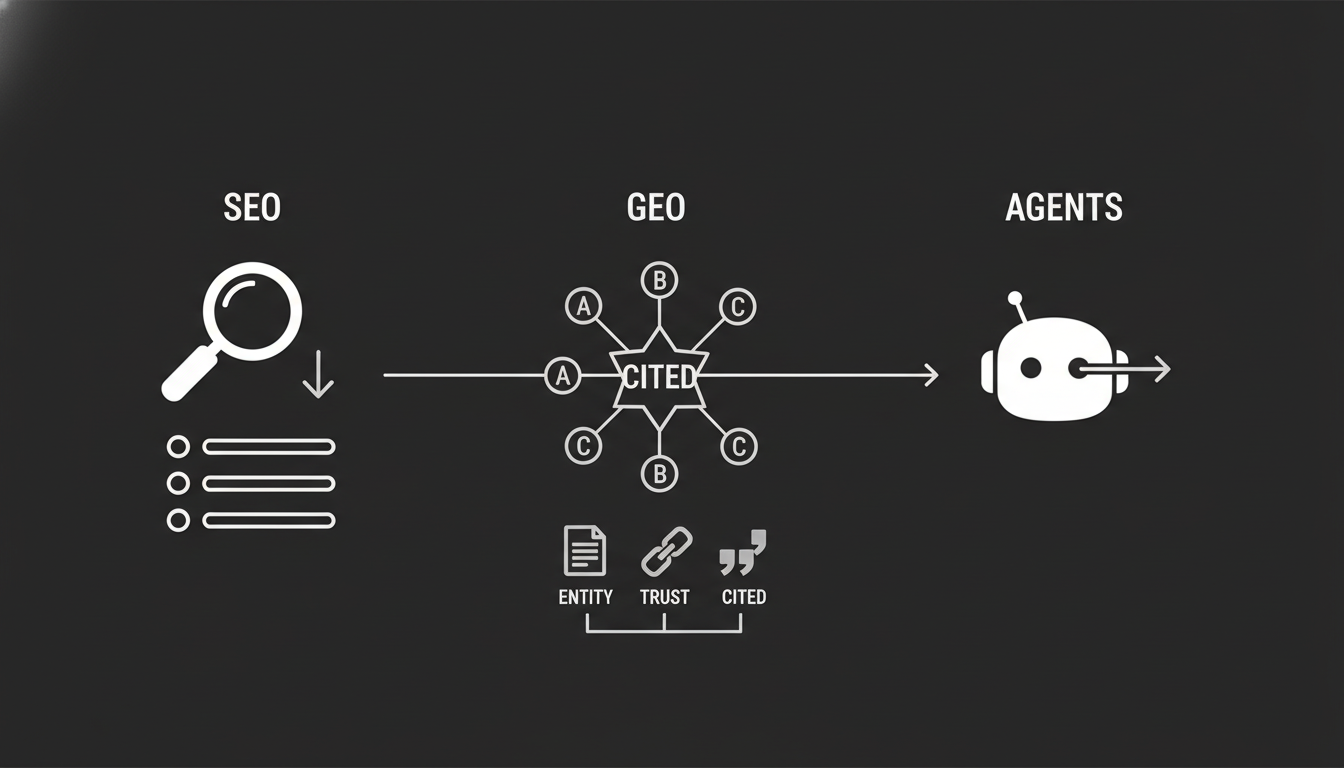
The Search Box Isn't a Search Box Anymore
For twenty years, the internet ran on one basic contract: improve for Google, Google sends you traffic. Keywords, backlinks, page speed, meta tags. An entire industry grew up around getting your URL into a list of ten blue links.
That contract is expiring.
When someone asks ChatGPT for a product recommendation, or uses Perplexity to compare software pricing, or gets an answer from Google's AI Overviews, they're not browsing a list of websites. They're reading a synthesized answer. One response, assembled from multiple sources, delivered as a finished thought.
If your brand isn't part of that answer, you don't exist in that moment. Doesn't matter if you rank number one in traditional search. The user never saw the list.
This is the shift that created Generative Engine Optimization, or GEO. If you're running a business that depends on being found online, which is most businesses, this is the most important change in digital visibility since Google itself.
So What Is GEO, Exactly?
Generative Engine Optimization is the practice of making your brand visible, citable, and trustworthy to AI systems that generate answers.
That's the short version. Here's what it actually means in practice.
When an AI engine constructs an answer, it doesn't just pull up a webpage and copy it. It runs a multi-step process.
Retrieval. It scans its internal knowledge graph and the live web for relevant entities: people, companies, products, concepts.
Reasoning. It evaluates relationships between those entities. Is this company credible? Does this product match what the user is asking about? Are external sources consistent about what this brand does?
Synthesis. It generates a natural language response, citing the sources it trusts most.
GEO is about influencing that process. Not gaming it. Making your brand's information so clear, so consistent, and so well-corroborated that the AI has no reason to leave you out.
Traditional SEO asks: "How do I rank higher in a list?" GEO asks: "How do I become the answer?"
How Is GEO Different from SEO and AEO?
Three acronyms are showing up in every marketing strategy meeting right now. They overlap, but they serve different purposes. Confusing them leads to wasted effort.
SEO (Search Engine Optimization) is about ranking in a list of links. The target is Google's traditional algorithm. The primary tools are keywords and backlinks. The goal is clicks.
AEO (Answer Engine Optimization) is about structure. Making your content machine-readable so AI crawlers can parse it cleanly. The tools are schema markup, clean formatting, and what I'd call "quotable canonicals": sentences designed to be extracted. The goal is to be parseable.
GEO (Generative Engine Optimization) is about authority. Building enough external credibility that an AI's reasoning layer trusts you enough to cite you. The tools are entity consistency, third-party citations, and sentiment signals. The goal is to be chosen.
Here's the distinction that matters most: SEO is about matching keywords. GEO is about earning trust from a reasoning engine.
Most brands are still applying SEO logic to a GEO problem. They're tuning pages for keywords when they should be building entity authority across the web. That's like tuning a radio when the world has moved to streaming.
Why Does This Matter Right Now?
Because the way people find information has already changed, and the data reflects it.
Industry analysis suggests that 68.5% of web traffic is now influenced by AI search. Users are getting answers without clicking through to websites. A developer asks ChatGPT for documentation. A CFO asks Gemini to compare SaaS pricing. A consumer asks Perplexity which running shoe works best for flat feet.
In each case, the "search" happens inside the chat interface. The answer is delivered there. The click may never come.
This is the zero-click reality. What it changes is what visibility actually means.
If your brand is cited in a generative answer, you get something more valuable than a click. You get an implicit endorsement from the AI itself. You're positioned as a verified source, framed as the answer rather than one of ten options.
If you're not cited? You're not in the conversation. Full stop.
I've watched multiple technology shifts over 25 years. The pattern is always the same: the new channel starts as a novelty, becomes a habit, and then becomes the default. AI-generated answers are already past the habit stage for millions of users. If you're waiting to see how this plays out, you're already behind.
What Are the Core Pillars of a GEO Strategy?
GEO isn't one tactic. It's a framework built on several pillars, each one addressing a different part of how AI engines decide what to trust.
Pillar 1: Entity Saturation
AI models don't see the web as a collection of pages. They see it as a network of entities: people, organizations, products, concepts. Your first job in GEO is making sure your entity is clearly established and consistent everywhere it appears.
Why does consistency matter so much? AI models look for what you might call "verified nodes." They trust information that shows up the same way across multiple credible sources. If your website says one thing, your Crunchbase profile says another, and your LinkedIn says something else entirely, the model detects a conflict. When there's a conflict, the safest move for the AI is to leave you out. It would rather say nothing about you than risk being wrong.
The practical move is creating a Master Entity Profile. One unified description, one consistent taxonomy, one boilerplate. Replicate it across your website, LinkedIn, Crunchbase, Wikidata, G2, and anywhere else your brand has a presence.
On the technical side, make sure your Organization Schema includes sameAs links pointing to each of these profiles. This tells the AI explicitly: the entity on this website is the same entity listed on these other platforms. Small detail, major weight in how models resolve identity.
Pillar 2: Quotable Canonicals
AI engines extract answers the way a rushed executive skims a document. They're looking for concise summaries, clear definitions, and direct answers to specific questions.
If your content buries the answer in paragraph seven of a 3,000-word post, the AI will find someone else's content that leads with the answer. This isn't about dumbing things down. It's about structuring content to be liftable.
What does that look like? Put a two to three sentence summary at the top of every article. Use question-based headings that mirror how real people ask things. Follow those headings immediately with a direct, declarative answer.
If someone asks an AI "What is GEO?" the model is looking for a sentence that starts with "GEO is..." If your content provides that cleanly, you're far more likely to be the source it pulls from.
This is where AEO and GEO overlap. Good structure makes you parseable. But structure alone isn't enough. You also need the authority signals that make the AI choose your structured content over someone else's.
Pillar 3: External Corroboration
This is where GEO diverges most sharply from everything that came before it.
Traditional SEO rewards what you say about yourself on your own site. GEO rewards what others say about you on theirs.
AI models are risk-averse by design. They're built to avoid hallucinations, the technical term for confidently stating something false. So when a model is deciding whether to cite your brand, it's looking for external corroboration. Are trusted third parties saying the same things you're saying about yourself?
A mention in a Gartner report. A strong G2 profile with consistent reviews. Coverage in a publication like TechCrunch. A well-maintained Wikidata entry. These are the "high-trust nodes" that give the AI permission to cite you.
Your own blog post claiming you're the best at something? That's not evidence to a reasoning engine. Ten independent sources confirming it? That's ground truth.
Your PR strategy, your review management, and your presence on authoritative platforms are now directly tied to your AI visibility. They're not nice-to-haves. They're the foundation of whether you get cited or ignored.
How Does GEO Strategy Change by Industry?
AI models don't apply the same reasoning logic to every query. The trust signals that matter for a software company are different from those that matter for a healthcare provider or a consumer brand. Treating GEO as one-size-fits-all is a mistake.
SaaS Companies
AI engines lean heavily on review platforms and comparison content when answering software questions. If someone asks "What's the best project management tool for remote teams?" the model is pulling from G2, Capterra, and curated "best of" lists.
The GEO priority here is entity saturation across the review platform space. Your G2 profile, your Capterra listing, your Crunchbase entry all need to be consistent, complete, and actively maintained. Your "Brand Understanding" score in AI models depends on these nodes confirming your feature set and positioning.
eCommerce and DTC Brands
This is harder. AI engines tend to favor platforms like Amazon over individual brand sites, unless the brand has strong earned media coverage. A direct-to-consumer brand with a beautiful website but no press mentions will rarely surface in AI answers.
The GEO priority for DTC is earned media. Get profiled. Get reviewed by publications your customers actually read. And on the technical side, use Product Schema so your pricing and availability are machine-readable.
Healthcare and Local Services
AI engines are extremely cautious here. The risk of giving bad medical or legal advice is high, so models default to established institutional sources like Mayo Clinic, government health sites, and well-known non-profits.
For healthcare providers and local service businesses, the GEO priority is trust signals. Aggressively manage your reviews on Healthgrades, Google Maps, and similar platforms. Negative sentiment doesn't just hurt your reputation with humans. It can cause an AI to filter you out entirely to protect the user.
How Do You Measure GEO Success?
This is the question I hear most from operators. If traditional rank tracking doesn't apply to AI answers, which are dynamic, personalized, and often zero-click, what do you actually measure?
You have to shift your KPIs from positions to visibility intelligence.
At Akii, we built the AI Brand Audit specifically for this problem. It automates tracking of your brand's presence across major models like ChatGPT, Gemini, and Claude. Unlike static SEO audits, it measures performance across several critical dimensions of AI visibility.
Brand Recognition measures how often AI models mention your brand when users ask for recommendations in your category. Are you part of the conversation at all?
Brand Understanding assesses accuracy. Does the model correctly describe your products and value proposition, or is it generating false information about your business?
Content Coverage evaluates your topical authority. How well does your content address the specific questions and intent-based topics your customers care about?
Brand Sentiment tracks how the AI describes you. Is it positive, based on strong trust signals? Or is it surfacing cautionary language and negative reviews?
The audit runs ongoing weekly scans, so you can set automated alerts for visibility changes, compare your Overall Visibility Score against industry benchmarks, and track trends over time. That last part matters because proving ROI on GEO efforts requires showing movement, not just a snapshot.
You can explore the full set of features here, and pricing is straightforward.
What Comes After Answer Engines?
We're currently in the transition from search engines to answer engines. The next phase is already taking shape: autonomous agents.
By the end of 2026, AI agents won't just answer questions. They'll perform tasks. Book travel. Purchase software. Compare vendors and make recommendations without a human ever opening a browser.
These agents won't browse the web the way we do. They'll retrieve data from knowledge graphs and make decisions based on exactly the GEO signals we've been discussing. Is this entity verified? Is the data structured? Is the authority corroborated by trusted sources?
If your brand isn't optimized for GEO today, you're not just losing search visibility. You're becoming invisible to the automated economy that's forming right now.
I've seen enough technology transitions to know that the companies who move early don't just survive the shift. They define the new ground while everyone else scrambles to catch up.
The Real Point
GEO isn't a marketing trend. It's a structural change in how businesses get found.
For twenty years, you optimized for a crawler that matched keywords. Now you need to earn trust from a reasoning engine that understands entities, evaluates authority, and makes judgment calls about who to cite.
The brands that win in this new reality will be the ones that are clear about what they are, consistent across every platform, and corroborated by sources the AI already trusts.
Stop improving for 2010. The AI isn't looking at your keyword density. It's deciding whether you're credible enough to be the answer.
That's a harder bar to clear. But it's also a more honest one. And if you've been doing good work, building real authority, and serving your customers well, GEO is the discipline that makes sure the machines know it too.