
The question everyone should be asking right now
For 20 years, digital marketing revolved around one obsession: Are we on page one of Google?
That yardstick is broken.
The way people find information has changed at a structural level. We've moved from ten blue links to synthesized answers. Today, 75% of searches don't result in a click to a website. Users get their answers instantly through AI systems, rich snippets, and voice assistants.
Think about what actually happens now. When a potential buyer asks ChatGPT, "What's the best CRM for a small marketing agency?", the AI doesn't present a list of links to browse. It acts as a gatekeeper. It retrieves data, synthesizes reviews, compares pricing, and delivers a curated shortlist of recommendations.
If your brand isn't cited in that answer, you're invisible. Even if you rank number one in traditional organic search.
That shift has created a new discipline most teams haven't caught up to yet: Answer Engine Optimization, or AEO.
So what is AEO, exactly?
Answer Engine Optimization is the practice of engineering your brand, content, and technical infrastructure so that AI agents like ChatGPT, Gemini, Claude, and Perplexity cite, recommend, and reference you directly.
That's the short version. Here's why it matters.
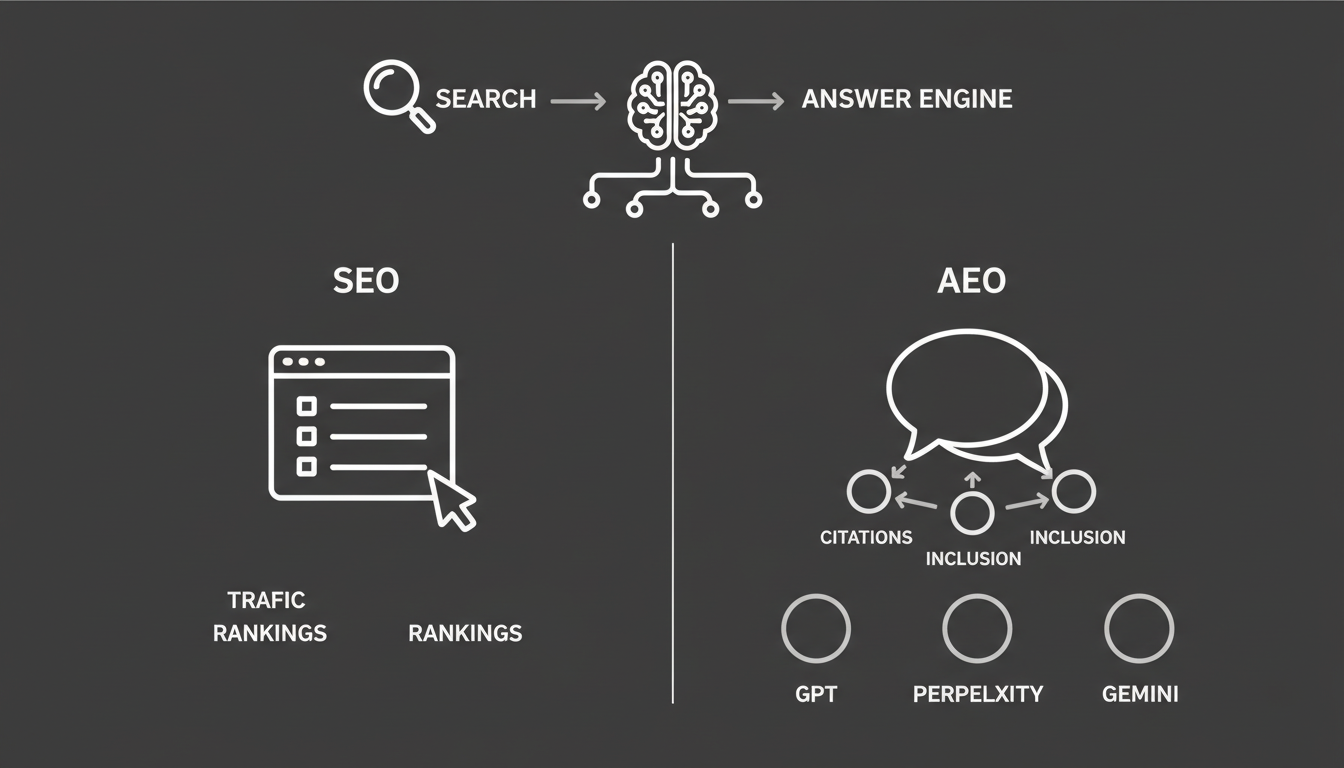
Traditional SEO focuses on driving traffic to a website via rankings. AEO is different. It's about driving mentions, citations, and direct answers. It ensures that when a Large Language Model constructs a response to a user's query, your brand is the verified node it chooses to quote.
I've watched technology cycles reshape marketing for over 25 years. The pattern is always the same: the underlying infrastructure changes, and the teams that recognize it early build a durable advantage. The teams that wait end up playing catch-up for years.
AEO is one of those shifts.
To understand it, you need to understand how the technology of search has actually changed. Traditional search engines are indexes. They match keywords in a query to keywords on a page. Modern AI models are reasoning engines. They don't just fetch links. They run a more complex workflow:
Crawl and Ingest. They read the web to build an internal understanding of the world.
Reason. They analyze relationships between entities. For example: "Akii" is an "AI Search Intelligence Platform."
Synthesize. They construct a concise, natural-language answer based on probability and trust.
Deliver. They present the answer to the user, sometimes with a citation, often without.
AEO is about making your brand readable and trustworthy to this specific workflow. It's about moving from being a search result to being the answer.
Does AEO replace SEO?
No. This is where most people get it wrong.
SEO and AEO are parallel disciplines that serve different stages of the modern user journey. Treating them as competitors misses the point entirely.
SEO is designed for the Browser. It works for a human scrolling through a list of options. Success is measured in rankings, impressions, and clicks. The risk is landing on page two.
AEO is designed for the Agent. It works for a machine synthesizing a single result. Success is measured in Inclusion Rate (how often you're mentioned) and Sentiment (how favorably you're described). The risk isn't low ranking. It's total exclusion.
Here's a clean comparison:
| | SEO (Traditional) | AEO (The Future) | |--|--|--| | Primary Goal | Drive traffic to a URL | Drive mentions and citations in answers | | Target Audience | Human users browsing links | AI agents synthesizing data | | Key Mechanism | Keywords and backlinks | Entities and Knowledge Graphs | | Success Metric | Click-Through Rate (CTR) | Brand Visibility Score and Inclusion % | | Content Style | Long-form, "Skyscraper" content | Concise, structured "Quotable Canonicals" | | Technical Focus | Site speed and Core Web Vitals | Schema markup and entity consistency |
A winning strategy in 2026 requires both. SEO captures the traffic that still clicks. AEO ensures you exist in the 68.5% of web traffic now influenced by AI search.
If you're only doing one, you're leaving half the board uncovered.
How do AI models actually "read" your brand?
Most marketing teams haven't internalized this part yet.
To succeed in AEO, you have to stop thinking in terms of pages and start thinking in terms of Knowledge Graphs. AI models don't view your website as a collection of text. They view the world as a network of Entities connected by Relationships.
Entities are the nodes. Example: "Akii."
Attributes are the facts. Example: "AI Search Intelligence Platform."
Relationships are the links. Example: "Akii created the Website Optimizer."
When an AI model receives a query, it scans its Knowledge Graph for verified nodes that match the user's intent. If your brand is a strong, verified node with clear attributes, you get recommended. If your data is unstructured or inconsistent, the model treats you as a hallucination risk and cuts you out.
That last part deserves a moment. The AI doesn't rank you lower. It drops you entirely because including you would increase the probability of being wrong.
What does the AI actually check before recommending you?
Every time a high-intent query comes in, AI models run brands through a rapid four-part interrogation. Think of it as the test your brand has to pass before it earns a mention.
1. Who are you? (Entity Identification)
The model first checks if you're a recognized entity. Do you have a consistent presence across Wikidata, Crunchbase, LinkedIn, and your own site?
Here's where it gets tricky. If your description varies ("Enterprise Software" on LinkedIn vs. "SMB Tool" on your site), the model loses confidence. Inconsistency is a disqualifier. Full stop.
2. What do you do? (Functional Clarity)
This is your Brand Understanding score. Does the model accurately classify your taxonomy?
If a user asks for "Best Email Marketing Tools" and the AI thinks you're a CRM, you'll be excluded from the consideration set. Not because you're bad. Because you're miscategorized.
3. Can you be trusted? (Reputation and Authority)
AI models are built to minimize risk. They look for external corroboration, and they weight citations from high-trust sources like G2, Gartner, or major media far above claims made on your own blog.
This is where Generative Engine Optimization (GEO) intersects with AEO. Your own content isn't enough. The model needs third parties to confirm what you're saying.
4. Are you relevant right now? (Contextual Fit)
Does your content explicitly tag the attributes the user needs? If someone asks for "Cheapest CRM," does your Schema markup explicitly identify your price point? If they ask for "Enterprise Security," is that attribute defined in your Knowledge Graph entry?
Relevance isn't about being good. It's about being specific.
The 6 pillars of a real AEO strategy
Improving for AEO isn't about stuffing keywords. It's about making your brand machine-readable. Here are the six pillars that actually matter.
Pillar 1: Intent mapping and question answering
You need to identify the specific questions your audience is asking and answer them directly. AI models look for Problem-Solution pairs. Bury the answer to "How much does X cost?" behind 500 words of fluff and the AI can't extract it.
What to do: Audit your high-traffic pages. Make sure the primary user question is answered in the first 100 words using clear, declarative language. No throat-clearing. No preamble. Answer first, then elaborate.
Pillar 2: Structured data (the language AI actually speaks)
Schema markup is non-negotiable in AEO. It's the code that translates your content into a format AI crawlers can digest instantly. Without schema, your pricing, ratings, and product details are just unstructured text sitting on a page.
What to do: Set up Product, Offer, and Organization schema. Use FAQ and HowTo schema on evergreen content. These formats create discrete data blocks that models can ingest cleanly. If you're not sure where to start, Akii's features can help you understand what AI engines are actually seeing when they look at your brand.
Pillar 3: Quotable Canonicals
AI agents prefer to cite content that is concise and factual. We call these Quotable Canonicals. Short, punchy summaries of two to three sentences that define a concept or answer a query definitively.
Why does this matter? Because the AI is looking for something it can lift and use directly. Dense, meandering, or hedging content gets skipped in favor of a competitor whose writing is cleaner.
What to do: Structure your content with "TL;DR" summaries at the top of sections. Use question-based headings (like "What is AEO?") immediately followed by the definition. This increases the probability of the AI lifting that exact sentence for its synthesized answer.
Pillar 4: Entity consistency (the single source of truth)
Ambiguity is the enemy of visibility. If your brand is described differently across the web, AI models will hesitate to cite you.
I see this constantly. A company describes itself one way on LinkedIn, another way on their homepage, and a third way on Crunchbase. Each description is technically accurate. But the inconsistency creates noise, and noise makes the AI less confident about citing you.
What to do: Create a Master Entity Profile. One unified description. One taxonomy. One boilerplate. Replicate this exact text across your website, LinkedIn, Crunchbase, and Wikidata. Consistency forces the model to accept your definition as the ground truth.
Pillar 5: Generative Engine Optimization (GEO)
AEO handles the on-page technical side. GEO handles the off-page authority. AI models need external proof to trust your entity. They weight citations from trusted nodes (academic sites, major media, review platforms) heavily.
What to do: Focus on Entity Saturation. Make sure your brand is cited in the knowledge hubs relevant to your industry. G2 for SaaS. Healthgrades for medical. Industry-specific directories and review platforms for everything else. The goal is to show up where the AI already looks for confirmation.
Pillar 6: Voice and conversational readiness
Many AI queries happen via voice or chat. Your content needs to sound natural. Keyword-ese like "Best plumber Chicago cheap" confuses reasoning engines.
What to do: Write in full sentences. Read your content aloud. If it sounds robotic, an AI agent is less likely to synthesize it into a conversational response. This isn't about dumbing things down. It's about writing the way people actually ask questions.
Does this actually work? A real example.
Theory is nice. Results are better.
Consider the case of FlowBoard, a mid-market SaaS platform analyzed in the Akii AI Visibility Index.
The problem: FlowBoard had excellent traditional SEO rankings but was invisible in AI search, appearing in only 9% of relevant prompts. AI models defaulted to citing incumbents like Asana because FlowBoard's entity data was unstructured.
What they did:
They added FAQ Schema to 20+ feature pages, making their specific capabilities machine-readable. They published a data-driven industry report that earned citations in authoritative tech media, providing external corroboration. They standardized their descriptions across Crunchbase and Wikidata.
The result: Within one quarter, their inclusion rate tripled to 29%. Perplexity began linking directly to their report. ChatGPT started listing them as a viable alternative to major competitors.
They didn't add more keywords. They added clarity.
That distinction is the whole point.
How do you measure AEO when there's nothing to click?
This is the question I hear most often from experienced marketing leaders. If many AI interactions are zero-click, how do you measure success? You can't rely on Google Analytics for something that never touches your website.
You have to shift your KPIs from Traffic to Visibility.
Here's what to track:
Inclusion Rate. The percentage of times your brand is mentioned in high-intent queries. This is your new ranking.
Share of Voice. How often you appear compared to your top competitors. Are you in the conversation, or are they?
Sentiment. Is the AI describing you positively, neutrally, or negatively? Negative sentiment doesn't just hurt perception. It can lead to exclusion.
Brand Understanding. A technical score measuring whether the model accurately identifies your product category and features. If the AI thinks you do something you don't, that's a problem you need to fix.
This is exactly why we built Akii. Legacy reporting tools weren't designed for a world where the most important brand interactions happen inside an AI's answer, not on your website. Akii tracks how AI engines mention brands in real answers, giving you visibility into a channel that most teams are flying blind on.
You can explore how it works on our pricing page or look into the specifics on our features page.
What comes after answer engines?
We're currently in the transition from Search Engines to Answer Engines. The next phase is already visible: Autonomous Agents.
By 2026, AI agents won't just answer questions. They'll perform tasks. Book travel, buy software, negotiate prices. These agents will rely entirely on the AEO signals discussed here: structured data, entity clarity, and authority.
I've seen enough technology cycles to know what this means. The companies that build their AEO foundation now will be the ones these agents recommend, purchase from, and integrate with. The companies that wait will be invisible to an automated economy that doesn't browse, doesn't click, and doesn't offer second chances.
The honest takeaway
AEO isn't a trend. It's the necessary evolution of digital marketing in an AI-first world.
The brands that win won't be the ones with the most backlinks or the highest keyword density. They'll be the brands that are the most machine-readable, consistent, and authoritative.
Most teams are still treating this as a nice-to-have. Something they'll get to after next quarter. That's a mistake. Every day you wait, AI models are forming opinions about your brand based on whatever inconsistent, unstructured data they can find.
Don't leave your reputation to an algorithm's best guess. Start engineering your visibility now.
If you want to see where your brand actually stands in AI search today, start with Akii.