
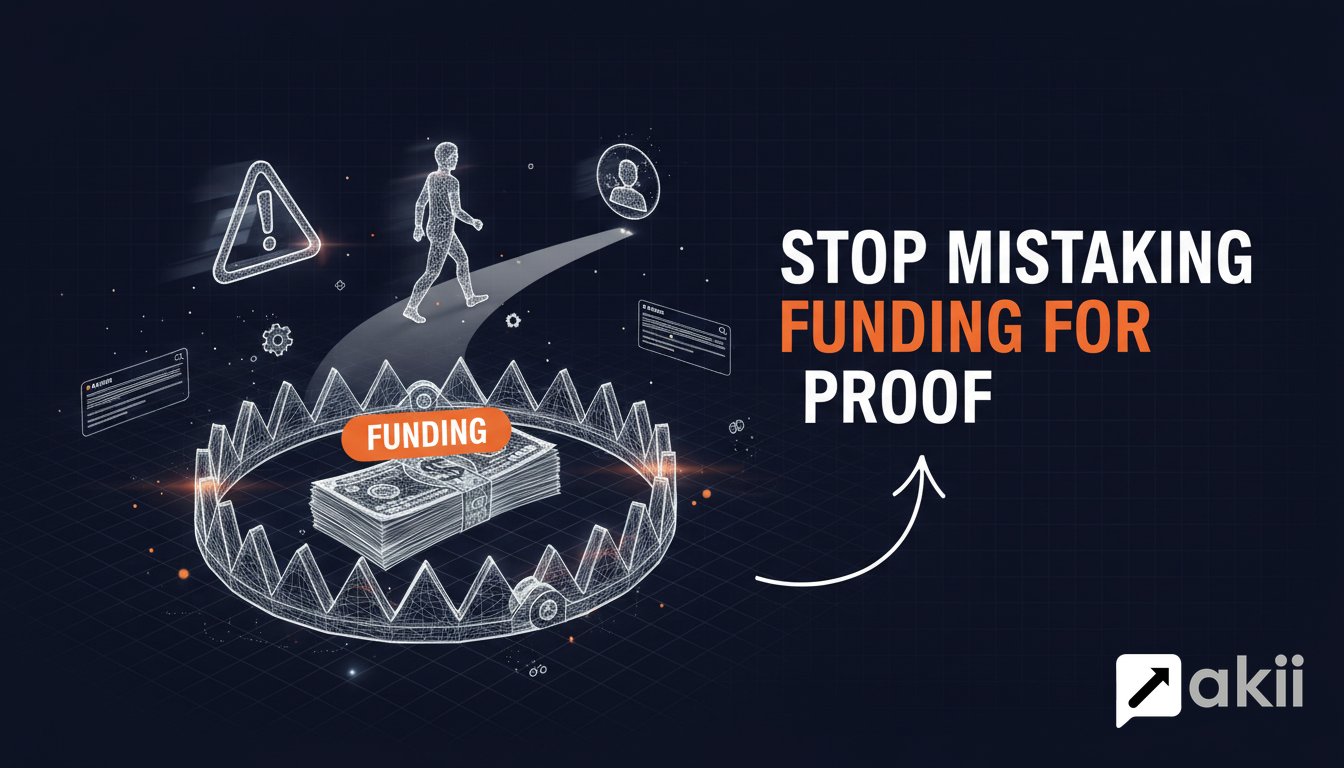
The VC Trap: AI Is Giving Founders a Way Out
I used to be a venture capitalist. I co-founded Draper Goren Holm with Tim Draper and Alon Goren.
So when I say that treating a funding round as proof of success is a habit worth killing, I'm not saying it from the outside.
An investment proves that someone wants to own part of your company on particular terms. It does not prove that customers need your product, that your economics work, or that the deal will make your life better.
My argument isn't that every investor is bad. It's that venture capital is a specialized financial product that too many founders treat as the default way to build a technology company.
AI gives us a real reason to question that default.
For founders building capital-light software and AI-enabled businesses, I think the starting question should now be: can I get this business to paying customers without selling part of it?
Not every company can. But taking venture money before seriously answering that question can be an extraordinarily expensive mistake.
The trap isn't simply dilution. It's accepting money that changes what your company must become, at a moment when technology may have already made a different path possible.
Your life-changing outcome might be irrelevant to their fund
Venture investing depends heavily on exceptional outcomes. This isn't a hostile outsider's characterization.
In a 2015 analysis of historical data supplied by investor Horsley Bridge, Andreessen Horowitz reported that roughly 6% of investments generated about 60% of total returns. It's an old dataset, not a current failure-rate estimate, but it illustrates the underlying logic clearly.
A fund is managing a portfolio. You are building a company. Those are not the same job.
Consider a simplified example. A $500 million fund owns 10% of your business when it sells for $50 million. Assuming a straightforward proportional payout, that investment produces $5 million in gross proceeds: just 1% of the fund's committed capital. At the same ownership, a $5 billion exit produces $500 million, enough to return the fund's original size before fees and other complications.
This doesn't mean every company must return the entire fund. What it explains is why the possibility of an enormous outcome matters so much to a large investor.
For a founder, a profitable company or a $50 million sale could be a spectacular success. For that fund, the same company might barely move the result.
A smaller fund may see things differently. So might an angel investing personal money. Investor fit matters, not just investor prestige.
But the central tension remains: the strategy that makes sense across a portfolio is not automatically the strategy that makes sense for the person whose working life is concentrated in one business. Economists Robert Hall and Susan Woodward examined precisely this problem in their research on the nondiversifiable risk borne by venture-backed entrepreneurs.
An investor can absorb the failure of one company as part of a successful strategy. You can't diversify the same five years of your life across thirty companies.
The fund can be behaving rationally and still be encouraging a risk you shouldn't take.
The money is temporary. The ownership you sell is not.
Carta's 2026 Founder Ownership Report makes the trade-off concrete. In its dataset of rounds raised from 2021 through 2025, the median founding team retained about 56% of fully diluted equity at seed and 36% at Series A. At Series C, median founding-team ownership was 16.1%.
That's the entire founding team, not each founder. These are stage-level medians, not a prediction of any individual company's journey. They reflect accumulated ownership changes, including employee equity, rather than the price of a single round.
Still, the implication is worth confronting before signing anything.
The standard response is that a small slice of a large company can be worth much more than a large slice of a small one. Of course it can. Venture capital can finance a business that would otherwise never exist.
But "can" is doing a lot of work there.
The comparison shouldn't be between owning 100% of nothing and 10% of a guaranteed billion-dollar company. Neither the zero nor the billion is guaranteed.
The relevant comparison is between two uncertain paths: the business you could build without institutional funding, and the business you might build after accepting its money, dilution, expectations, and constraints.
If AI reduces the capital required to discover whether customers will pay, that changes the calculation. You may be selling a permanent claim on future value to finance work you could now afford another way.
The question isn't whether equity financing is inherently bad. It's whether the capability you're buying is worth the ownership you're selling.
A good-looking exit can still produce a disappointing payout
Ownership percentages don't tell the whole story. Liquidation preferences determine who receives money first when a company is sold, and preferred shares can carry different economics from the ordinary shares held by founders and employees.
Here is a deliberately simplified illustration, ignoring debt, taxes, transaction costs, and other shareholders.
You raise $10 million for 20% of your company, with a 1x non-participating liquidation preference. You retain the other 80%. Later, the company sells for $20 million.
An ordinary ownership calculation suggests you receive $16 million. But the investor can take its $10 million preference instead of converting into a 20% share worth $4 million. That leaves you $10 million, not $16 million.
This isn't an exotic, predatory structure. Cooley's Q2 2026 financing report found that 95.8% of its reported deals had a 1x preference and 96.4% used non-participating preferred stock. Those are separate statistics from Cooley's deal sample, not a census of every venture financing.
The lesson isn't that standard terms are a scam. It's that even standard terms can make the economics quite different from the headline number.
Control is another part of the price. Depending on the documents, protective provisions can require investor consent for a sale, dividends, certain borrowing, or other major decisions. A founder can own a majority of the shares without having unilateral freedom over those choices.
None of this is necessarily unreasonable. Investors are entitled to negotiate protection for the risk they take.
But founders should stop discussing the cheque as though it arrives without a business model attached.
You can accidentally build a company whose most important customer is its next investor
Traditional venture funds operate on a clock. The conventional structure is an eight-to-ten-year fund life, often with extensions, with an initial investment period followed by a period focused on realizing investments.
That doesn't put every founder on an identical deadline. It does mean that a fund built to return capital is structurally different from an owner who would happily operate a profitable business for twenty years.
Now consider what happens when you raise money and build a cost base your customers can't yet support.
You need another round. To get it, you need to meet the next investor's expectations. You hire, expand, and make promises around that objective. If revenue doesn't catch up, the next financing becomes a condition of survival.
That's a possible consequence of the strategy, not an inevitable result of taking VC. Many venture-backed companies do become durable businesses.
But the distinction matters: are you using capital to accelerate customer demand, or using successive rounds to postpone finding out whether the business works?
Fundraising can make those two situations feel deceptively similar.
I'd rather see a founder ask what has to be true for customers to sustain the company than spend all their energy asking what has to be true for another investor to finance it.
AI changes the cost of finding out
The most important development here isn't the fantasy that one person can effortlessly replace an entire organization. It's the possibility of reaching useful evidence with less money committed upfront.
There is real evidence of AI improving some kinds of work. A 2025 paper examining randomized field experiments across 4,867 developers at Microsoft, Accenture, and a third company estimated about 26% more completed tasks among developers using an AI coding assistant. The authors included Microsoft researchers, and the result concerns specific development workflows, not a 26% reduction in every startup's operating costs.
There is also evidence against simplistic claims. METR's early-2025 experiment found experienced open-source developers took 19% longer on their tasks when allowed to use AI. Its February 2026 update suggested the situation may have improved, but the researchers explicitly warned that selection effects made the new data unreliable for measuring the current productivity benefit.
The conclusion isn't "AI always makes everyone faster." It's that the economics depend on the work, the tools, and the person using them.
Access to model capability has also become dramatically cheaper on some measures. Stanford's 2025 AI Index documented a more than 280-fold fall in the inference price of models reaching roughly GPT-3.5-level performance on a particular benchmark between November 2022 and October 2024. That's a benchmark-adjusted historical comparison, not a claim that every AI workload became 280 times cheaper.
But consider what even a more modest improvement means for a founder.
If you can test a product with a small team instead of committing to a large payroll, the value isn't just the salary difference. You can afford to discover that the first idea is wrong. You can change direction without defending a hiring plan. You can reach a paying customer before agreeing to someone else's definition of scale.
AI's most valuable contribution to entrepreneurship may be reducing the price of being wrong.
The inference I draw from the evidence is that more capital-light ideas deserve a serious attempt at customer-funded validation. It doesn't establish that every business can bootstrap, or that AI has made company-building easy.
The paradox: you can benefit from venture capital without taking it
Anyone claiming that venture capital has simply become unnecessary has to explain the money flowing into AI.
The PitchBook-NVCA Venture Monitor reported $515.8 billion in US venture deal value through the first three quarters of 2026. AI companies accounted for 82.7% of that value. These are investment dollars, not the percentage of companies receiving funding.
That's not evidence of a disappearing industry.
For some businesses, the case for VC is strong. A frontier-model developer, a semiconductor company, or a business facing years of expensive technical development has a different financing problem from someone selling a focused software product using existing infrastructure.
An investor's experience and relationships can also be genuinely valuable, not just the money. But founders should ask which introductions, decisions, or capabilities that particular investor will actually improve. A famous logo is not an answer.
The distinction cuts both ways.
The fact that somebody must finance the infrastructure doesn't mean every business using it must sell equity.
You don't need to finance a data centre to rent computing capacity. The capital intensity of building AI doesn't automatically determine the capital intensity of building with AI.
AI could produce a coexistence: more investment in platforms and frontier businesses, alongside more opportunities for independent founders using those platforms.
This doesn't prove that the independent businesses will outperform. It explains why record venture investment and reduced dependence on VC at the application level aren't contradictory.
There's also a different dependency worth naming. Replacing an investor with a critical platform doesn't make you immune to pricing changes, service interruptions, or a supplier becoming a competitor. Those risks belong in the business plan too.
Cheap code is not a business advantage by itself
Here's where the anti-VC argument can become its own kind of hype.
If AI helps you build a product more cheaply, it can help your competitor do the same. It can sometimes help your customer avoid buying the product at all.
That's a reason to think harder about what customers are paying for, not a reason to pretend every generated app is a company.
My view is that founders should focus on advantages that survive cheaper implementation: deep knowledge of a customer's problem, trusted relationships, useful proprietary data, reliable execution, and access to a market that's difficult to reach.
You still need customers to choose you, stay with you, and pay enough to cover what you actually spend serving them. A working demo doesn't settle any of those questions.
A small team is not automatically profitable. Serving each customer can consume meaningful compute. Your budget also needs to cover support, security, integrations, and human review. Don't assume that cheaper development means cheaper distribution.
That may be a valid reason to raise.
"We should raise because serious startups raise" is not.
Make capital compete for a place in your business
I'm not proposing bootstrapping as a moral test.
A founder with savings, a strong network, and existing customers has options that someone without those advantages may not have. Working unpaid is still financing the company, just with your own time and financial resilience. Customer prepayments also create obligations to deliver.
Equity financing can also be the safer choice. You're selling an ownership interest rather than taking on a loan that must be repaid. Giving up some ownership can be a sensible exchange for sharing risk, especially when the alternative is putting more of your own savings into an uncertain business.
Rejecting conventional VC doesn't mean rejecting all external finance. Angels, grants, customer funding, and suitable debt all deserve consideration. None is free of trade-offs. Debt is not a sensible substitute for equity when the business can't support repayment.
My preferred sequence for a capital-light business is to get as close to commercial proof as your circumstances allow before selling ownership.
Choose a specific customer and an expensive problem. Build the smallest solution that delivers a result worth paying for. Charge. Measure the full cost of delivery, including your own work. Learn whether customers stay. Then decide which constraint genuinely requires more capital.
Before accepting a term sheet, I'd want a clear answer to one question:
What does this money make possible that a leaner build, paying customers, or a different financing structure cannot?
Sometimes the answer will be excellent: a time-sensitive distribution opportunity, essential infrastructure, a technical milestone, or growth the business can exploit but can't finance internally.
Then test the second question: does this particular investor's required outcome fit the company you want to build?
Model the founder's payout at an ordinary exit, not only the spectacular one. Understand the consent rights. Speak to founders whose companies disappointed the investor, not only the portfolio stars.
Raise when you can explain the mechanism by which capital improves your options. Don't raise merely because it improves how your company sounds at dinner.
The goal is not to become fundable
I helped build a venture capital firm. I still believe there are businesses for which venture capital is exactly the right tool.
What I no longer accept is the idea that the financing model should determine the ambition of every founder.
A business that supports its customers, pays its people well, produces meaningful profit, and leaves its founders in control doesn't need to apologize for being insufficiently interesting to a large fund.
Nor should a founder apologize for wanting to build something much bigger and choosing an investor to help. The point is to choose deliberately.
AI doesn't make judgment, distribution, or execution disappear. What it does is give founders a reason to revisit an old assumption: that they must sell ownership before they can do anything consequential.
This is the premise behind how Akii builds: start with a real customer problem, build useful software with a small team, and stay responsible for the product after launch. Distribution matters from the start, not as an afterthought funded by someone else's timeline. That's a deliberate choice, not a limitation.
The real opportunity isn't to build the same company with fewer employees and the same dependence on fundraising. It's to reconsider what success can look like when you need less permission to begin.
Venture capital should be a tool you choose, not a trap you enter because everyone calls it success.