
Search Changed. Your Stack Didn't. That's the Problem.
For 25 years, search visibility lived in dashboards. You'd log in, check rankings, export a PDF, maybe paste a chart into a slide deck. The data sat in one place. Decisions happened somewhere else.
That worked when search was a reporting metric.
It stops working when search becomes a live perception layer that determines whether your brand exists the moment a buyer asks a question.
Buyers aren't scanning ten blue links anymore. They ask ChatGPT. They ask Google AI. They ask Perplexity. They get one answer. If your brand isn't in that answer, you're invisible at the exact moment it counts.
Since Akii launched in late 2025, we've helped growth teams monitor this shift through a dashboard. That was step one. Today we're moving from dashboard to infrastructure.
We're launching the Akii API.
Why Does AI Visibility Data Need to Flow Into Your Stack?
Modern growth teams don't live in dashboards.
They live in BI systems, Slack, Jira, CRMs, internal analytics stacks, client portals. The tools where decisions actually get made, where work gets assigned, where priorities get set.
If AI-driven discovery influences revenue, and it does, then AI visibility data can't sit in a silo. It has to flow into the systems where people act on it. That's what the API makes possible.
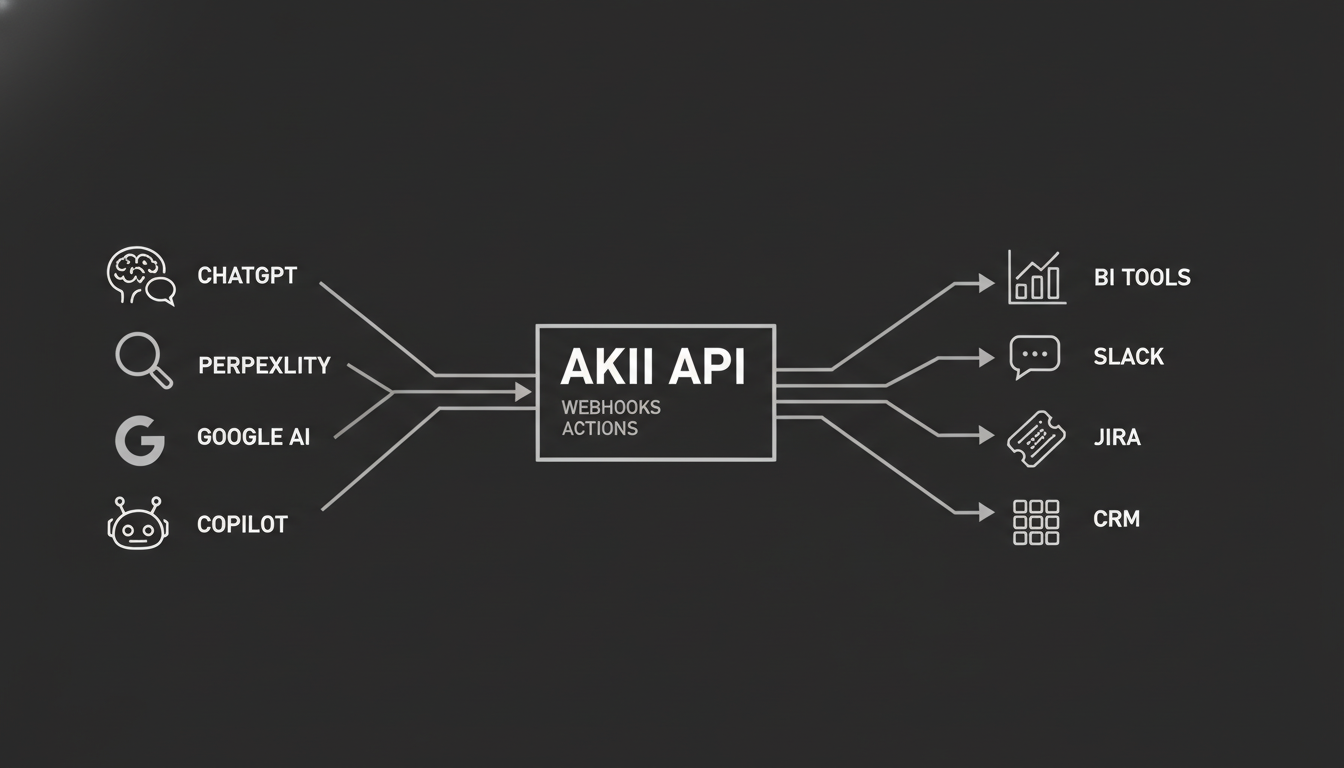
Your stack can now trigger multi-engine scans, pull citation time series, monitor competitor shifts, sync prioritized actions into project tools, and fire alerts when perception changes. Instead of logging in to check a chart, your systems ask Akii directly.
That's not a feature upgrade. It's a category shift.
What Can You Actually Do With the Akii API?
"We launched an API" can mean almost anything. It can mean a thin wrapper around existing reports. It can mean a half-baked endpoint someone bolted on to check a box.
This is neither. Here's what it actually enables.
Programmatic Multi-Engine Visibility Scans
You can run scans across Google AI Search, ChatGPT, Perplexity, and Microsoft Copilot. Trigger via API. Poll for completion. Subscribe to webhooks.
Why does this matter? Think about an agency managing 50 clients. Right now, running weekly AI visibility audits for every client is manual work. Someone logs in, runs scans, pulls data, builds reports. Multiply that across dozens of brands and it doesn't scale.
With the API, that becomes a system. Automated. Scheduled. Integrated into whatever client reporting tool you already use. It stops being something a person does and starts being something your infrastructure handles.
The same logic applies to enterprises embedding AI visibility into existing reporting, or SaaS platforms that want to add AI search monitoring inside their own product.
Time-Series Citation Intelligence
You can pull structured data on citation trends over time, engine-level visibility shifts, competitor mentions, and source authority concentration.
Feed it into your BI stack. Overlay it with revenue data. Combine it with campaign performance. This is where AI visibility stops being a screenshot someone shares in a meeting and starts being an operational metric you can track the same way you track conversion rates or pipeline velocity.
Metrics that live inside your analysis environment get used. Metrics that live in a separate tool get checked occasionally and forgotten.
The Deterministic Action Layer
Here's what most tools get wrong. They give you data. They don't give you execution.
I've seen this pattern across multiple technology cycles. A new category of data emerges, tools race to collect and display it, teams get dashboards full of charts, and then nothing happens because there's a gap between seeing a problem and doing something about it.
Through the API, you can access prioritized actions, impact scoring, urgency signals, and confidence levels. Push those into Slack, Linear, Jira, or whatever internal planning system your team uses.
Detection becomes execution. That's where the real value lives.
If your system detects that a competitor just started getting cited in ChatGPT responses for a query that matters to your business, you don't want that insight sitting in a dashboard waiting for someone to notice. You want it showing up as a task in your project management tool with a priority score and a recommended action attached.
Webhooks and Real-Time Automation
You can subscribe to events: scan completed, visibility shift detected, new opportunity surfaced, action generated.
Your systems don't wait for someone to check a dashboard. They react.
That's infrastructure. Not reporting.
Who Should Actually Care About This?
Agencies: Your Clients Are Already Asking
If you run an agency, your clients are already asking how AI search affects them. Some are asking politely. Some are panicking. Either way, you need an answer.
The API lets you build automated scans, client-facing dashboards, and a billable AI visibility layer on top of your existing SEO services. This is how you stay relevant when AI answers start replacing traditional rankings as the thing clients care about.
I've watched agencies go through this before. When Google started eating organic clicks with featured snippets, the agencies that adapted fastest won. Same pattern here, just bigger stakes.
Enterprise Growth Teams: Board-Level Signal
AI answers are shaping purchase decisions right now. That makes brand perception inside LLMs a strategic asset, not a marketing curiosity.
With the API, enterprise teams can merge AI visibility with performance marketing data, detect brand perception drift early, and monitor competitors continuously. This turns AI discovery into something you can report at the executive level with the same rigor you bring to pipeline metrics.
Most enterprise teams are still treating this as an experiment. The ones that treat it as infrastructure will have a real advantage.
SaaS Platforms: Build on Top of It
If you operate in marketing, analytics, reputation management, or competitive intelligence, you can plug Akii in as your AI search layer. You build the product. Akii powers the intelligence.
We handle the complexity of scanning multiple AI engines, normalizing the data, and generating practical output. You focus on your user experience and your market. That's the infrastructure play.
How Is This Built? And Why Does That Matter?
If you're going to build on top of something, you need to trust it.
The API is versioned, authenticated with scoped API keys, and async job-based for heavy scans. It's designed for production systems, not experiments. Every endpoint is consistent. Every response is structured. Every request is built for real environments.
Why emphasize this? Because I've integrated enough poorly designed APIs over 25 years to know what happens when infrastructure isn't reliable. People build workarounds. Then workarounds for the workarounds. Then they abandon the integration entirely.
We built this to be the kind of API you can depend on without thinking about it.
Security and Isolation
Visibility data reflects competitive positioning. We treat it that way.
Strict tenancy isolation, brand-level scoped keys, role-based permissions, webhook signing, rate limits and concurrency controls.
If infrastructure isn't trusted, it doesn't get used. Simple as that.
What Plans Include API Access?
The Akii API is available on the Growth and Agency plans.
The Growth plan gives you full API access to integrate scans, monitoring, and actions into your own stack. The Agency plan opens the same infrastructure at scale for teams managing multiple brands or clients.
This is not a separate add-on. It's built into the plans designed for teams that operate programmatically.
Why This Is a New Category, Not Just a New Feature
I've been building and operating technology businesses for over 25 years. Long enough to recognize when something shifts from being a metric to being infrastructure.
For most of the internet's history, search visibility was a reporting metric. Rankings. Clicks. Traffic charts. You measured it, reported on it, and optimized for it. The underlying system was stable. Ten blue links. PageRank. Keyword targeting. The rules were known.
AI changed the structure. Not the tactics. The structure.
Visibility inside AI systems is a live perception layer. It shifts based on how models are trained, what sources they trust, how they interpret authority. You can't check it once a week and call it done. It's a signal that moves continuously across multiple engines, each behaving differently.
Treat it like a dashboard KPI and you're already behind.
It needs to be programmable. Integrated. Operational. Something your systems can query, react to, and act on without a human in the loop for every check.
That's why we built the API. Not because APIs are fashionable. Because the problem demands infrastructure, not reports.
From Insight to Execution
The direction is clear: from dashboard to platform, from reporting to integration, from monitoring to infrastructure.
The Akii API is live. Available now on the Growth and Agency plans.
If you're serious about growth in a world where AI answers are replacing search results, this is where the work starts. Not with more dashboards. With infrastructure your team can actually build on.
Build with it.