


The Machine Is Writing Your Brand Story. Do You Know What It's Saying?
You are no longer the primary author of your brand narrative. Most marketers haven't accepted that yet.
For twenty years, brand reputation was a reactive game. You monitored social mentions, tracked Glassdoor reviews, maybe hired a PR firm to push negative articles off page one of Google. That playbook assumed people would find your brand through links, click through, and form their own opinions.
That assumption is gone.
People now ask AI for synthesized answers. When a prospective buyer asks ChatGPT "Is [Your Brand] reliable?" or "How does [Your Brand] compare to [Competitor]?", the AI doesn't retrieve a pre-written answer. It constructs a narrative in real time, acting as biographer, analyst, and critic all at once. It pulls your pricing page, a Reddit thread from 2023, a G2 review, and a TechCrunch article, then compresses everything into a single probabilistic story.
If that story is wrong, you don't just lose a click. You lose the narrative. Most of the time, you don't even know it happened.
I've watched this pattern form over the last two years. Most marketers still think AI hallucinations are random glitches. They aren't. They're the logical result of how these systems process information, and understanding that process is the only way to do anything about it.
What follows is a breakdown of exactly how AI systems build your brand story every time a user hits enter, and what you can actually do to shape the outcome.
How Does an AI Actually Build an Answer About Your Brand?
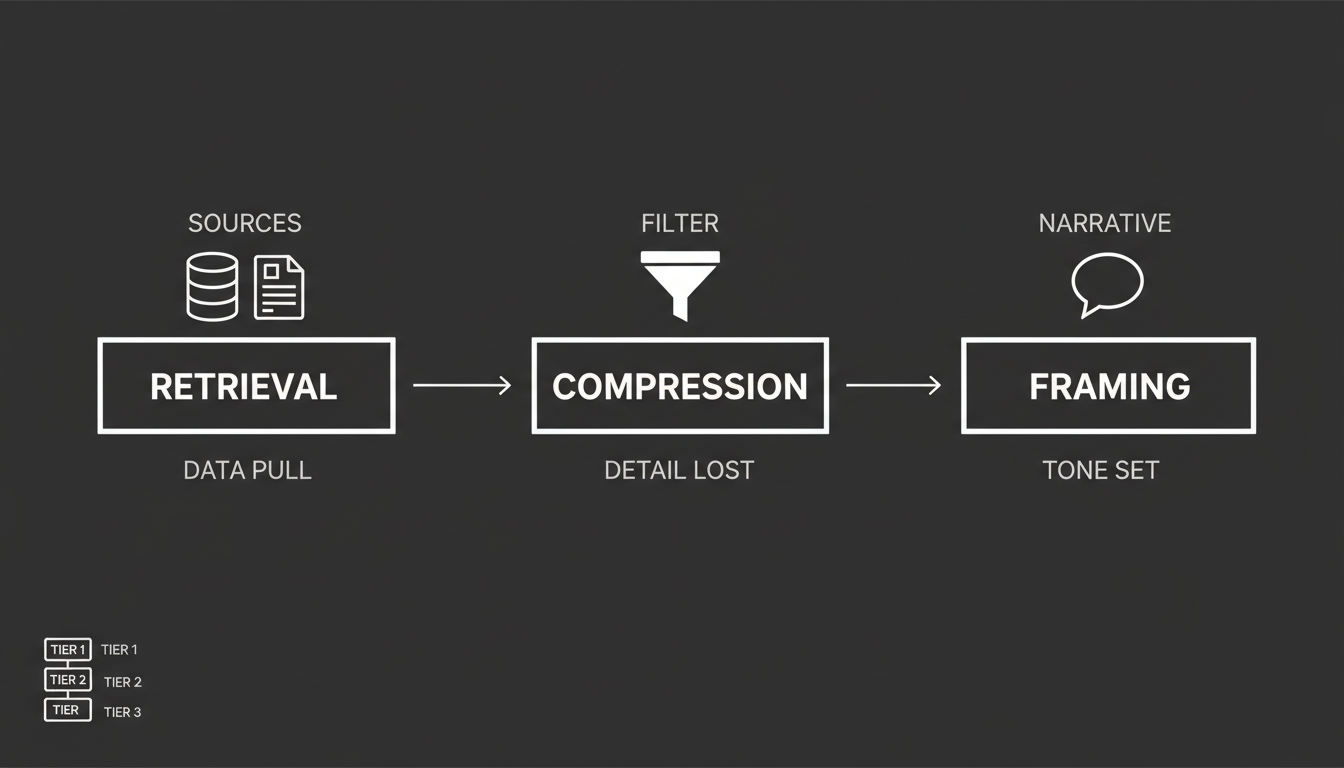
To control your narrative, you need to understand the machine writing it. When a user prompts an AI, the system runs through three stages: Retrieval, Compression, and Framing.
Each stage introduces specific risks. Each one is a place where you can intervene.
Stage 1: Retrieval (The Hunt for Facts)
The AI doesn't scan the entire internet for every query. It relies on Retrieval-Augmented Generation (RAG) or its internal training data, looking for relevant text chunks associated with your entity.
The model scans its knowledge graph for what I'd call verified nodes: entities it recognizes and trusts.
Here's the risk. If your brand isn't a verified node because your data is inconsistent across the web, the model may fail to retrieve your official information. Instead, it pulls from noisy sources. Forum posts. Outdated third-party directories. That one blog from 2019 that got your product category wrong.
Stage 2: Compression (The Loss of Detail)
Once data is retrieved, the AI compresses it. Thousands of words of context get squeezed into a 150-word summary.
The model prioritizes information that is statistically probable and structurally simple. Detail is the first casualty.
If your value proposition is complex, say "We are an API-first headless CMS with hybrid capabilities," the AI will likely compress it to something generic like "a content management tool." Your differentiation disappears in the squeeze.
Stage 3: Framing (The Tone Assignment)
Finally, the model predicts the next sequence of words based on the sentiment of the retrieved data.
If the majority of retrieved chunks contain negative adjectives like "expensive," "slow," or "difficult," the AI frames the entire narrative with a cautionary tone. A few high-authority negative citations can poison the well. You get labeled a "risky alternative" rather than a "market leader."
This three-stage process happens in seconds. Every single time someone asks about you.
The practical move: Feed the AI what I call Quotable Canonicals. Short, declarative sentences placed at the top of your key pages. Something like: "Akii is the AI Search Intelligence Platform for brands that need to understand how AI engines represent them." Pre-compressed summaries are easy for the AI to lift and insert directly into its final answer. If you don't provide them, the AI writes its own summary. You won't like it as much.
Does the AI Even Know Who You Are?
Narrative construction can't begin if the AI doesn't recognize your brand as a distinct entity. In the AI era, entity recognition is the foundation of all visibility.
AI models view the web as a network of entities: people, places, organizations, products. Before constructing a narrative about you, the model tries to resolve your identity. Is this brand a software company? Is it still in business? Is it the same entity listed on LinkedIn and Crunchbase?
If your digital footprint is fragmented, the AI detects a conflict. Maybe your LinkedIn says "Consultancy" but your website says "SaaS Platform." The AI doesn't pick one. It loses confidence. To avoid hallucinating, it may simply refuse to describe you, or default to a vague, low-confidence description that tells buyers nothing useful.
I've seen this happen to companies with eight-figure revenues. Invisible to AI not because they're small, but because their identity signals contradict each other.
How Do You Fix Entity Identity?
You build what amounts to a master entity profile: a single source of truth.
Draft a unified boilerplate. Write one clear definition of your brand. Not your elevator pitch, not your tagline. A factual, declarative description of what you are, who you serve, and what category you belong to.
Replicate it everywhere. Use this exact text on your website, LinkedIn, Crunchbase, and Wikidata profiles. Consistency is the signal.
Use Schema markup. Build Organization Schema with sameAs links pointing to all your verified profiles. This tells the AI crawler that the entity on your website is the exact same entity found on those trusted, high-authority sites.
If you're running on the Akii platform, the Website Optimizer can generate the Schema markup required to link your entity nodes. It takes about 30 minutes to set up and pays dividends for years.
Who's Talking About You Matters More Than What You Say
Once the AI knows who you are, it determines what to say about you based on who else is talking. This is where citation weighting comes in, and where most brands completely lose the thread.
Not all sources carry equal weight in the eyes of a large language model. The model weighs information from high-trust nodes far heavier than anything on your own marketing blog.
Here's the rough hierarchy:
Tier 1 (Ground Truth): Wikipedia, Wikidata, government sites, major academic institutions.
Tier 2 (High Authority): Major media like TechCrunch or the NYT, verified review platforms like G2 and Capterra, established industry reports from firms like Gartner.
Tier 3 (Low Authority): Social media comments, obscure blogs, your own unverified claims.
Your beautifully written product page? Tier 3. That's a hard pill for most marketing teams.
What About the "Repeated Mention" Effect?
AI narratives are reinforced by consensus. If 10 trusted sources all describe your product as "expensive but powerful," the AI accepts this as a fixed attribute of your entity. It becomes part of your permanent record in the knowledge graph.
This is how brand perception calcifies in AI systems. Not one bad review. The pattern across multiple trusted sources locks in the description.
How Do You Influence Citations?
You can't edit the internet. But you can practice what's increasingly called Generative Engine Optimization (GEO).
Identify the sources that matter. Use tools like the Akii AI Search Tracker to see which sources the AI currently cites when it talks about your competitors and your category.
Target high-trust nodes. Focus your PR and content distribution on getting mentioned in those specific Tier 1 and Tier 2 publications. Not vanity press. The publications the AI actually trusts.
Corroborate your claims. If you claim to be the "fastest" solution, make sure a third-party benchmark supports it. The AI needs external corroboration to convert your marketing claim into a verified fact. Without it, your claim stays in Tier 3.
Why Does the AI Keep Getting Your Category Wrong?
One of the most common complaints I hear from founders: "The AI keeps calling us a dashboard tool. We're an enterprise data analytics platform."
That's category misclassification, and it happens because of narrative compression.
LLMs are designed to simplify complex concepts for the user. When an AI processes your brand, it tries to fit you into a pre-existing category bucket. If you use vague marketing jargon, the AI guesses your category based on probability.
Here's what that looks like in practice:
Your input: "We offer an AI-driven, multi-modal interface for customer success."
The AI's compression: "This is a chatbot."
That's not a hallucination. That's the AI doing its best with bad input.
Why Does Misalignment Compound?
Once an AI categorizes you incorrectly, say "SMB Tool" instead of "Enterprise Solution," that label acts as a filter. When a user asks for "enterprise solutions," you're filtered out. When a user asks for "cheap tools," you're included, but you're too expensive, so you lose the deal anyway.
You end up visible to the wrong buyers and invisible to the right ones. That's a positioning trap.
How Do You Fix Framing?
Be explicit. Boringly, repetitively explicit.
Use Product Schema. Tag your product category in your code. Don't leave it to interpretation.
Avoid synonyms. If you're an "Enterprise CRM," use that exact phrase consistently across every surface. This is not the time for creative variation.
Disambiguate. Add a section to your About page that explicitly states what you are not. Something like: "Unlike basic chatbots, Akii is an Intelligence Infrastructure for AI search visibility." This helps the AI draw negative boundaries around your entity. Telling the AI what you aren't is almost as important as telling it what you are.
Does Your Brand Story Change Based on How Someone Asks?
Yes. And this is the part that catches most people off guard.
Your brand narrative is not static. It shifts based on the user's intent, and that's fundamentally different from traditional search.
A search engine delivers the same static link for a keyword. An AI constructs a completely different story depending on the prompt wrapper.
"What is Akii?" produces a definitional narrative: "Akii is an AI visibility tool."
"Compare Akii vs. Traditional SEO" produces a comparative narrative: "Akii is a specialized intelligence layer that complements SEO."
"Is Akii worth the money?" produces an evaluative narrative: "Akii offers high ROI for enterprise teams but may be overkill for personal blogs."
Same brand. Three completely different stories. You need to be prepared for all of them.
What's the Biggest Risk in Comparative Prompts?
The most dangerous narrative construction happens when users ask the AI to compare you to a competitor. If the AI has more data on your competitor than on you, it defaults to framing your competitor as the "Standard" and you as the "Alternative."
Being described as "a cheaper alternative to X" anchors your brand value to your competitor's price rather than your own value proposition. That's a positioning trap that's very hard to escape once the AI has internalized it.
How Do You Manage Context Sensitivity?
You audit your brand across different intent categories.
Run multi-prompt simulations. The Akii Brand Audit lets you test definitional, comparative, and evaluative prompts to see how your narrative shifts across contexts.
Create intent-specific content. If you're losing on "Is [Brand] worth it?", publish a detailed ROI case study with HowTo Schema that the AI can ingest to answer that specific question. Don't create content just for keywords. Create content for the questions AI users are actually asking.
Why Does Your AI Narrative Decay Over Time?
Even if you fix everything above, your narrative will erode if left alone. I call this narrative drift. It's the silent killer of AI visibility.
Stale Sources Kill Confidence
AI models prioritize freshness. If your last major TechCrunch mention was in 2021 and your last G2 review was six months ago, the model's confidence in your verified node status drops. It starts using hedging language: "appears to be," "was known for." Newer competitors generating fresh signal quietly take your place.
You don't get flagged as irrelevant. You just fade.
Competitor Reinforcement Rewrites the Category
If your competitors are actively publishing new data and securing new citations, they're rewriting the category narrative without you. The AI learns from the volume of new signal. If 80% of recent content in your space discusses "AI Search" and you're still talking about "keywords," the AI will disassociate your brand from the modern category definition.
You don't have to be wrong to lose. You just have to be stale.
How Do You Prevent Drift?
Narrative construction is a continuous cycle, not a one-time project.
Maintain review velocity. Keep a steady stream of fresh reviews on trusted platforms. Not a burst of 50 reviews in one month, then silence. Consistent signal over time is what the model reads as credibility.
Update your Quotable Canonicals quarterly. Your positioning evolves. Make sure the pre-compressed summaries on your key pages evolve with it.
Monitor for changes. Use the Akii AI Search Tracker to detect when the AI's description of your brand starts to drift. Watch for sentiment drops, the introduction of "legacy" keywords, or shifts in category association.
So What Does This Actually Mean for Your Business?
Here's my honest take after watching this shift unfold.
In the age of AI search, you are not the author of your brand story. The AI is the author. You are the editor.
You can't force the AI to say what you want. What you can do is provide the structured data, the authoritative citations, and the consistent entity signals that make the AI's job easy. When you understand the mechanics of Retrieval, Compression, and Framing, you move from being a passive victim of hallucinations to an active architect of your digital reputation.
The brands that win in 2026 will be the ones that treat their brand narrative as a living system that must be engineered, monitored, and maintained. Not once. Continuously.
That's what we built Akii to do. Not to replace your marketing. Not to game the system. To give you visibility into a process that's already happening, whether you're paying attention or not.
The AI is writing your story right now. The only question is whether you're going to edit it, or let it run unattended.