
The New Retainer Line Item That's Actually Worth the Money
Agency retainers have run on the same rails for a decade. Monthly SEO reporting, content production, backlink acquisition. The specific deliverables shift a little each year, but the structure stays familiar.
That's changing. In 2025, a new line item is showing up on agency proposals, and it's often commanding premium pricing: AI Visibility Management.
I've watched agencies adapt to platform shifts for over two decades. Some of those shifts were real. Some were manufactured urgency dressed up as opportunity. This one is real, and the agencies moving early are going to own the client relationship through the next cycle.
The reason isn't complicated. Search is no longer just a list of links. It's a conversation. When 68.5% of web traffic is now influenced by AI search, clients are starting to realize that ranking number one on Google doesn't matter much if ChatGPT recommends their competitor instead.
That's not hypothetical. It's happening right now, across every industry I talk to.
Why Is the Demand Coming from the C-Suite?
The demand for AI visibility services isn't coming from marketing managers. It's coming from CEOs and founders.
They're typing their own brand names into ChatGPT. They're asking Gemini about their product category. And they don't like what they find.
"Why does it say we don't offer enterprise support?"
"Why is it recommending our competitor for a service we invented?"
That executive anxiety is a real sales driver. Not because it's irrational, but because it's grounded in something real. These models are shaping purchase decisions, and nobody inside the company has been watching what they say.
The other factor is fear of what you can't see. Clients know that 73% of consumers now use AI for recommendations. But they don't understand how these systems decide what to recommend. They're worried about what I call the hidden tax of AI hallucinations, where a model incorrectly describes their pricing, their features, or their market position, and it costs them revenue without anyone ever knowing it happened.
These clients don't need another blog post. They need to know their digital reputation inside the machine is accurate.
What Are the Three Retainer Models Agencies Are Using?
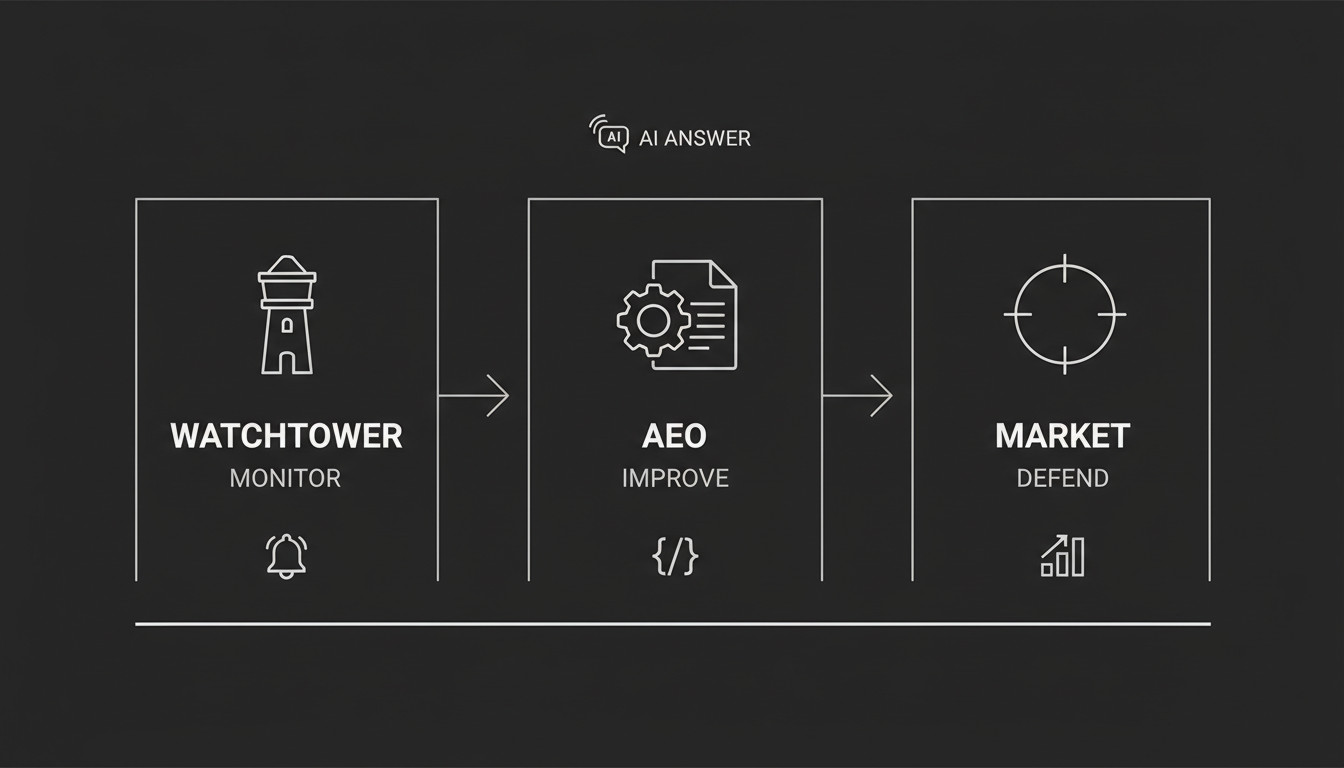
Agencies are productizing AI visibility in three distinct tiers. Each one moves further from passive monitoring toward active defense.
The "Watchtower" Retainer: Monitoring Only
The pitch is straightforward: "We make sure AI models aren't lying about your brand."
Low-touch, high-margin. The agency tracks the client's brand across ChatGPT, Gemini, Claude, and Perplexity, monitoring for hallucinations and watching for sentiment drops over time.
The value is pure risk mitigation. If Gemini suddenly starts describing a client's premium product as a "budget alternative," the agency catches it through automated alerts before the client finds out from a confused prospect on a sales call.
For agencies, this tier scales well. The work is mostly automated. The reporting is clear. And the client feels protected without requiring constant hand-holding.
The "AEO" Retainer: Optimization Plus Monitoring
This is where things get more interesting. The pitch moves from defense to offense: "We translate your brand into a language AI models understand."
This tier combines monitoring with Answer Engine Optimization. Agencies build technical fixes that make the brand machine-readable, deploying FAQ and product schema, creating what some call "quotable canonical" content, and fixing entity inconsistencies across directories like Crunchbase and Wikidata.
The goal is specific: move the client from being "known" by AI models to being "recommended" by them. That distinction is meaningful, and it's measurable.
Why does this matter more than traditional SEO content? AI models don't just crawl pages. They build entity relationships. If your brand's information is inconsistent across sources, the model trusts you less. It's that direct.
The "Market Defense" Retainer: Competitive Intelligence
This is the strategic, high-ticket offering. The pitch is blunt: "We find out why AI recommends your competitor and help you take their spot."
Agencies at this tier use tools to reverse-engineer competitor strategies. They identify what I'd call hidden competitors, brands the client didn't even know existed but that AI models consistently favor. They analyze the specific authority signals competitors use, then execute campaigns to close those gaps.
The value is market share protection. It answers the question every executive is quietly asking: who is eating our lunch in the zero-click era?
This is where the most interesting work is happening. It's not just monitoring. It's intelligence. Clients pay because of this.
What Do Agencies Actually Deliver Each Month?
Most agencies stumble here. They try to justify an AI visibility retainer with the same reporting framework they use for SEO. That doesn't work.
The deliverables need to match the service. Here's what the better agencies are shipping.
Share of Voice in AI. Not keyword rankings. A clear view of how often the client is cited compared to competitors across different models. This is the metric clients actually care about because it maps directly to whether they're being recommended or ignored.
Hallucination alerts. A log of detected inaccuracies with timestamps and corrective actions. Something like: "ChatGPT hallucinated your pricing on Tuesday. Here's what it said, here's what we did, here's the current status." A CEO can read that in 30 seconds and understand it immediately.
Strategic recommendations. A prioritized roadmap of quick wins. Specific schema updates, knowledge graph interventions, content adjustments, ranked by effort and expected impact.
The agencies winning these retainers make the reporting feel urgent and real, not decorative.
Can You Actually Do This Profitably Without Automation?
No. This is the biggest mistake I see agencies make.
Assigning someone to type 50 prompts into ChatGPT every week is unscalable and inaccurate. Manual testing gives you a snapshot of a single moment. It doesn't capture the volatility of AI models, doesn't account for differences between user locations, and definitely doesn't scale across a client roster.
To run a profitable retainer, automation isn't optional. Agencies are using platforms like the Akii AI Brand Audit to automate tracking across multiple dimensions and multiple models simultaneously. That's what makes it possible to monitor 50-plus clients without adding headcount, use historical trend analysis to prove ROI, and diagnose whether a drop in visibility comes from a technical infrastructure problem or a reputation issue.
I've seen this pattern before in other cycles. Agencies that try to deliver a new service with old workflows burn out fast. The ones that invest in the right tooling early build durable margin.
How Are Agencies Using Free Scans to Close Deals?
The most effective sales tactic for AI visibility services isn't a slide deck. It's proof.
Agencies are using tools like the free AI Visibility Score as a lead magnet. Before a pitch meeting, they run the prospect's domain through a scan. Then they walk in with specific, undeniable findings.
"Did you know Gemini claims you went out of business?"
"Did you know ChatGPT recommends your competitor for enterprise queries, but not you?"
That changes the conversation instantly. You're not selling an abstract concept. You're pointing at a problem the client didn't know they had, and you're the one who found it.
From there, upgrading the client to a paid competitor intelligence audit or a monthly monitoring retainer is a natural next step. The scan did the selling. The agency just needs to be ready with the right package.
This "show, don't tell" approach is why some agencies are closing AI visibility retainers faster than any other new service line they've added in years.
What Should Agencies Be Careful About?
Here's something the typical "how to sell this" content leaves out.
Don't oversell what AI visibility management can do today. These models change constantly. What works in March might not work in June. If you promise a client you'll "control" what ChatGPT says about them, you're setting yourself up for a difficult conversation later.
The honest pitch is simpler: we monitor, we detect, we improve your positioning, and we adapt as the models change. That's valuable. That's worth a retainer. But it's not the same as guaranteeing a specific outcome.
I've seen too many agencies burn client trust by over-promising on new service lines. The ones that build lasting relationships set clear expectations and then consistently exceed them. That's not a new lesson. It just applies here too.
Where Does This Go From Here?
The agencies adding AI visibility to their retainer stack right now aren't doing something exotic. They're doing what good agencies have always done: following the attention.
Attention is moving from search results pages to AI-generated answers. The brands that show up in those answers will win. The ones that don't will wonder where their pipeline went.
If you're running an agency, the question isn't whether to offer this. It's whether you want to be the one your clients come to, or the one they leave behind.
The tools exist. The demand is real. The pricing models work. And the clients who need this are already asking the question, even if they don't know exactly how to phrase it yet.
Don't wait until they find someone else who can answer it.