
The announcement, and why it matters now
Akii Technologies is now live with managed AI visibility and reputation defense for UAE companies. We're registered at the DIFC AI Campus, we're a member of the Dubai Chamber of Digital Economy, and the service is running.
I don't want to just repeat the press release. What I want to do is explain why we built this, what problem it actually solves, and why the timing is more big than most people realize.
If you run a business in the UAE, this comes down to one practical question: can buyers find you and trust you in the places they're actually looking right now? Not two years ago. Now.
What changed in buyer behavior, and why most companies haven't caught up
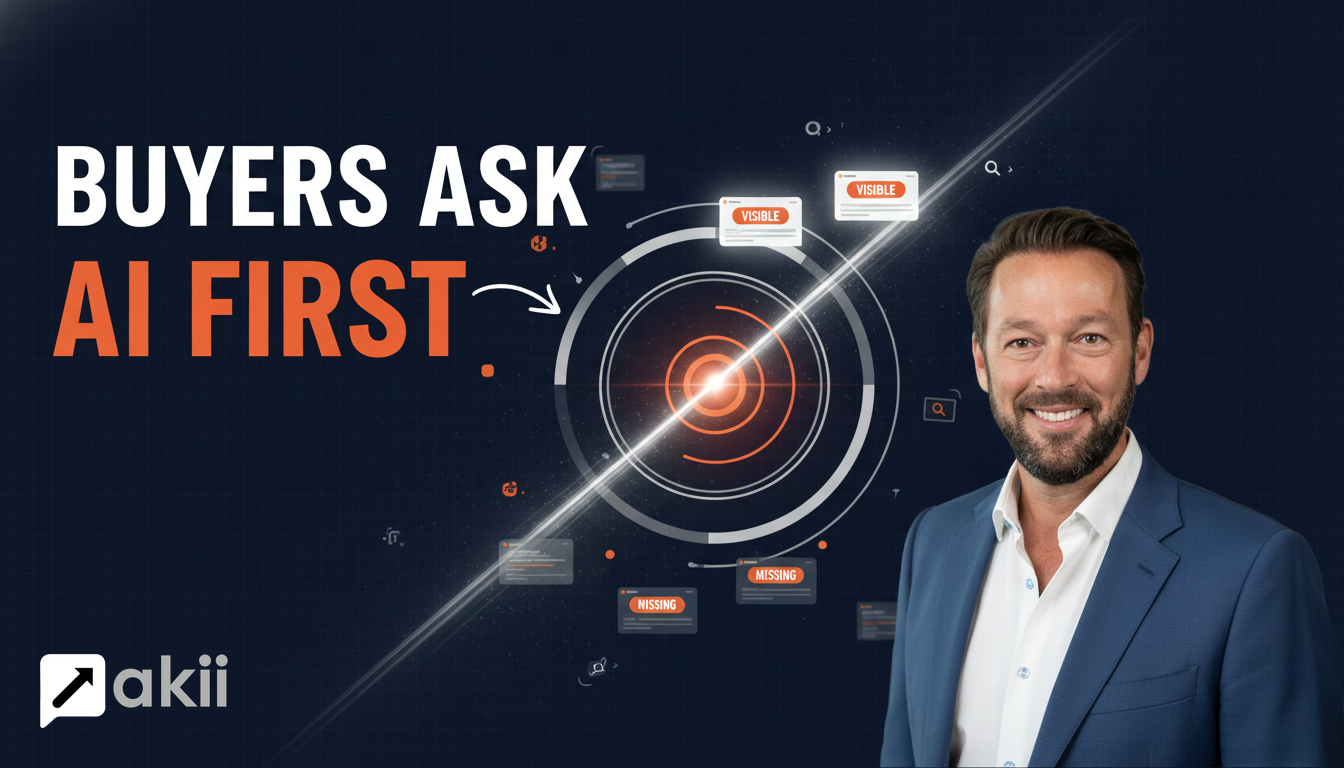
Here's the shift in one sentence: buyers now ask AI before they ask you.
Before someone picks up the phone, fills out a form, or visits your website, they're typing a question into ChatGPT, Claude, Gemini, Perplexity, or Copilot. Something like "best logistics companies in Dubai" or "top wealth management firms UAE" or "who handles commercial fit-outs in Abu Dhabi."
The AI gives an answer. It names companies, describes them, compares them. Sometimes it recommends one over the others.
The buyer reads that answer, forms an opinion, and either contacts someone or moves on. Often without ever clicking through to a website. That's what zero-click means. The decision gets shaped inside the answer itself.
So what happens if your company isn't in that answer? What if it is, but described inaccurately? What if the AI confidently names two competitors and leaves you out entirely?
You lose the deal. And you never know it happened.
The client you lose never shows up in your analytics. No bounce. No missed click. No abandoned form. Just silence where a lead should have been.
Most companies are still measuring visibility with tools built for a different era. They watch Google rankings, track website traffic, monitor keyword positions. That still matters. But it's now only part of the picture, and the other part, the AI answer part, is invisible to legacy reporting.
What AI visibility actually means in practice
Let me be specific, because this term gets used loosely.
AI visibility means: when a buyer asks an AI engine a question your company should be relevant to, does the AI mention you? How does it describe you? Does it send the buyer your way, or somewhere else?
It's not one check. It's a pattern across multiple engines, multiple question types, and multiple buyer intents. The same company might show up well in Perplexity for one question and be completely absent from ChatGPT for another. Descriptions differ. The competitors named alongside you differ. The accuracy of what's said about you can vary wildly.
This is what Akii tracks. Across ChatGPT, Claude, Gemini, Perplexity, Copilot, and Google AI results. Not a one-time snapshot. Ongoing monitoring that shows where you appear, where competitors appear instead, and whether what the engines say about you is actually true.
Why does accuracy matter so much? AI engines pull from sources. They read your website, your directory listings, third-party mentions, reviews, structured data, news coverage. If those sources are outdated, inconsistent, or thin, the AI will either skip you or say something wrong. Wrong descriptions repeated at scale, across millions of buyer queries, compound fast. That's a real business problem.
What reputation defense means here, and what it doesn't
I want to be clear about what we mean by reputation defense, because the term carries baggage.
We're not talking about deleting bad reviews. We're not talking about burying negative press or any of the tactics that gave "online reputation management" a bad name.
What we mean is this: when AI engines describe your company to a buyer, is that description accurate, current, and fair? And if it's not, what needs to change in the underlying sources so the engines get it right?
That includes correcting outdated information AI engines are still repeating. It includes strengthening structured data on your website so engines can read and cite it properly. Building credible third-party mentions and citations that AI engines trust as sources. Improving review signals and sentiment data. Making sure your technical setup doesn't block AI from reading what matters.
All white-hat. All source-level. Nothing auto-published. Human strategists review every fix before it goes live.
Here's the part most people miss: AI engines don't just make things up from nothing. They synthesize from sources. If your sources are weak, inconsistent, or outdated, the AI output reflects that. The fix isn't to argue with the AI. The fix is to improve what the AI reads.
Why we built this in Dubai, for UAE and GCC companies
I've been building technology companies for over 25 years. I co-founded Draper Goren Holm. I was named AIBC Investor of the Year in 2021. I've watched multiple technology cycles run their course.
This one is different in a specific way: the shift to AI-mediated buyer decisions is happening everywhere, but the opportunity for companies in the UAE and GCC is particularly sharp.
Dubai is building its economy around AI. The infrastructure is here. The ambition is here. The government commitment is real. Dr. Marwan Alzarouni, who advises Akii and serves as CEO of AI at the Dubai Department of Economy and Tourism, said it plainly in our announcement: "Dubai is building its economy around artificial intelligence, and that includes how companies are found and judged. Buyers increasingly turn to AI engines for answers before they decide, so it matters that businesses here are represented accurately in those answers."
But here's the gap I kept seeing. UAE companies are investing heavily in digital presence, in SEO, in brand building. Yet almost none of them know how AI engines describe them to buyers right now. They're spending money to be visible in one channel while being invisible or misrepresented in the channel that's growing fastest.
That's not a knowledge problem. It's a tooling and service problem. The monitoring didn't exist. The methodology didn't exist. The connection between "what AI says about you" and "what you can actually do about it" didn't exist in a practical, managed form.
So we built it. Registered at the DIFC AI Campus. Built the AI agents that do the checking and preparation at scale. Hired the human strategists who set priorities and review quality. Designed a clear service structure that UAE and GCC companies can actually buy and measure.
How the 90-day rhythm works
I believe in showing the work, not just describing the outcome. Here's how the service actually runs.
Weeks 1 through 3: Find where you're losing buyers. Our AI agents check how you appear across ChatGPT, Claude, Gemini, Perplexity, Copilot, and Google AI. They identify buyer questions where you should appear but don't. They find where competitors are named instead. They flag inaccurate descriptions, outdated claims, and missing trust signals. This becomes a clear picture of your AI visibility gaps.
Weeks 3 through 5: Agree on priorities. Not everything can be fixed at once. We work with the client to decide what matters most. Which buyer questions drive the most revenue? Where are competitors winning that you should be winning? What inaccuracies are most damaging? This becomes the plan.
Weeks 5 through 10: Prepare and review the fixes. Our AI agents prepare the content, structured data, citation work, and technical fixes. Human strategists review every piece before it ships. Nothing is auto-published. The client sees what's going out and approves it.
Weeks 10 through 12: Publish and measure. Fixes go live. We begin tracking changes in AI visibility. The first monthly report shows what moved, what didn't, and what comes next.
Then it repeats. AI engines update their sources constantly. Competitors shift. Reviews change. New buyer questions emerge. This isn't a one-time project. It's ongoing management of how AI perceives and presents your business.
The question I keep getting from CEOs
"Can't we just do SEO better and hope the AI picks it up?"
I understand why people ask this. SEO is familiar. Agencies are everywhere. The instinct is to assume that if you rank well on Google, AI engines will follow.
Sometimes they do. Often they don't.
AI engines pull from a broader set of signals than Google's traditional ranking algorithm. They weight third-party mentions differently. They care about structured data in ways many SEO agencies don't address. They synthesize across sources rather than ranking individual pages. And they can confidently describe your competitor in a way no Google search result ever would, because they generate narrative answers rather than showing links.
Good SEO helps. It's necessary. But it's not sufficient for AI visibility.
At Akii, we keep SEO, AI search, and reputation data connected. The same content, technical setup, structured data, and third-party mentions need to support both Google results and AI answers. Treating them as separate workstreams creates gaps. Treating them as identical creates blind spots. Neither works.
What this looks like when it goes wrong
Let me give you a scenario that plays out more often than you'd think.
A well-established UAE company, strong brand, good reputation, solid Google rankings, invests steadily in marketing and lead generation. Their pipeline starts softening. Not dramatically, but noticeably. Fewer inbound inquiries. Fewer RFP invitations. The leads that do come in seem less informed, as if they're starting from scratch rather than arriving with some existing awareness.
The marketing team checks the usual metrics. Website traffic is stable. Google rankings haven't dropped much. Paid campaigns are performing within normal ranges. Nothing in the data explains it.
What they can't see: six months ago, a competitor published a series of well-structured case studies, got mentioned in several credible industry directories, and cleaned up their structured data. Now when buyers ask ChatGPT or Perplexity who the best providers in this space are in the UAE, that competitor shows up first with a clear, accurate description. The original company either doesn't appear or gets a one-line mention with outdated information.
The pipeline didn't soften because of anything the company did wrong in its traditional marketing. It softened because the buyer's first impression now forms in a place the company isn't monitoring.
This is happening right now, across industries, in the UAE and globally. The companies that see it early have an advantage. The ones that wait will spend months trying to diagnose a pipeline problem with the wrong tools.
Who this is for, and who it's not for
I want to be honest about fit.
This service is built for UAE and GCC companies that depend on being found and trusted by buyers. Professional services, real estate, hospitality, healthcare, technology, financial services, legal, consulting, logistics. Companies where the buying decision involves research, comparison, and trust.
It's not for companies selling low-consideration consumer products where brand awareness is driven entirely by social media and impulse. It's not for companies that don't yet have a product or service worth recommending. AI visibility only works if there's something real for the AI to describe accurately.
And it's not a magic fix. It's a managed service with a clear methodology, real human oversight, and measurable reporting. The results compound over time. The first 90 days build the foundation. The months after that build the lead.
Why this matters beyond marketing
I'll end with a broader point.
The shift from search to AI-mediated answers isn't just a marketing problem. It's a trust infrastructure problem. When AI engines become the primary way buyers evaluate companies, the accuracy and completeness of what those engines say becomes a business-critical issue.
A company that's misrepresented in AI answers doesn't just lose leads. It loses pricing power, because buyers arrive with the wrong expectations. It loses talent, because candidates research employers the same way. It loses partnership opportunities, because potential partners check the same AI engines before picking up the phone.
This is why I think of it as reputation defense, not just visibility. Visibility is about being seen. Defense is about being seen accurately. Both matter. But in an AI-mediated world, accuracy might matter more than presence. A wrong description repeated across five AI engines does more damage than being absent from one.
Dubai is positioning itself as a global AI hub. The companies based here should be leading in how they manage their AI presence, not catching up later. The tools and methodology exist now. The question is whether you'll use them before your competitors do.
If you want to see how AI engines describe your company today, we run an AI Search Audit that shows exactly where you stand. Or reach out through our contact form and we'll start the conversation from there.
The buyers are already asking AI who to trust. The only question is what the AI is telling them about you.