
The Ad Money Is Coming. That's Not the Problem.
For two years, the question I hear most from founders and marketing leaders is some version of: "How do I get ChatGPT to recommend my brand?"
Fair question. But a second question is gaining volume fast, and it's the one that worries me: "Can I just pay to be the answer?"
The short answer is yes, soon you probably can. Perplexity is already testing sponsored follow-up questions. Google is weaving shopping ads into Gemini-powered AI Overviews. The economics demand it. Running an LLM costs dramatically more than serving ten blue links. Advertising was always going to show up.
Here's what concerns me. Most marketing teams will treat AI search the way they treated Google Ads. Skip the organic work. Buy the slot. Move on.
That's a strategic trap. Walk into it, and 2026 is going to be very expensive.
Why Does Paid AI Placement Feel Different From a Search Ad?
Think about how you use traditional search. You type "running shoes," you see an ad for Nike, you click. Simple. The intent is navigational. You already know roughly what you want.
Now think about how people use AI. They ask, "What are the best running shoes for flat feet and marathon training?" The intent is consultative. They came for reasoning and synthesis, not a ranked list of the highest bidders. That's a fundamentally different relationship with the interface.
When a model shifts from helpful advisor to salesperson mid-answer, the experience breaks. People turn to AI agents specifically because they want something better than a page of ads. If the AI just serves them ads dressed up as advice, they'll notice.
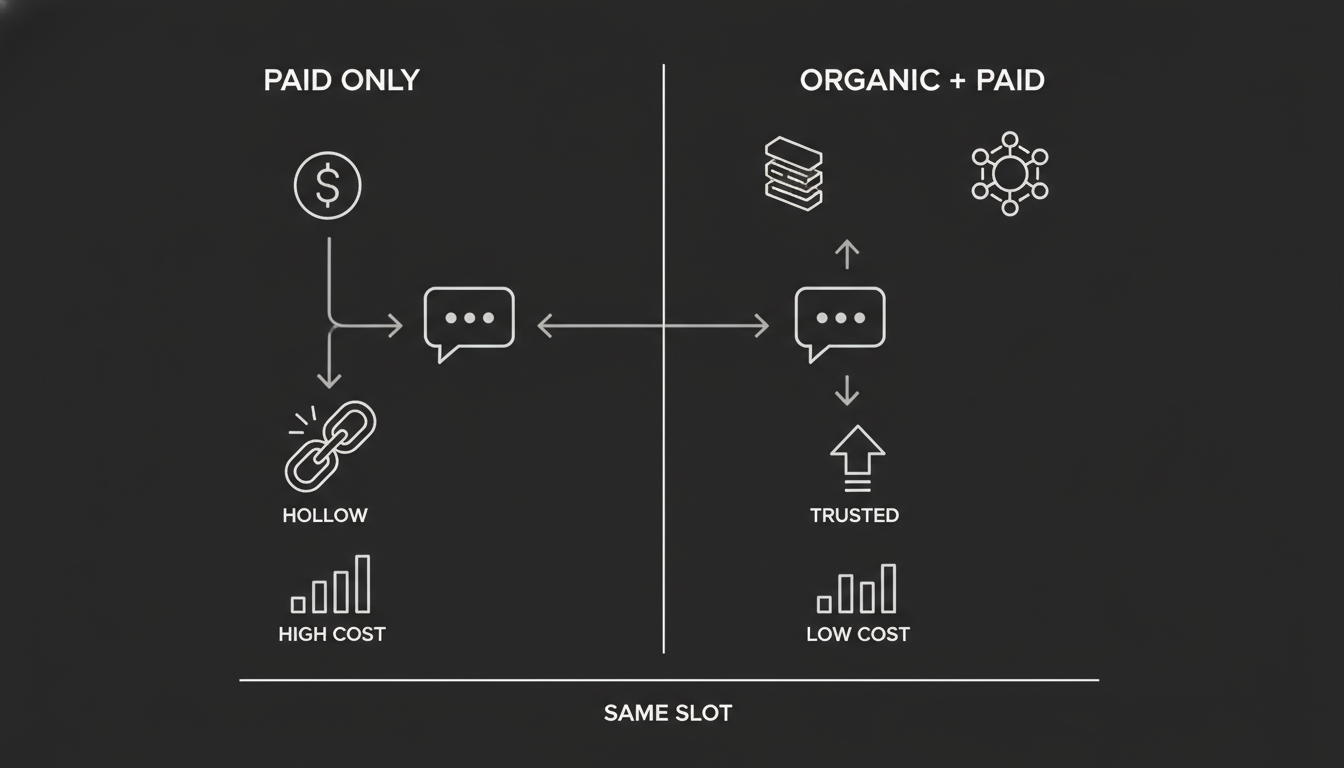
This is the part most marketers haven't internalized yet. In an AI answer, paid placement does not equal trusted placement. The information gets blended into a single narrative. There's no clean separation between "Ad" and "Organic" the way there is on a search results page. If a model recommends your brand solely because you bid for the slot, but its training data can't verify your quality, the recommendation reads as hollow. Or worse, it reads as hallucination.
Users will learn to spot the dissonance. When they do, the brand that paid for the slot doesn't look authoritative. It looks desperate.
What Will Paid AI Ads Actually Look Like?
By 2026, I expect paid AI visibility to show up in a few specific forms.
Sponsored Citations. Your brand appears in the reference list or footnotes of an answer, even if you weren't the primary source the model drew from. Think of it as buying a seat at the table without being part of the conversation.
Suggested Follow-Ups. This is what Perplexity is already experimenting with. After a user asks "Best CRM?", the suggested next question becomes "Why is [Your Brand] the best for enterprise?" You're buying the next question, not the current answer.
Shopping Module Integration. For ecommerce, models like Gemini are already blending organic product data with paid shopping inventory in the final recommendation block. This will accelerate.
In all three cases, visibility becomes something you can purchase. But being seen and being chosen are fundamentally different outcomes. That tension between the platform's commercial incentive to sell slots and the user's expectation of accurate, unbiased answers is the central conflict brands will face in 2026. Nobody has resolved it yet.
What Happens When the Model Doesn't Trust You?
Here's a scenario I think about a lot.
A user asks an AI model for "the most reliable project management software." A brand with a 2-star rating on Trustpilot pays to be injected into the answer. The model complies. The user reads the recommendation, checks the rating, and immediately spots the contradiction.
Two things happen. The user's trust in the model dips. And the brand gets labeled as unreliable, not because of its product, but because of the context in which it appeared.
This is where the analogy to Google Ads becomes useful, but not in the way most people think.
Google Ads has a Quality Score. If your landing page is irrelevant to the keyword you're bidding on, Google charges you more and shows you less. The system penalizes misalignment. Future AI models will almost certainly develop something similar. Call it a "Truth Score." If you bid to appear for "Best Enterprise Security Tool," but the model's training data from Wikipedia, G2, and TechCrunch identifies you as a small business tool, one of two things happens: the model rejects your ad, or it charges you a massive premium to display it.
Why? Because the model resists lying to the user. It can't comfortably recommend a brand that contradicts its own internal knowledge.
Organic AI visibility isn't just a traffic source. It's the permission slip that lets you buy ads efficiently. Without it, you're paying the "Invisible Brand Tax," forcing a model to display a brand it doesn't know or trust.
Is Organic Visibility Really a Cost Control Mechanism?
This is the financial argument that will define 2026 strategy. Strong entities pay less.
Let me make it concrete. Imagine two competitors bidding for the same "Best CRM" placement in an AI answer.
Brand A has no schema markup, inconsistent entity profiles across the web, and low organic visibility in AI answers. The model views inserting this brand as high-risk, low-relevance. Cost is high. Conversion rate is low because the recommendation feels forced.
Brand B has a high AI Visibility Score, consistent entity data everywhere that matters, and gets cited organically in AI answers already. The model views inserting this brand as a natural extension of the answer it was already building. Cost is lower. Conversion rate is higher because the paid placement aligns with what the model already believes.
Same slot. Same bid. Wildly different outcomes.
You can't buy trust. You can only buy attention. Organic AI visibility builds the trust that makes paid attention profitable.
What Do the Brands That Win in 2026 Look Like?
They won't be the ones with the biggest ad budgets. They'll be the ones that blend organic authority with paid amplification. I keep seeing the same characteristics in the brands that are already ahead.
They're machine-readable. Their pricing, inventory, and features are accessible via structured data. When a paid module needs to render their information, it pulls accurate data instantly. No hallucination. No friction.
They're consistently cited. They've built what I'd call "entity saturation" across the web. When a paid placement surfaces their name, users recognize it from organic contexts. The paid slot feels like confirmation, not introduction.
They monitor both sides. They track organic inclusion alongside paid performance to make sure the narratives match. If the organic answer says one thing and the paid placement says another, the whole system breaks down fast.
How Do You Actually Prepare for This?
Here's the practical part. Four steps. None of them are complicated, but all of them require doing the work now, not in Q1 2026.
Step 1: Secure Your Organic "Truth"
Before you spend a dollar on AI ads, make sure the model knows who you are. If you pay for a placement but the AI hallucinates your pricing, you're paying to burn leads.
Start by checking where you stand. Run a free AI Visibility Score and look at your Brand Understanding metric. If it's low, the fix is structural: deploy Organization and Product Schema so models can read your actual data instead of guessing.
This matters for paid because dynamic ad units will pull data from your site. If that data isn't structured, the ad displays wrong information. You paid for a slot that actively hurts you.
Step 2: Build the Trust Shield
You need external validation so that when your paid placement appears, it feels earned, not bought.
Audit your citation density. Are you mentioned in the high-trust sources for your industry? G2, Capterra, TechCrunch, relevant industry publications? These are the data sources that feed the models. If you're absent from them, the model has no third-party basis for trusting you.
This is where Generative Engine Optimization comes in. Secure mentions in the specific sources that AI models actually draw from. Not vanity press. Not pay-for-play directories. The real nodes that shape model reasoning.
When a user sees your sponsored suggestion and thinks, "Oh, I've seen them mentioned in that industry report," you've won. The paid slot triggered a memory of organic authority. That's the combination that converts.
Step 3: Monitor the Split
You need to know where you're already winning organically so you don't waste money paying for those same spots.
Basic resource allocation. Almost nobody does it for AI search yet. Use tracking to identify two buckets:
Prompts where you have high organic inclusion. Don't bid heavily here. Let the organic presence carry you. Save your budget.
Prompts where you're invisible but your competitor is present. This is where you allocate paid budget. You're bridging a gap while you fix the underlying organic signals.
Paying for slots you'd get organically is lighting money on fire. Ignoring slots where competitors are visible and you're not is ceding ground for free.
Step 4: Defend Against Competitor Ads
In 2026, competitors will try to buy their way into your brand conversations. "Alternatives to [Your Brand]" is going to become a paid battleground.
When you see a competitor aggressively appearing in AI answers for your brand terms, the response isn't to outbid them. Reinforce your specific value propositions organically so that their paid interception feels irrelevant.
If your competitor buys the "Alternative to [You]" slot but the model's organic knowledge strongly associates you with "enterprise security" and the competitor lacks that signal, the paid ad falls flat. The model's own reasoning undermines the interruption. Defense through substance, not spending.
The Race to the Bottom Is Optional
The rise of paid AI placements is not an excuse to abandon organic work. It's the reason organic work becomes more valuable.
In a world where anyone can buy a slot, the only differentiator left is whether the model actually believes what it's saying about you.
Paid ads buy you a moment of attention. Organic AI visibility buys you a permanent place in the model's reasoning. One is a rental. The other is equity.
I've watched this pattern play out across multiple technology cycles over 25 years. Every time a new channel opens up, the first instinct is to throw money at it. The brands that win long-term are always the ones that build the foundation first and use paid as an accelerator, not a substitute.
The brands that rely solely on paid placements in 2026 will find themselves in a familiar trap: paying ever-higher prices to force recommendations that users inherently distrust. The ones that build their organic authority now, becoming verified nodes in the model's knowledge, will find that paid amplification actually works. Because the model isn't being asked to lie. It's being asked to say what it already believes, just louder.
That's the difference. Get it right before the ad auction opens.
If you want to see where your brand stands today, start with your AI Visibility Score. The data will tell you whether you're building equity or renting attention. In 2026, that distinction is going to matter a lot.