
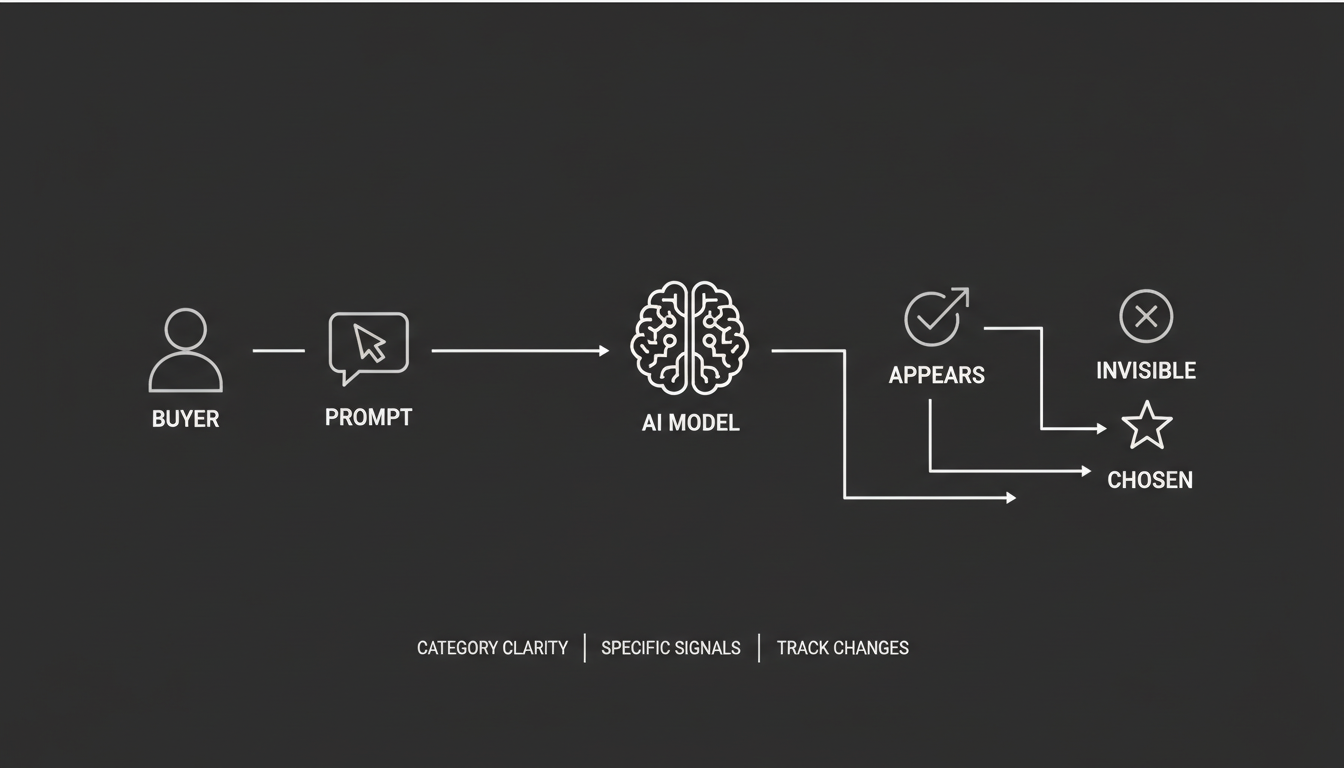
How SaaS Buyers Actually Use AI Now
Your buyers are already using AI to shortlist tools before they ever talk to your sales team. That's not a prediction.
The prompts look like this: "Best project management tools for remote teams." "Compare Notion vs Coda for product teams." "What CRM works best for a 50-person B2B company?" These are purchase-intent queries. AI models are answering them with specific product recommendations, often with reasoning attached. Not just links. Not just ads. Actual opinions about which tool fits which use case.
So here's the question every SaaS company should be sitting with: when someone types that kind of prompt into ChatGPT, Perplexity, or Gemini, does your product show up? And if it does, is the description accurate?
I've spent 25 years watching how buyers find software. The channel changes every few years. Directories, then review sites, then SEO, then paid search. Each wave rewarded whoever adapted fastest. AI recommendations are the next wave, and most SaaS companies aren't even tracking whether they appear in answers.
The difference this time is that AI doesn't return a list of ten blue links. It returns one or two answers, sometimes three. If you're not in that answer, you're not buried on page two. You're gone.
Why Do SaaS Brands Get Misrepresented by AI?
This is the part that frustrates people most. Your product might show up in AI answers, but with the wrong description, outdated features, or positioned in a category you don't even compete in.
Why does this happen? Two reasons.
Overlapping categories. SaaS categories are messy. Is your tool a "project management" platform or a "work management" platform? Is it "sales engagement" or "CRM"? AI models pull from whatever training data and web content they can find. If your category isn't crystal clear across your own site, review profiles, and third-party mentions, the model will guess. And it will often guess wrong.
I've seen tools that compete directly with each other get placed in completely different categories by the same AI model. One gets recommended for "team collaboration" while the other shows up under "document management." Same product type. Different framing. One wins the comparison prompt, the other doesn't even appear.
Unclear positioning. If your homepage says you're "the all-in-one platform for modern teams," that tells an AI model almost nothing. It can't differentiate you from 400 other tools using the same language. AI models need concrete signals: what you do, who it's for, what makes you different from named competitors.
Vague positioning has always been a problem in SaaS marketing. It used to just mean your ads performed worse. Now it means AI models literally can't figure out where to put you.
What Prompts Actually Matter for SaaS Recommendations?
Not all AI prompts are equal. For SaaS, two prompt patterns drive the most purchase-relevant recommendations.
"Best X tools" prompts
These are category queries. "Best CRM for startups." "Best analytics tools for ecommerce." "Best onboarding software."
When someone asks this, the AI model builds a short list. Usually three to five tools, sometimes with pros and cons, sometimes with a clear winner. What determines who makes the list? Category association, mostly. The model needs to confidently connect your product to that specific category, and that confidence comes from consistent signals across your website, documentation, review sites, comparison articles, and third-party content.
If ten different sources describe your tool as a "CRM for startups" and your competitors only have three or four sources saying the same thing, you're more likely to appear. Volume and consistency of category signals matter.
"X vs Y" comparison prompts
These happen further down the funnel. The buyer already has a shortlist. Now they're deciding.
"HubSpot vs Pipedrive for small sales teams." "Linear vs Jira for engineering." "Webflow vs WordPress for marketing sites."
Here, the AI model pulls from comparison content, review sites, feature lists, and whatever structured data it can find. A well-written, detailed comparison article that covers your product fairly has a strong chance of influencing the AI's answer.
This is where most SaaS companies leave money on the table. They invest in SEO for their own brand terms but ignore the comparison space entirely. Meanwhile, a third-party blog post from 2022 with outdated information is shaping how AI models describe the matchup.
You can track how AI models handle both of these prompt types. Akii's competitor intelligence features are built specifically for this: monitoring how AI engines position your brand relative to competitors across real recommendation prompts.
How Do You Fix Your Positioning for AI?
This isn't about tricking AI models. It's about making your positioning so clear that models can't get it wrong.
Get specific about your category
Pick a category. Own it. Make sure your homepage, product pages, documentation, and meta descriptions all use the same category language consistently.
If you're a "revenue intelligence platform," say that everywhere. Don't call yourself "revenue intelligence" on your homepage, "sales analytics" in your docs, and "pipeline management" on your pricing page. That inconsistency confuses AI models the same way it confuses buyers.
I know this sounds basic. It is basic. But I've audited dozens of SaaS sites and the category language is almost never consistent. Marketing uses one term. Product uses another. The blog uses a third. AI models see all of it and average it out into something that means nothing.
Build differentiation signals that AI can detect
AI models don't just need to know what category you're in. They need to know why someone would pick you over the alternatives.
Differentiation signals include:
- Named use cases. "Built for product-led growth teams" is a signal. "Built for modern teams" is not.
- Specific integrations. "Native Salesforce and HubSpot integration" tells the model something concrete.
- Named competitors. Having comparison pages on your own site ("Why teams switch from X to us") gives AI models direct positioning data.
- Quantified claims. "Reduces onboarding time by 40%" is detectable. "Saves you time" is noise.
The pattern is specificity. AI models are good at extracting structured, specific information. They struggle with vague marketing language. Every piece of content on your site is training data for how AI models understand your product.
Make your pricing and plans easy to parse
This one surprises people. AI models get asked about pricing constantly. "How much does [tool] cost?" "What's the cheapest project management tool with Gantt charts?"
If your pricing page is clear, structured, and specific, AI models can answer these questions accurately. If your pricing is hidden behind a "contact sales" wall with no public information, the model either skips you or guesses based on whatever outdated blog post it can find.
I'm not saying you need to publish every enterprise tier. But having clear, public pricing for at least your entry-level plans gives AI models something accurate to work with. That matters when a buyer asks "What does X cost?" and the AI confidently gives a number.
How Do You Build the Signals That Drive Recommendations?
Getting your own site right is step one. But AI models pull from the entire web. You need consistent signals across multiple sources.
Citations and authority sources
AI models weight certain sources more heavily. For SaaS, the high-authority sources include:
- G2, Capterra, and TrustRadius reviews. These are heavily cited in AI answers about software comparisons. Volume and recency of reviews both matter.
- Industry publications. Coverage in relevant trade publications or analyst reports adds weight.
- Technical documentation. Well-structured docs and API references help AI models understand your capabilities accurately.
- Comparison and review articles. Third-party content that mentions your product alongside competitors directly feeds comparison prompts.
You don't control all of these. But you can influence them. Encourage customers to leave detailed reviews on G2. Publish thorough documentation. Create comparison content on your own blog. Pitch relevant publications.
The goal isn't to game the system. It's to make sure the information that exists about your product is accurate, current, and specific enough for AI models to use.
Internal content architecture
Your own site structure matters more than most SaaS companies realize. AI models crawl and index content. If your site has clear, well-linked pages for each feature, use case, and integration, models can build a more accurate picture of what you do.
A single landing page that tries to cover everything is harder for AI to parse than ten specific pages that each cover one thing well. Same principle that worked for SEO, but it matters even more for AI because models are trying to extract structured understanding, not just match keywords.
What Does Tracking AI Visibility Actually Look Like?
Most SaaS companies have no idea how AI models describe them. They track Google rankings, review scores, and brand mentions. But they don't track AI recommendations.
That's the gap. You can't fix what you can't see.
At Akii, we built tools specifically for this problem. You can see how we help brands move from mentions to actual recommendations and understand the difference between showing up and being chosen.
The practical workflow looks like this:
- Audit your current AI visibility. How do major AI models describe your product today? What category do they place you in? Who do they compare you to? An AI brand audit gives you the baseline.
- Identify gaps and misrepresentations. Where is the model wrong? Where are you missing from comparison prompts you should own?
- Fix the inputs. Update your site content, review profiles, and third-party mentions to be more specific and consistent.
- Track changes over time. AI model outputs change as they ingest new data. You need ongoing monitoring, not a one-time check.
This isn't a one-and-done project. AI models update continuously. Your competitors are updating their positioning. The ground shifts. You need a system for tracking it, not a quarterly audit.
The Real Advantage Is Moving Now
Here's what I think most SaaS founders and marketing leaders are missing: the window for establishing AI visibility is open right now, and it won't stay open forever.
Most SaaS companies aren't paying attention to this yet. They're still focused entirely on traditional SEO and paid acquisition. That means the companies that move first will establish strong positioning before the competition even starts trying.
I've seen this pattern in every technology shift I've lived through. Early movers don't win because they're smarter. They win because they're paying attention while everyone else is still debating whether the shift is real.
The shift is real. Your buyers are asking AI models which tools to use. The only question is whether your product shows up with the right answer.
Category clarity. Specific positioning. Consistent signals. Ongoing tracking. That's the work. It's not glamorous, but it's the work that determines whether AI recommends your product or your competitor's.
If you want to see where you stand today, start with Akii and find out what AI models are actually saying about your brand. The answer might surprise you.