
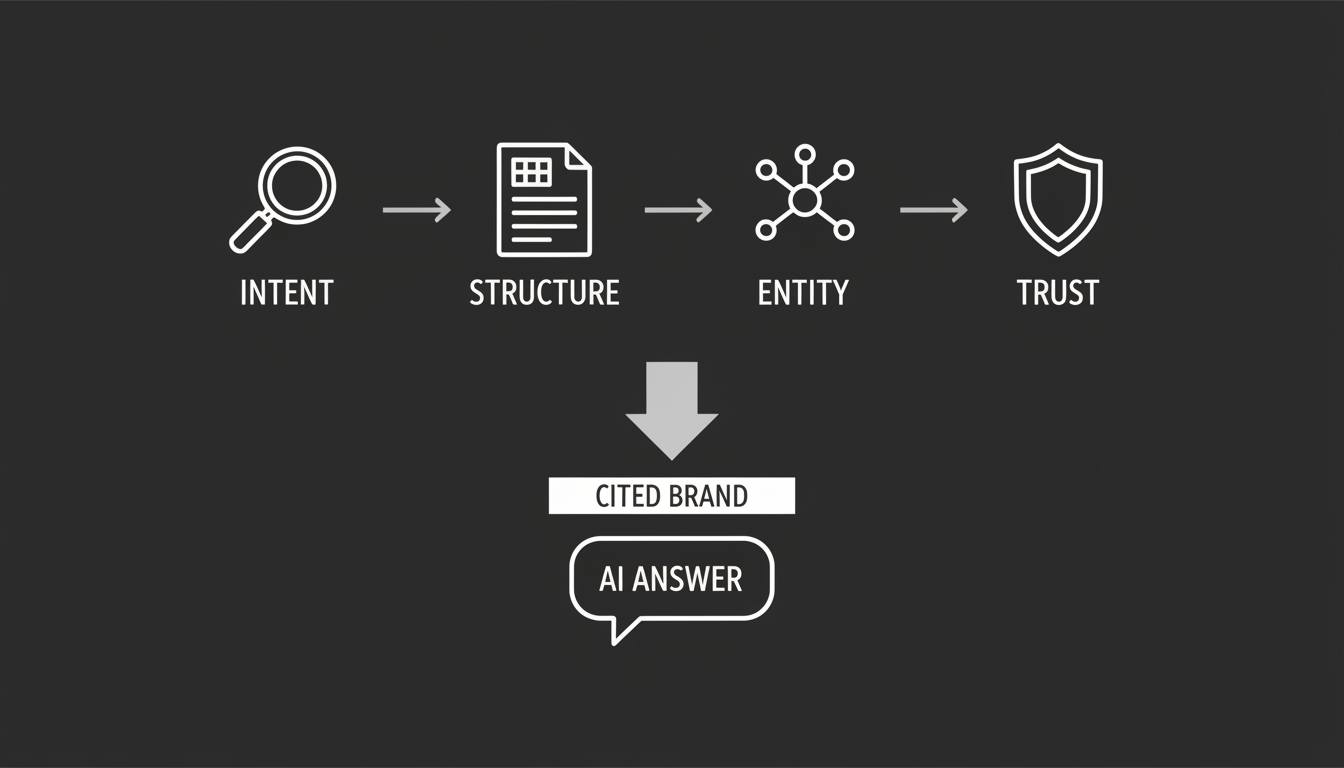
The Race Isn't for Page One Anymore
For over 20 years, digital marketing had one scoreboard: where you ranked on Google. Page one or bust. Every SEO strategy, every content calendar, every agency pitch deck was built around that single goal.
That scoreboard is now irrelevant for a growing share of your audience.
People are asking ChatGPT, Gemini, Claude, and Perplexity for recommendations instead of scrolling through ten blue links. These AI engines don't return a list of websites. They synthesize information from across the web and deliver a single, conversational answer. Your brand is either in that answer or it doesn't exist.
This isn't a subtle shift. It's structural. And most marketing teams are still measuring success with tools built for the old game.
What Actually Is AI Search Optimization?
Strip away the jargon. AI Search Optimization is the practice of making your brand understandable, trustworthy, and citable to AI reasoning engines. Not just crawlable. Not just keyword-rich. Understandable.
Traditional SEO was designed for a crawler that matches keywords to a query. AI Search Optimization is designed for a system that reasons. These models build knowledge graphs, infer meaning, and look for what I'd call "verified nodes," brands with clear, consistent information across multiple trusted sources.
Here's the simplest way I can frame it: traditional SEO is about being found. AI Search Optimization is about being chosen.
Your content needs to do four things to win in this environment:
- Be authoritative and credible. Validated by sources the AI already trusts.
- Be structurally precise. Formatted so AI agents can parse it without guessing.
- Be intent-oriented. Mapped to the actual questions people are asking, not just keywords they might type.
- Be consistent. Saying the same thing about yourself everywhere, not roughly the same thing.
If that sounds like a higher bar than traditional SEO, it is. But when an AI engine recommends your brand in a direct answer, you're not competing with nine other links on a page. You are the answer. That's a different kind of payoff entirely.
Why Does This Matter Right Now?
I've watched multiple technology cycles reshape how businesses reach customers. This one is moving faster than most people realize.
The behavioral shift is already here. Industry analysis suggests that 68.5% of web traffic is now influenced by AI search, and AI-driven recommendations convert at 8x the rate of traditional search traffic. Those numbers deserve serious attention.
What's actually happening on the ground?
People ask differently now. Nobody types "best CRM small business" into ChatGPT. They ask, "What's the best CRM for a small marketing agency with five employees?" The query carries context, specificity, and intent that keyword-matching was never designed to handle.
AI synthesizes, it doesn't list. These models pull from reviews, product specs, comparison sites, and dozens of other sources to build a single response. Your brand needs to show up across enough of those sources, with consistent information, to make the cut.
Zero-click is the default. The answer appears right in the chat. The user's question is resolved without ever visiting a website. If your brand isn't in that answer, there's no click to fight for.
Here's the part that should actually worry you. Even if you rank number one on Google today, an AI model might exclude you. Why? Because it can't verify your pricing. Or your product descriptions contradict each other across different platforms. Or your brand data is so inconsistent that citing you would be a hallucination risk for the model.
That's a new kind of technical debt. And it's completely invisible if you're only watching traditional search metrics.
What Are the Core Pillars of AI Search Optimization?
I think about this in three layers. Get all three right and you move from invisible to indispensable.
Understanding Intent at a Semantic Level
AI engines don't match keywords. They try to satisfy the meaning behind a question. That's a fundamentally different problem.
To adapt, you need to map the real questions your audience asks, not the keywords your SEO tool suggests. There's overlap, sure. But the framing matters more than most people expect.
A practical place to start: use prompt-based testing to see how AI models actually perceive your brand. Ask models questions like "What problem does this brand solve?" and "What are the best tools for X industry?" Score the results on a simple 0 to 3 rubric for functional clarity and market alignment.
What you find might surprise you. Models often carry a distorted or incomplete picture of brands, even well-known ones. The gap between how you describe yourself and how AI describes you is exactly where the work needs to happen.
Building Deep, Structured Content
AI models extract answers the way a busy executive skims a document. They look for concise summaries, clear definitions, and direct answers. Buried insights in paragraph seven of a long blog post? They'll miss it.
Make your content machine-readable. Use structured headings, tables, bullet lists, and FAQ/HowTo schema. This isn't about aesthetics. It's about giving the model clear signals about what your content actually says.
Create what I call "quotable canonicals." These are 2 to 3 sentence summaries at the top of your high-traffic pages that a model can lift directly into a generated response. Think of them as the TL;DR that an AI agent will actually use. If you don't write these, the model will try to summarize your content on its own, and it might get it wrong.
Improving for Crawlability and Trust
Your content needs to be accessible to AI crawlers and appear trustworthy to the models that process it. These models are risk-averse by design. They prefer brands with external corroboration from what the industry calls "trusted third-party nodes."
On the technical side: make sure your site isn't blocked by robots.txt for AI crawlers. Consider setting up an /llms/ directory and llms.txt file specifically for AI agents. Small technical changes, outsized impact.
On the trust side: AI reasoning engines weigh citations from sources like Gartner, G2, and TechCrunch far more heavily than claims you make on your own blog. Your own content matters, but it's not sufficient. You need external validation that the model can verify independently.
How Do You Actually Execute This?
Theory is nice. Execution is what matters. Here's a step-by-step approach that works.
Step 1: Roll out Rich Formats
This is the technical foundation. The goal of Answer Engine Optimization is to make your content machine-readable at a structural level.
Deploy Schema.org markup. Use Organization, Product, Offer, and AggregateRating schema. This communicates details like price, stock status, and ratings in a format AI crawlers can digest instantly. It's not glamorous work. It's high-impact work.
Add FAQ and HowTo markup on your evergreen content. These schema types provide discrete data blocks that models prefer to ingest, especially for Google AI Overviews.
At Akii, we built the Website Optimizer specifically for this. It analyzes up to 50 pages and generates ready-to-deploy schema packages and AI-optimized sitemaps. The point isn't to sell you a tool. The point is that this work is tedious to do manually, and most teams either skip it or do it inconsistently.
Step 2: Add Entity Signals
This is where things get interesting. In the AI era, search engines are moving toward entity-first indexing. An entity is a node in a Knowledge Graph. Your brand is an entity, connected by relationships to other entities like your products, your founder, your industry category.
Unify your entity profile. Create a Master Entity Profile with a single, unified description, taxonomy, and boilerplate. Then replicate it exactly across your website, LinkedIn, Crunchbase, and Wikidata. Not roughly similar. Exactly.
Why does that precision matter? AI models use something I think of as a "Chain of Trust." When you use sameAs links in your schema to point to official profiles on high-trust platforms, you're telling the AI that all these profiles represent the same verified node. Inconsistency creates doubt. Doubt gets you excluded.
Resolve ambiguity explicitly. If your product serves both enterprise and SMB markets, tag those value propositions clearly. Don't make the model guess. Models that have to guess will sometimes guess wrong, and then you've got a hallucination problem that's genuinely hard to fix.
Step 3: Invest in External Signals
This is the off-page work of AI search, sometimes called Generative Engine Optimization. It focuses on the signals that make an AI choose to cite you over a competitor.
Target high-trust nodes. Focus your PR and content distribution on the sources AI models already rely on. Gartner reports, G2 profiles, industry publications. These provide the ground truth data that models use to verify your expertise.
Earn media coverage. For eCommerce brands especially, earned media is often the only way to break through the dominance of giant aggregators. If the only place your brand appears is your own website, you're invisible to models that triangulate across multiple sources.
Manage your review presence. AI models track sentiment trends on platforms like Trustpilot and industry-specific review sites. Brands with poor or outdated reputation signals get excluded. This isn't optional anymore. It's infrastructure.
Step 4: Systematic Model Education
Here's something most people don't realize: you can't fix an AI hallucination by filing a support ticket. You have to engineer the correction by feeding models better data.
This is why we built AI Engage. It systematically educates platforms like Google AI Search, ChatGPT Search, and Perplexity about your brand. The platform executes queries from over 150 million residential proxy IPs in your brand's language and country, prompting models to analyze and learn about your optimized content.
Is this a new category of work? Yes. Strange to think about "teaching" an AI about your brand? Probably. But this is the reality of how these systems learn and update their understanding. If you're not actively shaping that understanding, someone else is, or worse, nobody is, and the model is filling in the blanks with whatever inconsistent data it can find.
How Do You Measure AI Search Visibility?
You can't manage what you can't measure. And the metrics for AI search are fundamentally different from traditional SEO.
Traditional tools track rankings, click-through rates, and organic traffic. Those still matter for conventional search. But they tell you nothing about whether your brand appears in AI-generated answers.
The Akii AI Brand Audit tracks your brand across four dimensions that actually matter here:
Brand Recognition. How frequently do AI models mention your brand during recommendations in your industry? If you're not being mentioned, nothing else matters.
Brand Understanding. How accurately do models describe your value proposition and product category? Being mentioned is step one. Being described correctly is step two.
Content Coverage. How well does your site cover the specific topics and intent-based questions your customers ask? Gaps in coverage mean gaps in citations.
Brand Sentiment. How do AI models rate your reputation and trustworthiness based on trust signals? This is the qualitative layer that determines whether you're recommended confidently or mentioned with caveats.
Beyond these four dimensions, you need to understand your positioning context. Are you being positioned as a "Leader," a "Challenger," or a "Risky Alternative"? That context reveals the real impact of your visibility efforts. Being mentioned isn't enough if you're mentioned as the option people should avoid.
You can explore the full set of tools and capabilities at akii.com/features, or check pricing to see what fits your situation.
What Happens If You Ignore This?
I've seen this pattern before. A new technology cycle emerges. Early adopters gain a structural advantage. The majority waits until the shift is obvious, then scrambles to catch up.
The difference this time is speed. AI adoption is compressing what used to be a 5 to 7 year transition into 18 to 24 months. The brands that figure out AI Search Optimization now won't just have a head start. They'll have compounding advantages that are genuinely hard to replicate later.
Think about what that actually means. If an AI model already trusts your brand, cites you consistently, and understands your positioning accurately, every new piece of content you publish reinforces that position. A competitor starting from scratch has to build all of that trust from zero while you're already the default answer.
That's the flywheel effect of AI search. It favors early movers in a way that traditional SEO never did.
The Shift from Search Result to Definitive Answer
AI Search Optimization isn't a tactic you bolt onto your existing SEO strategy. It's a different discipline with different rules, different metrics, and different winners.
The brands that will thrive are the ones that are machine-readable, consistent across every platform, and externally validated by sources the AI already trusts. That's a high bar. It's also a clear one.
I've spent 25 years watching technology cycles reshape how businesses find customers. This one is real, it's moving fast, and the playbook is available to anyone willing to do the work.
The question isn't whether AI search has already replaced traditional search for a notable share of your audience. It has. The question is whether your brand will be the answer when they ask.