How can an AI product reach the people it serves?
A founder can build useful software and still struggle to reach the people it serves. A launch plan that postpones distribution leaves the audience and the path to adoption unresolved. Those choices deserve attention while the product is still taking shape.
Distribution is a design choice. Plan it as you choose what to build, what to charge, and how the product will work.
Why should AI founders consider distribution early?
An AI prototype can make a build-first approach tempting. The technology is interesting. The demos are compelling. It's easy to spend months refining a model or an interface and convince yourself the product will speak for itself once it's live.
It won't.
The people who need your product don't know it exists. They aren't searching for your category name. They're searching for the problem they already have, in the places they already look. If you haven't figured out where those places are before you launch, you're hoping for luck.
Luck is not a distribution strategy.
What does "designing distribution" actually mean?
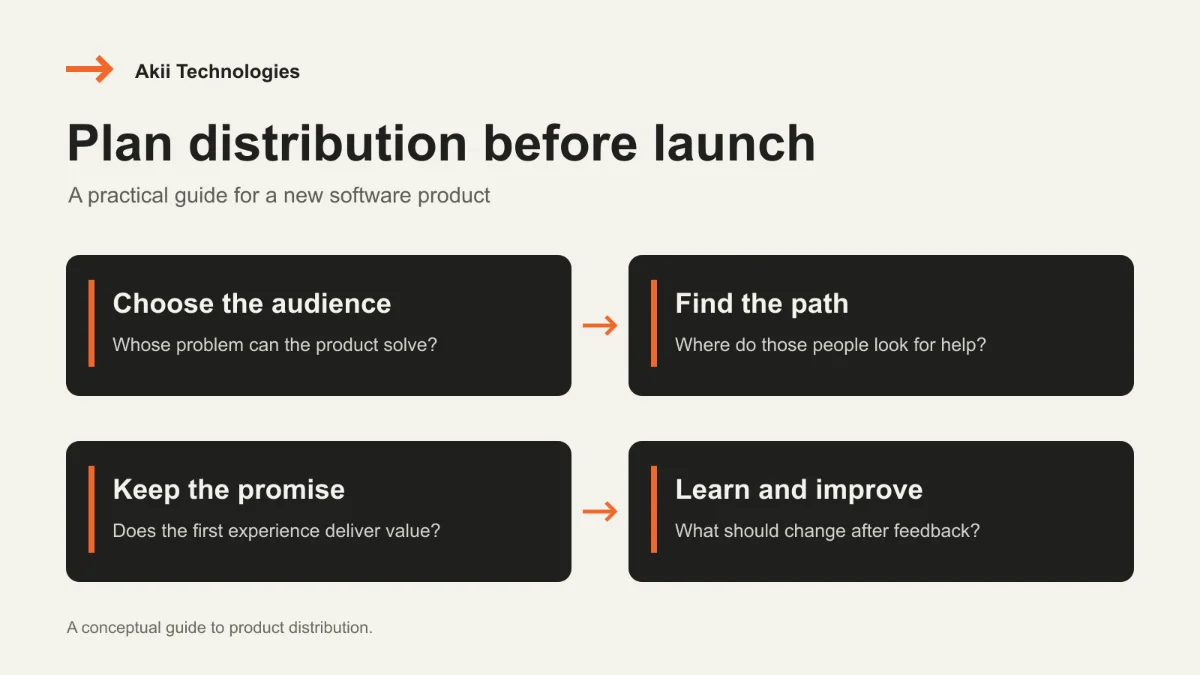
It means making four decisions before you ship, not after.
1. Define your first audience with painful specificity
Not "small businesses." Not "marketing teams."
Your first audience is the smallest group of people who share a specific, urgent problem that your product solves right now. Not eventually. Not with customization. Right now, out of the box.
Say you've built an AI tool that drafts responses to customer complaints. Your first audience isn't "customer service teams." It's something closer to "e-commerce operators with fewer than ten staff who handle returns manually through email and lose two hours a day doing it." That's specific enough to find, reach, and serve.
Why does specificity matter this much? Because a narrow audience tells you where to show up, what language to use, and what promise to make. A broad audience tells you nothing.
2. Decide where that audience already looks for help
Your first audience may already be trying to solve the problem. Find the forums they read, the people they follow, and the words they search for. Then show up with useful help before launch.
Follow the path your buyer takes when they need help. They might ask a Slack group for Shopify store owners. They might search YouTube for ways to answer refund emails faster. Each is a place to reach them with useful advice.
One trap is choosing channels based on what feels comfortable instead of checking where a buyer actually looks for help. You might love writing long blog posts. Your buyer might never read them. Design your distribution around their behavior, not your preferences.
3. Connect a clear product promise to onboarding
This is where your message meets the product.
Your product promise is the one sentence that tells someone what they'll get and when they'll get it. Not a feature list. Not a vision statement. A promise.
"Paste a customer complaint, get a draft response in ten seconds." That's a promise. It's testable. It sets an expectation that onboarding has to deliver on immediately.
Check that a new user can reach the value you promise. Do this in the first session. Plan the promise and the first experience together. A channel can bring people to your door, but the product has to help them once they arrive.
This is exactly why distribution belongs alongside product work from the start. The promise you make in your distribution channels has to be the same promise your product keeps in the first five minutes. When those two things are disconnected, you burn every channel you touch.
4. Plan a useful feedback loop before launch
A plan to "collect feedback" after launch can be too vague to act on.
A useful feedback loop asks three clear questions:
Did they understand the promise? If people sign up and immediately ask "what does this do," your distribution message is broken.
Did they reach value? If people sign up and drop off before completing the core action, your onboarding is broken.
Would they come back? If people complete the core action once and never return, either your product is solving a problem that isn't recurring, or it didn't solve it well enough.
You don't need sophisticated tooling for this. Watch what happens with your first ten users and be honest about what you see. The feedback loop isn't a dashboard. It's a discipline.
Why is this a design choice and not just a marketing plan?
Because the decisions above change your product.
Think about a small store handling returns and a large support team. They need different screens, templates, first steps and prices. Who you plan to reach shapes what you build and how you build it.
It is tempting to postpone distribution because it can feel less technical than building the product. I think it belongs among the earliest design constraints. Who is this for? Where are they? What do I promise them? How do I learn if I'm right?
Those aren't marketing questions. They're product questions.
What happens if you skip this?
You launch into silence. You get some initial traffic from your personal network. You post on social media a few times. Nothing sticks. Then you start guessing: maybe the product needs more features, maybe the pricing is wrong, maybe you need a rebrand.
Before changing features, pricing or identity, check how the right people will find the product and why they would care. A useful product needs a clear path to the people it serves.
The short version
Before you launch an AI product, make four decisions:
- Who is the smallest, most specific audience you can serve right now?
- Where do they already go when they need help with this problem?
- What's the one promise you'll make, and does your onboarding keep it?
- How will you know if your distribution message and your product experience match?
Get those four things right and you have a foundation. Skip them and you're guessing.
Distribution isn't what happens after you build. It's part of what you're building.
Explore the products we build and operate, or contact Akii Technologies.